
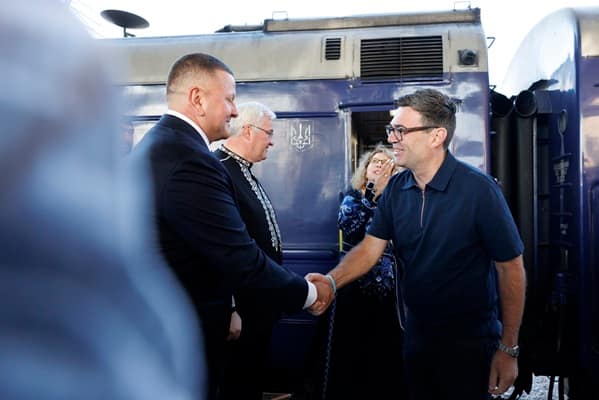
Russia has accused Britain of directly participating in the war in Ukraine after Prime Minister Andy Burnham pledged to provide Kyiv with classified information needed to manufacture components for Anglo-French Storm Shadow and Scalp cruise missiles.
The Kremlin’s warning marks a sharp escalation in its rhetoric towards London, as the UK government seeks to deepen military support for Ukraine and expand Kyiv’s capacity to produce long-range weapons domestically.
Dmitry Peskov, Vladimir Putin’s spokesman, said Moscow viewed the British move “extremely negatively” and accused London of deliberately obstructing efforts to end the conflict.
“Britain is participating in this war,” Peskov said.
“It is participating in this war on the side of the Kyiv regime. Britain methodically and regularly pours fuel on the fire and methodically and regularly plots to prevent any progress in the peace process. This is precisely what Britain is doing.
“Our armed forces are conducting the relevant work, obtaining the relevant information in order to identify the production sites of such missiles, the production sites of other military equipment, and are taking measures to destroy these sites.”
The comments came as Burnham travelled to Kyiv for his first foreign visit as prime minister, using Ukraine’s Independence Day to reaffirm Britain’s military and political commitment to the country.
The government has agreed to share blueprints for British-made components of the Storm Shadow system, allowing Ukraine to pursue domestic production of the long-range weapons. The French-produced version is known as Scalp.
The move reflects a broader shift in Western strategy from supplying finite stocks of weapons towards helping Ukraine establish its own defence-industrial capacity. Reports have suggested that stocks of Storm Shadow and Scalp missiles supplied by Britain and France have become increasingly constrained.
Kyiv and Paris are also examining plans to establish local assembly lines, potentially giving Ukraine a more sustainable source of long-range strike capability.
For Moscow, however, the development presents a more direct military challenge. Russian forces have repeatedly targeted Ukrainian defence infrastructure, while the Kremlin has warned that Western assistance enabling Ukrainian strikes against Russian territory could make supplier countries legitimate targets.
Burnham sought to frame the policy as part of a strategy to force Moscow towards a durable settlement.
“Russia should be in no doubt of our resolve. We will not back down until there is a just and lasting peace,” he said.
The prime minister arrived in Kyiv as Ukraine marked 35 years since declaring independence from the Soviet Union. He laid a wreath at the National Military Cemetery before meeting President Volodymyr Zelensky.
During the visit, Finnish President Alexander Stubb told Burnham that Europe was “in a war period” and highlighted the growing challenge posed by Russian ballistic missile attacks.
Zelensky, meanwhile, used his Independence Day address to reject any prospect of Ukrainian capitulation.
“Ukrainians will not be cobblestones under the feet of tsars and rulers. Ukrainians will not submit,” he said.
He presented Burnham with the Honorary Distinction to the British People, Gratitude of the Ukrainian People, recognising Britain’s support for Ukraine.
The Kremlin’s response nevertheless underlines the increasingly narrow margin between Western military assistance and direct confrontation with Russia.
By helping Ukraine manufacture long-range strike weapons rather than simply supplying them, Britain is potentially embedding itself more deeply in the Ukrainian defence industry — precisely the kind of development Moscow has warned it will seek to disrupt.
For London, the calculation is that strengthening Ukraine’s ability to defend itself will improve its negotiating position and reduce the prospect of a Russian victory. For Moscow, the same policy is evidence that Britain has crossed another threshold in its involvement.
The danger is that the distinction between supporting Ukraine and becoming an active participant in the conflict will continue to be contested — with each new weapons programme raising the stakes.


Leave a Comment