
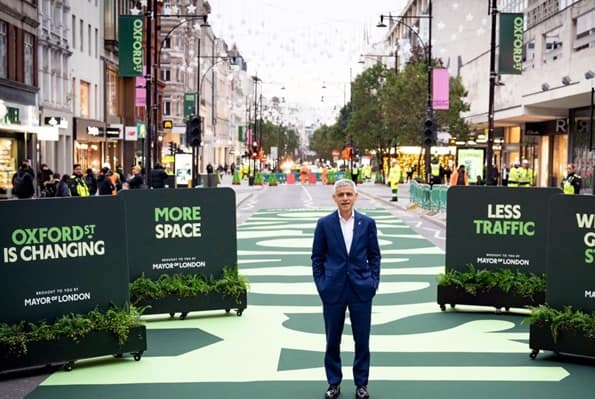
Sadiq Khan has hailed the start of a new era for Oxford Street as one of the world’s best-known shopping districts closes to vehicle traffic, launching an ambitious transformation of a thoroughfare that contributes an estimated £25bn a year to London’s economy.
From Monday, October 26, the stretch between Orchard Street and Great Portland Street will be closed to private vehicles, buses, taxis, private hire vehicles, cycles, scooters and pedicabs. The move marks the first stage of the mayor’s long-promised plan to turn the capital’s flagship retail destination into a pedestrian-focused public space.
Khan described the closure as a “truly momentous occasion for the capital”, arguing that the changes would help Oxford Street adapt to modern shopping habits and strengthen its appeal to businesses and visitors.
“For centuries, Oxford Street has reinvented itself, adapting to changing times and helping shape British culture along the way,” he said. “There has been talk of pedestrianising Oxford Street for decades.”
“After so many false dawns, and now working with a Government who share the scale of my ambition, I’m proud that we’re finally unlocking a new era for the street.”
The mayor’s plans will be tested against the commercial realities of one of Britain’s most important retail corridors. Oxford Street generates an estimated £3.1bn in annual spending, making the success of its transformation significant not only for London’s shops and property owners but also for the wider economy.
The immediate challenge will be to establish a traffic-free environment without disrupting the flow of shoppers and workers through the West End. The closure comes shortly before the busiest retail period of the year, when Christmas trading places particular demands on transport networks, retailers and surrounding streets.
Buses, taxis, bikes and other traffic are being diverted onto nearby roads, with Transport for London overseeing the changes. Construction will be kept to a minimum between now and Christmas under the initial phase of the programme, limiting disruption during the peak shopping season.
More substantial improvements are planned over the following 12 months. By the end of spring next year, the transformation is expected to include 50 new trees, more than 100 seats, two public squares, rest areas and improved signage.
Khan said the changes would create a destination extending beyond conventional shopping.
“The transformation will turn the nation’s high street into a world-class pedestrian space, where flagship retailers will sit alongside new shops and workplaces — and we’ll bring exciting new experiences to the street, from sport to fashion and cultural events,” he said.
The ambition reflects a wider effort to redefine the role of major shopping streets at a time when retailers are competing for consumers’ attention and physical destinations must offer more than a collection of shops. Khan’s plan envisages Oxford Street as a place to spend time, attend events and experience the city, as well as a location for retail transactions.
There is evidence of public support for the idea. A trial car-free day last year attracted strong pedestrian footfall and prompted brands to organise pop-ups and other events. Consultations subsequently helped shape the decision to proceed, with about seven in 10 respondents supporting the mayor’s plans.
Polling conducted in 2025 found that 63 per cent of Londoners and 72 per cent of visitors favoured pedestrianising Oxford Street.
Supporters argue that reducing vehicle traffic could improve the experience of walking through the area, while creating opportunities for businesses to attract customers through events and a more welcoming public realm.
Catherine Woodhead, chief executive of Living Streets, said vehicles had for too long been prioritised over people.
“By making it easier for people to walk, we can create a healthier environment while attracting business and economic growth,” she said.
“Putting people first on one of the country’s most famous streets will hopefully inspire a whole host of walkable high streets across the UK.”
The commercial property sector has also welcomed the move. Dee Corsi, chief executive of New West End Company, described the start of pedestrianisation as “one of the most significant days in the history of Oxford Street”.
Jamie Witty-Lewis, chief executive of Grosvenor Property, said removing traffic would help attract more people to Oxford Street and the surrounding area.
For the businesses that depend on the West End, however, the measure’s ultimate success will be judged by its practical effects: whether the street becomes easier and more attractive to visit, whether retailers benefit from increased activity, and whether transport diversions can be managed without creating new problems nearby.
The first phase is intended to deliver the immediate change — removing traffic — while keeping construction disruption low during the Christmas rush. The planned trees, seating and public squares will follow as the wider transformation takes shape.
Khan said he was “hugely excited” to see the plans become reality and urged Londoners to experience the new traffic-free street.
After decades of discussion and what the mayor called “false dawns”, Oxford Street has reached a decisive turning point. Whether the transformation becomes a model for other British high streets will depend on whether its new public space can translate political ambition and public support into sustained footfall, stronger retail performance and a more attractive West End.


Leave a Comment