
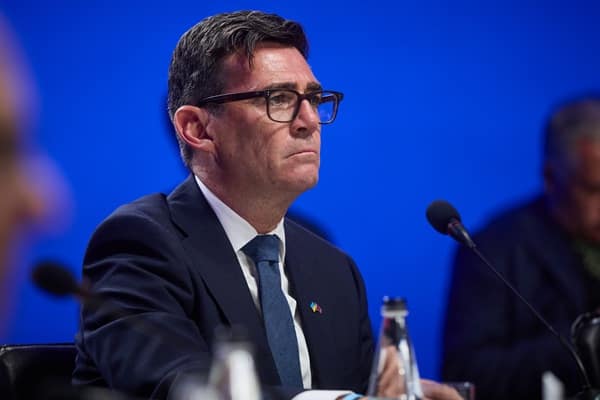
Andy Burnham is facing mounting pressure over plans to release prisoners serving controversial indefinite sentences, with critics warning the Prime Minister is paving the way for “some of the most dangerous people in prison” to return to communities.
Mr Burnham on Sunday set out his latest position on early release — his “fifth position on early release in less than six weeks” — confirming that the killers of PC Andrew Harper would remain behind bars.
He also announced that offenders convicted of manslaughter would be excluded from the early-release scheme, alongside those convicted of causing death by dangerous driving, indecent assault, and causing or allowing the death of a child.
But the Government intends to create additional prison capacity by converting some Imprisonment for Public Protection (IPP) sentences into sentences with a defined release date.
More than 2,000 people serving IPP sentences remain in prison, despite the scheme having been abolished for new offenders in 2012.
Nick Timothy, the shadow justice secretary, accused Mr Burnham of repeatedly changing course on one of the most politically sensitive issues facing his government.
“This is Andy Burnham’s fifth position on early release in less than six weeks since he became PM. There are serious questions about what he’s now proposing – including about the release of dangerous IPP prisoners.
“Burnham says he’ll create space in prisons by releasing those on IPP sentences.
“They’re among the most dangerous people in prison. Will they all be released?
“Just some? How many? And on what timescale? What about those who would have had a life sentence had IPP not existed?
“The PM is asking Parliament and the country to simply trust that he has got this right – on the fifth attempt. We need a robust democratic process to make sure he has. There are far too many questions – about hugely important matters of public safety – to take it on trust.”
The controversy follows Mr Burnham’s decision to abandon plans inherited from Sir Keir Starmer that would have allowed a number of killers, including Albert Bowers and Jessie Cole, to secure earlier release.
The Prime Minister has gone further than expected by extending the exclusions to all forms of manslaughter and several other serious offences.
Mr Burnham said he had made the “judgement” that the public would prefer prisoners who had served their sentences to be released rather than offenders who had not completed their punishment.
He also said he had “long-standing concerns” about IPP sentences, which he argued had created “a sense of unfairness” in some cases.
The Prime Minister promised to take a “common sense” approach and said legislation would be introduced to end IPP sentences by the end of the current Parliament.
Speaking on BBC Breakfast, Mr Burnham said: “Many of the people in this position have more than served their time. But on the scheme that I inherited, they would have remained in prison, while others who committed serious offences would have been let out early.
“And we will set up a cross-party oversight group to look at how this is done, because there are still individuals who will pose a risk to communities. It does need to be done in a very careful way with regard to public safety, national security, and all of those issues.”
The Government says prison capacity will also be increased by deporting more foreign offenders and creating additional cells within existing prisons.
Mr Burnham defended the measures as necessary to prevent the prison system from reaching a point where courts are unable to send newly convicted offenders to jail.
“I can look them in the eye now and say, I have turned over every stone, working with the Justice Secretary, over the summer, we have worked hard to look at everything.
“But at this point in time, there is no further that we can go without risking new offenders coming through the court system.
“Those guilty of the most serious offences, not being able to be sent to prison because the prisons are full, and I can’t allow that situation to arise either.”
The Prime Minister said around 1,000 prisoners would remain incarcerated as a result of his initial changes, while “hundreds more” would remain behind bars because of the additional exemptions announced on Sunday.
The Government’s position has received support from senior police figures, who said the controversy surrounding the proposed release of PC Harper’s killers had caused profound concern among victims and their families.
Chief Constable Jason Hogg of Thames Valley Police, the force where PC Harper served, said: “I am grateful that those concerns were listened to and carefully considered. Throughout this process, our focus has been on ensuring that the voices of victims, families, colleagues and communities were heard and understood and properly considered alongside the wider challenges facing the criminal justice system.
“We know this case has resonated far beyond Thames Valley Police. Today’s announcement may bring reassurance not only to Andrew’s family, but to other victims and bereaved families who have followed this issue closely and who continue to seek confidence that the most serious offences are treated with the gravity they deserve.
“Today is not about politics. It is about remembering Andrew, recognising the profound impact his death continues to have on those who knew him, the communities he protected and those who serve in policing today.”
Aileen O’Connor, chair of the Thames Valley Police Federation, said: “PC Andrew Harper made the ultimate sacrifice for the job that he loved, serving communities, serving society.
“His killers should never have been considered for early release. It remains shocking that they were.
“We are pleased that the Government – despite what was frankly initial reluctance – has eventually listened, seen sense and made the right decision to keep these lowlifes behind bars.
“They had no option.
“The weight of public and policing opinion against such plans was overwhelming.
“The fact that more than 1 million people signed our petition over this was a historic public backing for police officers.
“The fact 50 Chief Constables across the UK wrote an open letter calling for the Government to reconsider was unprecedented.
“The right and proper decision has been made.”
The political dispute now turns on the treatment of the wider IPP population.
Mr Burnham argues that many prisoners subject to the abolished system have already served the tariff originally imposed for their offences and that keeping them incarcerated indefinitely creates an unfairness the Government must address.
Opponents counter that the very purpose of IPP sentences was to prevent the release of offenders considered to pose an ongoing risk to the public.
That tension leaves the Prime Minister facing a difficult balancing act: freeing enough prison capacity to prevent the criminal justice system from being overwhelmed, without allowing a prison-capacity crisis to translate into a public-safety crisis.
For Mr Burnham, the latest concessions may have settled the immediate controversy surrounding PC Harper’s killers. But the decision to use IPP prisoners to create additional capacity threatens to open a new and potentially more damaging front in the Government’s early-release battle.


Leave a Comment