
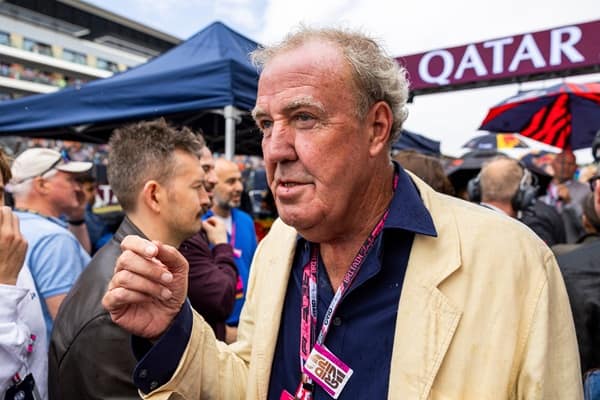
Jeremy Clarkson has delivered a withering assessment of Andy Burnham’s premiership, warning that the Prime Minister risks being overwhelmed by the demands of running the country and suggesting he would be better suited to the comparatively modest responsibilities of local government.
In a sharply worded column for The Sun, the broadcaster and former Top Gear presenter questioned whether Burnham possessed the political authority and strategic focus required at the top of British government, arguing that a series of recent announcements had done little to address the country’s more pressing challenges.
“While he seems to be nice, he’s not terribly prime ministerial,” Clarkson wrote, identifying what he described as his “biggest worry” about the Prime Minister.
“He’d be fine on a local council, organising bus timetables and sorting out neighbourhood leylandii issues, but I worry that he might be slightly out of his depth when faced with anything bigger and more important than that,” he added.
The remarks amount to a pointed challenge to Burnham’s priorities, questioning whether his emphasis on everyday irritations has come at the expense of the economic, security and political pressures facing Britain.
Clarkson singled out the Prime Minister’s recent interventions on private car parking charges and disruptive behaviour on public transport, including passengers playing loud music through their phones. Both issues are familiar sources of public frustration, but the broadcaster argued that they should not dominate the attention of a leader responsible for the country’s wider direction.
The criticism is notable given Clarkson’s longstanding association with motoring culture and his outspoken views on issues affecting drivers. Yet his argument was not that the parking measures were necessarily unwelcome, but that Burnham should be concentrating on problems of considerably greater national consequence.
Among them, Clarkson pointed to the high cost of diesel, the continuing small boats crisis, the burden of national debt and cyber attacks attributed to Moscow. He also raised concerns about the possibility of unrest in France spreading across the Channel, describing the potential threat as “far-Left riots”.
The list reflects a broader question facing the government: whether highly visible interventions on local and consumer issues can demonstrate responsiveness without appearing to distract from the more complex challenges that demand sustained attention from Downing Street.
For Clarkson, the danger is that the Prime Minister could become preoccupied with the political equivalent of municipal administration while leaving larger questions unanswered. His comparison with a local councillor was designed to sharpen that distinction, contrasting the management of neighbourhood disputes with the responsibilities of national leadership.
The reference to France adds an international dimension to the criticism. The country has faced repeated bouts of unrest in recent years, including demonstrations and clashes following the decision to raise the state pension age from 62 to 64. More recent violence has included looting, burning vehicles and attacks on public buildings, intensifying concerns over public order and the government’s ability to maintain control.
French authorities prepared for another major round of protests on Saturday, with museums in Paris closing and security forces deploying across the country. Interior Minister Laurent Nunez said as many as 70,000 officers would be mobilised nationwide, supported by helicopters, armoured vehicles and water cannons.
The deployment followed unrest that had shocked the country, with masked groups targeting businesses and public buildings in Paris and other urban centres. More than half a million people had taken to the streets the previous week, according to the supplied account, prompting fears of further disorder.
Clarkson’s concern was that Britain should be considering the implications of such unrest rather than treating it as a distant French problem. His remarks place public order alongside debt, energy costs and cyber security as issues he believes should command the Prime Minister’s attention.
Burnham, who became Prime Minister in July, has also made significant announcements on pensions, one of the most politically sensitive areas of domestic policy. His proposed changes to the state pension triple lock would replace the current approach — which allows payments to rise in line with earnings, inflation or 2.5 per cent, whichever is highest — with an uprating formula based on inflation or 2.5 per cent, removing the earnings guarantee.
The proposed change would represent a significant departure from a policy that has helped protect pensioners’ incomes but has also attracted scrutiny over its long-term cost to the public finances.
Burnham has argued that the savings would help fund plans for a national care system. Altering the triple lock has long been considered by governments across the political spectrum as a potential way to ease pressure on the Treasury, but successive administrations have avoided abandoning its earnings link amid the risk of a backlash from older voters.
The decision therefore places the government between competing fiscal and political demands: finding resources for public services while maintaining a commitment that has become central to pensioners’ expectations.
Clarkson’s attack does not resolve that dilemma, but it highlights the broader test confronting the Prime Minister. The government must demonstrate that its domestic agenda is more than a collection of targeted measures, while persuading voters that it has a coherent response to the country’s economic and security challenges.
The contrast between local interventions and national strategy is central to Clarkson’s argument. Parking charges and nuisance behaviour on public transport may be issues that people encounter directly in their daily lives, but they compete for political attention with pressures that are harder to solve and potentially more consequential: the cost of energy, the management of public debt, border security and the threat of hostile cyber activity.
The danger for Burnham is not simply that critics will dismiss individual policies as small-scale. It is that the accumulation of such announcements could shape a wider perception of his leadership before his government has established its record on the most difficult questions.
Clarkson’s language was deliberately personal, questioning whether Burnham appears “prime ministerial” and whether he is “out of his depth”. Those are judgments rather than evidence of the government’s performance, but they frame a familiar political challenge: a prime minister must not only make decisions, but convince the public that those decisions reflect an understanding of the scale of the job.
For now, the criticism is a warning about priorities rather than a definitive verdict on Burnham’s premiership. The government’s proposed pension changes, its approach to public order and its handling of the economic and security agenda will ultimately provide a more substantive test.
Clarkson, however, has made his position clear. In his view, the country needs a leader focused on problems commensurate with the office — not one who risks being remembered for sorting out the political equivalent of bus timetables and troublesome hedges.


Leave a Comment