
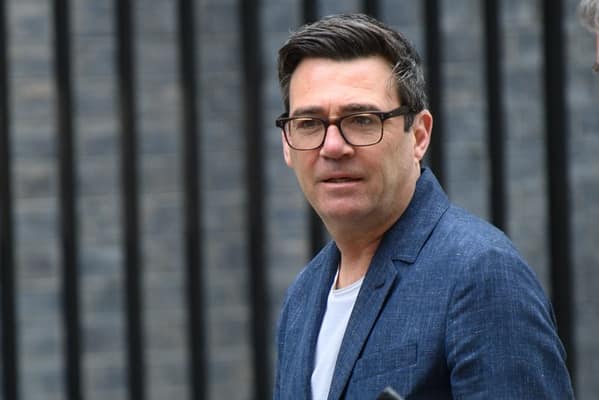
Andy Burnham’s rise towards the centre of British politics is forcing investors to confront a question that has been debated for decades but rarely felt so immediate: should Britain ask wealth to carry more of the tax burden?
The former cabinet minister and current mayor of Greater Manchester has long argued that the UK relies too heavily on taxing income from work while placing comparatively less pressure on accumulated wealth, property and assets.
Now, as speculation grows over a possible future Burnham premiership, that argument is moving from political theory into a debate about markets, investment and Britain’s ability to compete for global capital.
Nigel Green, chief executive of deVere Group, one of the world’s largest independent financial advisory organisations, warned that any major shift in the taxation of wealth would have consequences far beyond high-net-worth individuals.
“Andy Burnham’s rise marks one of the most significant moments for investors in years,” Green said.
“For the first time in a generation, Britain could have a prime minister whose political instinct is to ask whether accumulated wealth should contribute more.”
The debate comes at a difficult moment for the UK economy. Growth remains weak, public finances are under pressure and governments face rising demands from healthcare, pensions, infrastructure and defence.
The challenge facing any future administration is how to raise additional revenue without weakening investment, entrepreneurship and competitiveness.
Burnham has not set out a specific wealth tax package. But investors are increasingly examining areas that could become politically attractive targets, including capital gains tax, inheritance tax, property taxation, investment income and land values.
The possibility of reforming the tax treatment of assets has already prompted discussion among entrepreneurs, business owners and investors about the direction Britain could take.
“The question is not simply whether wealth should pay more,” Green said. “The question is how you do it without damaging the conditions that create wealth in the first place.”
The scale of the debate reflects the size of Britain’s private wealth base.
Privately owned wealth in Great Britain stands at roughly £13.6tn, including property, pensions and financial assets. That figure represents one of the largest pools of household wealth in Europe.
Yet wealth distribution remains highly uneven. The wealthiest households hold a substantial share of total assets, strengthening arguments from those who believe taxation should place greater emphasis on accumulated capital rather than earnings.
Supporters of reform argue that Britain’s tax system places too much pressure on workers while allowing asset growth to escape with a lighter burden.
Critics warn that targeting wealth risks creating uncertainty for investors and encouraging capital to move elsewhere.
That concern has become increasingly significant as global capital becomes more mobile.
A generation ago, investors and wealthy individuals had fewer alternatives. Today, financial centres across Europe, the Middle East and Asia compete aggressively for entrepreneurs, companies and internationally mobile families.
“The UK’s challenge is that capital now has more freedom than at any point in history,” Green said.
“It compares jurisdictions, tax systems and governments. And it moves.”
Britain remains one of the world’s leading destinations for investment, supported by deep financial markets, legal stability and London’s position as a global economic hub.
But its future competitiveness depends heavily on confidence.
Business leaders often make decisions years ahead. Investment plans, hiring strategies and expansion decisions are shaped not only by current tax rates but by expectations about future policy.
A government perceived as hostile to wealth creation could influence those decisions even before legislation changes.
“The danger is that wealth creation becomes viewed with suspicion rather than encouragement,” Green said.
“Governments must balance fairness with competitiveness.”
The issue extends beyond the richest households. Changes to inheritance tax could affect family businesses and succession planning. Property tax reform could reshape the housing market. Adjustments to investment taxation could influence entrepreneurs and long-term investors.
For millions of households, the debate is not abstract. It touches homes, savings, pensions and family assets built over decades.
Burnham’s argument reflects a broader international debate about inequality, taxation and the role of wealth in modern economies.
As governments struggle with ageing populations and rising public spending demands, many are examining whether traditional tax systems remain fit for purpose.
But the economic risk is that a policy designed to redistribute wealth could also affect the creation of future wealth.
The question facing any future government will be whether it can change the balance of taxation without changing Britain’s reputation as a place where businesses and investors want to operate.
“Burnham believes wealth should carry more of the burden,” Green said.
“That belief has taken him a long way politically. Now investors are asking what happens if it starts shaping government policy.”
The debate is no longer only about who pays more.
It is about what kind of economy Britain wants to build — and whether the world’s capital still wants to be part of it.


Leave a Comment