
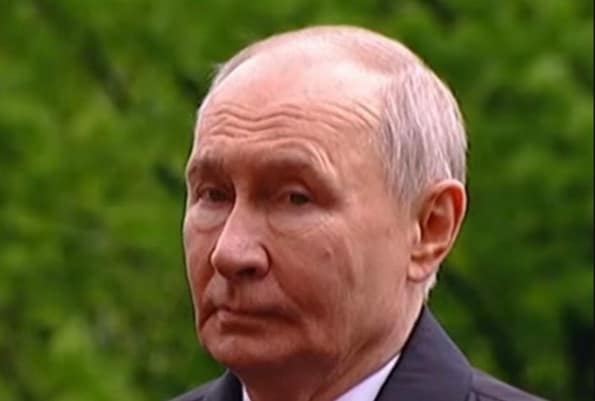
Vladimir Putin has faced an unusually direct public challenge from a senior figure in Russia’s military establishment, after retired Colonel-General Leonid Ivashov accused the president of miscalculating the invasion of Ukraine and urged the Kremlin to bring the war to an end.
“You lost; you didn’t foresee a thing,” Ivashov told Russian blogger Pavel Ivanov during a live-streamed discussion, in a pointed assessment of the campaign that Moscow initially presented as a swift military operation.
“You didn’t have the wits to realise that the war wouldn’t be some light-hearted operation: flit in there, peck somewhere, and that’s it — victory,” he said.
Ivashov, who heads the All-Russian Officers’ Assembly, called for an immediate ceasefire and a return to negotiations. He warned that prolonging the conflict risked pushing Russia towards deeper militarisation, economic deterioration and long-term national damage.
His intervention is notable because criticism of the war from within Russia’s military establishment remains politically sensitive. Ivashov has previously challenged the Kremlin’s approach to Ukraine, making him a longstanding critic rather than a figure who has only recently broken ranks.
Read more related news:
Putin’s war catastrophe laid bare: Leaked data suggests ‘450,000 Russians died’ fighting in Ukraine
Putin’s brutal ultimatum to Kyiv, ‘I will destroy all your infrastructure until you agree’
Europe on alert as Russian extremist group threatens passenger planes and to ‘turn the skies red’
The remarks come as the human and economic costs of Russia’s invasion continue to mount. A cyber leak from Russia’s state statistics agency, Rosstat, reportedly revealed more than 400,000 death certificates explicitly linked to combat operations. The figures have been cited as evidence of the scale of the losses, although they do not provide a complete account of Russian military casualties.
Western intelligence assessments and independent researchers have put the total number of Russian troops killed or wounded substantially higher, with some estimates reaching 500,000. That figure includes casualties beyond those killed and should not be interpreted as a confirmed death toll.
The burden has also fallen disproportionately on poorer and more remote regions. Research cited in the source material suggests combat deaths account for a significant share of working-age male fatalities in areas including Buryatia and Tuva.
Ivashov’s criticism comes as diplomatic efforts gather pace. US envoys Steve Witkoff and Jared Kushner have joined representatives from Ukraine and Russia for discussions in Abu Dhabi, where negotiations are focused on possible terms for ending the conflict.
Washington has suggested there are signs of flexibility over disputed eastern territories, including Donetsk. But European leaders remain cautious about the Kremlin’s intentions.
Norwegian prime minister Jonas Gahr Støre has said there is still no convincing indication that Putin is ready for peace, while German chancellor Friedrich Merz has raised the prospect of face-to-face discussions at an upcoming summit.
Ivashov’s intervention exposes a question facing Moscow as the war approaches its fifth year: how much longer can Russia sustain the costs of a conflict whose promised quick victory remains out of reach?


Leave a Comment