
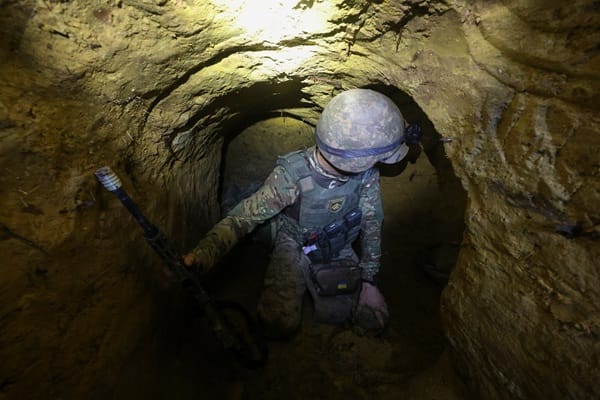
The battlefield in one sector of Ukraine’s front has moved underground, with Ukrainian forces gaining an advantage over Russian troops in a new phase of combat that is being reshaped by technology and tactics every few months.
Ihor Oboliensky, commander of the National Guard’s 2nd Khartiia Corps and a recipient of Ukraine’s highest state honour, Hero of Ukraine, said underground operations had become increasingly important in his corps’ area of responsibility.
“Today, in our corps’ area of responsibility, the battlefield has gone underground,” Oboliensky, known by the call sign “Kornet”, said at the annual Yalta European Strategy (YES) conference in Kyiv.
“And we are more effective there than the Russians.”
Read more related news:
Captain Chaos postpones nuclear attack subs, putting the UK further at risk
Kushner has ‘no diplomatic experience’ and wants Ukrainians to ‘surrender’ their homes
Warsaw warns the next months ‘could truly be critical’ for NATO
Germany orders troops into Lithuania as Russia threatens NATO’s Eastern flank
His assessment highlights the increasingly fluid nature of the war, where advantages can shift rapidly as both sides introduce new weapons, electronic systems and battlefield methods.
Oboliensky said technologies and tactics that had been effective two years ago could now be obsolete, with developments capable of changing combat operations every two or three months.
That pace of adaptation is also affecting Ukraine’s air-defence requirements, particularly as Russia develops faster jet-powered attack drones that could place additional pressure on Ukrainian systems.
But the commander warned against allowing the growing emphasis on drones and other technologies to obscure the importance of conventional troops.
“[The soldier remains the most important.] Please do not shift the focus under any circumstances,” he said.
Oboliensky argued that Russia’s continued attacks on Ukrainian cities were closely linked to its ability to demonstrate progress on the battlefield. Preventing Moscow from making even limited territorial advances could therefore weaken the Kremlin’s political justification for prolonging the war.
“As soon as the front is stopped, as soon as Moscow has no success, not a single kilometer, then you will ask the question, and Moscow and Putin will face the same question: Why are you fighting? Why are you not advancing?” he said.
The commander identified three priorities for Ukraine’s international partners: financing, access to technology and industrial capacity, and military training.
Western governments should finance at least half of Ukraine’s available production capacity for drones and missiles, he argued. Such an approach would strengthen Ukraine’s military position while creating economic activity for both Western companies and Ukrainian workers.
The argument reflects Kyiv’s increasing focus on expanding domestic defence production as it seeks to sustain a prolonged war while reducing reliance on deliveries of finished weapons from allies.
Oboliensky also highlighted the importance of training and logistics, recounting a visit by Ukrainian officers under his command to France and the Normandy beaches, where Allied forces landed during the Second World War.
The officers subsequently called him from Utah Beach and described how the experience had changed their understanding of military logistics.
“They said, ‘Commander, we understood what logistics means,’” Oboliensky said.
For the commander, the lesson was that battlefield effectiveness depends on the entire military supply chain rather than simply the forces engaged in combat.
Oboliensky made the remarks during a discussion with Ukrainian military commanders at the 22nd YES Annual Meeting, held in Kyiv on September 11-12. Organisers said the conference brought together about 700 politicians, diplomats, military personnel, business leaders, veterans, activists and experts from 28 countries.
His warning comes as Ukraine and its allies confront a war increasingly defined by rapid technological adaptation — while the decisive advantage may still rest with the side capable of supplying, training and sustaining the soldiers on the front.


Leave a Comment