
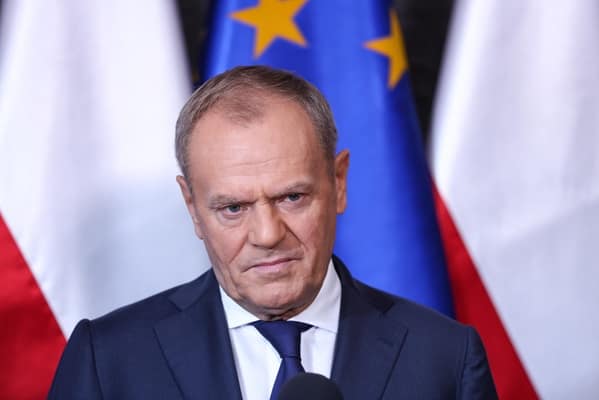
Polish Prime Minister Donald Tusk has warned that Russia’s escalating attacks on Ukraine could spill into Polish territory in the coming months, after Russian drones struck infrastructure close to the NATO frontier.
Tusk said Moscow’s increasingly aggressive campaign was bringing the risk of direct confrontation closer to Poland as Russian forces targeted a border crossing and a passenger train near the Ukrainian-Polish frontier.
“The escalation of actions of the Russian Federation is becoming a fact and its examples are getting closer and closer to our borders,” Tusk said in a briefing with defence officials.
“What can be expected is that the next weeks and months will be a period of very intensive actions from the Russian side. Unfortunately, we cannot rule out that this escalation will also concern our territory.”
Read more related news:
Trump demands Ukraine stops attacking Putin’s diesel amid a global shortage
Kremlin blames Russia’s human safari on Kyiv as they ‘opened Pandora’s box’
NATO warns Russia’s attacks are being treated with ‘upmost seriousness’
Johnson condemns Putin as terror is ‘knocking directly on the doors of the EU’
The warning followed a Russian drone assault on western Ukraine that struck a gas station near the Yahodyn-Dorohusk border crossing and a Kyiv-Warsaw passenger train about 2km from the Polish border.
The attack carried particular significance because a diplomatic train carrying European security officials and former UK prime minister Boris Johnson had been in the area shortly before the Russian drone arrived.
Ukrainian Railways said the train may itself have been the intended target.
“It is quite likely that the target of this Russian drone could have been the diplomatic train, which departed from the station earlier than its scheduled time, as part of a review of train schedules in real-time due to the constant threat of Russian attacks,” the railway operator said.
Tusk said the strikes demonstrated that Moscow was prepared to deploy increasingly dangerous weaponry close to Poland’s territory.
He said the attacks could have been intended to “disorganise, paralyse, and perhaps also destroy Ukrainian border crossings”, potentially disrupting one of the principal logistical routes between Ukraine and its European allies.
In response, Tusk called for “maximum preparation” by Poland and its allies, signalling a more urgent approach to the possibility of Russian attacks affecting NATO territory.
“There is no doubt that we must be prepared together with our allies for a joint reaction if such a need arises,” Tusk added.
The Polish prime minister also acknowledged growing concerns that Russia could test NATO’s response with a limited attack or provocation against one of the alliance’s eastern members.
“I hope that the worst scenario will not work, but unfortunately, the events so far confirm the information that we have been receiving for many months, that also the worst variants are possible,” Tusk said.
His warning follows comments in July that the coming months “[could truly be critical]” as Poland assessed the threat posed by Russia.
The risks are not hypothetical. Russian attacks have previously crossed into Polish territory during strikes on Ukraine, including when a Russian Kh-101 cruise missile crashed in Poland’s Lublin region on July 30.
For Warsaw, the latest incidents underscore the increasingly narrow margin between Russia’s war against Ukraine and the security of NATO’s eastern flank. Tusk’s warning suggests Poland is preparing for a period in which attacks near its borders could become more frequent — and where even a limited Russian strike could force the alliance to decide how far it is prepared to go in response.


Leave a Comment