
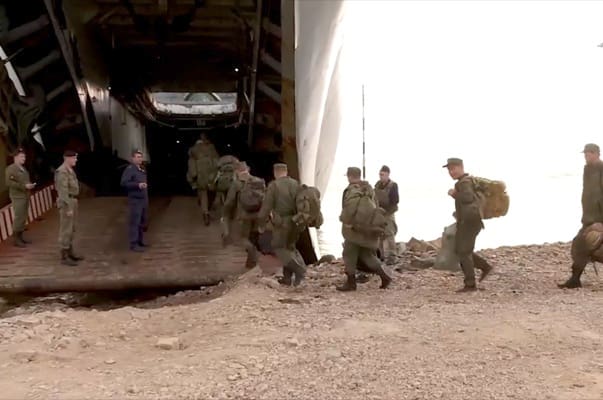
Vladimir Putin has shut down a string of border crossings with neighbouring European countries as the Kremlin prepares for what could become its biggest military mobilisation since the early months of the war in Ukraine.
The Russian government confirmed that multiple railway checkpoints along its borders with Finland, Estonia and Latvia would be suspended from today, restricting the movement of passengers, vehicles and freight.
While Moscow offered no detailed explanation for the closures, the timing has fuelled speculation that the Kremlin is preparing for another major wave of conscription as Russia struggles to replace heavy battlefield losses.
The largest disruption is along Russia’s border with Finland, where crossings at Vyborg, Vartsilya, Lyuttya, Saint Petersburg-Finlandsky and Svetogorsk have all been halted.
Read more related news:
Russia’s great army, held together by twisted metal, skeletons and no morale
The next war has started: Britain’s £5bn drone revolution after Ukraine’s warning
Monaco bomb horror: Ukrainian billionaire, wife and son critically injured in attack
Putin’s ‘elite’ army now has a staggering ’20-minute’ shelf life
Finnish, Estonian and Latvian authorities have all been formally notified by Russia’s Foreign Ministry.
The move comes as reports inside Russia suggest the Kremlin is considering a fresh mobilisation after September’s State Duma elections.
Officials have so far resisted another nationwide call-up following the political chaos triggered by the partial mobilisation announced in September 2022.
That decision sparked one of the biggest population movements in modern Russian history, with around 70,000 men reportedly fleeing the country within days to avoid being sent to fight.
Many crossed into Finland, Georgia and Kazakhstan before Russia tightened border controls.
According to independent estimates, those leaving were overwhelmingly young and highly educated, depriving Russia of skilled workers while exposing deep public anxiety over the war.
Now the Kremlin faces an increasingly uncomfortable reality.
Recruitment is slowing while casualties continue to mount.
Russian media reports suggest the number of volunteers signing military contracts this spring has fallen by around a third compared with last year.
To keep its invasion going, Moscow has increasingly relied on financial incentives, regional recruitment drives and prison recruitment programmes.
One mobilised Russian soldier previously claimed many new arrivals had been recruited directly from prisons or detained by police and offered military service instead of prosecution.
“Some were taken from prison, others from the streets,” he said.
The manpower crisis comes as Ukraine continues expanding long-range strikes deep inside Russian territory.
Recent attacks have targeted oil refineries, logistics hubs, bridges and military infrastructure hundreds of miles from the front line, increasing pressure on the Kremlin’s war machine.
Among the latest targets were energy facilities in the Krasnodar and Yaroslavl regions, with Russian officials confirming casualties following the strikes.
The growing strain has forced Putin into a series of unusually candid public admissions.
Speaking at a congress of his ruling United Russia party, the Russian president acknowledged his country faced significant difficulties.
“Yes, we see the problems, we are aware of them and are responding to them,” Putin said.
He insisted Russia would overcome the challenges posed by attacks on its territory and infrastructure while maintaining what he described as the country’s security.
The comments followed another rare concession only days earlier, when Putin admitted Russia was experiencing fuel shortages in several regions and confirmed authorities were considering emergency measures to stabilise domestic supplies.
Even inside the Kremlin, the atmosphere appeared subdued.
Television footage from Putin’s latest address showed former Russian president Dmitry Medvedev apparently struggling to stay awake, with cameras capturing him sitting with his eyes closed during the speech.
For more than four years, the Kremlin has insisted its military campaign remains firmly under control.
But with recruitment slowing, fuel shortages emerging, infrastructure coming under repeated attack and fresh mobilisation rumours gathering pace, the pressures confronting Moscow are becoming increasingly difficult to conceal.
The closure of Russia’s western border crossings may yet prove temporary.
But coming as the Kremlin weighs another politically risky call-up, the move has inevitably raised one question inside Russia:
Is Moscow preparing not simply to send more men to war—but to make it harder for them to leave?


Leave a Comment