
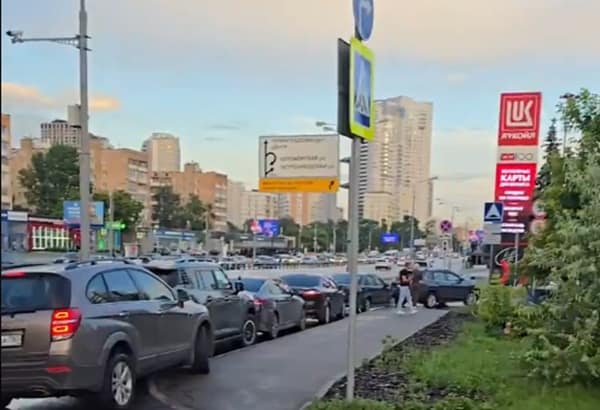
Russia’s worsening fuel shortages are beginning to generate a more politically sensitive problem for the Kremlin: public complaints about access to petrol are increasingly being treated as a security issue.
A court in Volgograd has fined a local woman 10,000 roubles after police classified a small gathering at a petrol station as an unauthorised public event, according to Mediazona.
The case arose after five residents assembled on July 16 to record a video appeal to Alexander Bastrykin, head of Russia’s Investigative Committee, complaining about petrol shortages and preferential access for officials.
Participants alleged that local authorities were filling vehicles using official fuel cards while ordinary motorists were being turned away.
Read more related news:
Kremlin insider warns Russia will ‘respond asymmetrically’ against the UK
Putin sends hypersonic missile warship into NATO’s backyard
Kremlin threatens nuclear retaliation against Britain over Ukraine strikes
Putin’s threat backfires as Britain vows to stand firm against Russia
Police detained all five immediately after the video was recorded.
One participant, lawyer Alexey Sevastyanov, was sentenced to five days in detention for disobeying police and also faced a separate administrative case over the alleged unauthorised gathering.
The episode illustrates how a supply-chain problem is colliding with Russia’s increasingly restrictive political environment. What might ordinarily amount to a consumer complaint has instead become a matter for police and the courts.
The shortages are spreading. At least 10 Russian regions have tightened controls on petrol sales, while reports suggest around one-third of the population has experienced difficulties obtaining fuel.
The disruption has been compounded by Ukrainian strikes on Russia’s refining infrastructure. Kyiv claims attacks have taken as much as 40 per cent of Russian refining capacity offline in recent months, although the precise impact is difficult to independently verify.
The fuel crisis is eating Russia from the inside. In Sochi they queue with jerrycans from the middle of the night while even imported gasoline fails to plug the holes. Same story from annexed Crimea to Novosibirsk: stations ration 20 liters, black market hits 200 rubles,… pic.twitter.com/COZBmkvEg6
— medoyid_ua (@LetsArmUKR) August 13, 2026
Moscow has responded by redirecting petrol supplies from Belarus and pursuing alternative channels for petroleum products. Even increased imports, however, have struggled to close the gap.
For the Kremlin, the economic consequences extend beyond motorists facing queues and rationing. Fuel shortages threaten transport, agriculture and industrial activity, while visible preferential treatment for officials risks deepening public resentment.
The Volgograd case points to the awkward political arithmetic confronting President Vladimir Putin: the harder it becomes to keep Russia supplied with petrol, the greater the pressure to explain why ordinary citizens are bearing the cost — and the more aggressively the state appears prepared to police those asking the question.


Leave a Comment