
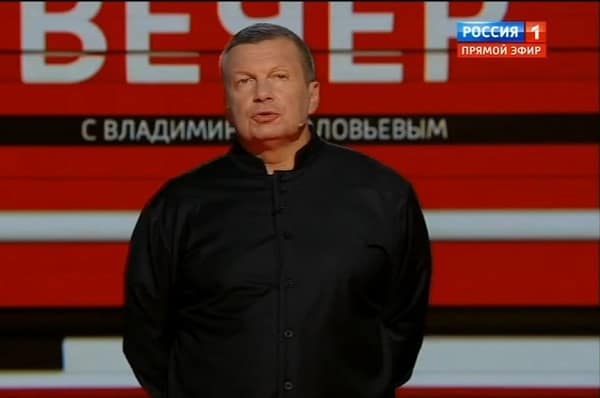
A senior Russian state television host has intensified threats against Britain, accusing London of enabling Ukrainian attacks deep inside Russia and calling for Moscow to respond with “asymmetric” measures.
Vladimir Solovyov, a prominent Kremlin-aligned broadcaster, made the comments during a televised discussion with war correspondent Yevgeny Poddubny, as Russian state media stepped up rhetoric against Ukraine and its western allies.
Solovyov argued that the use of British-supplied weapons in strikes inside Russia represented a direct confrontation with Moscow.
He called for Russia to identify its adversaries and retaliate against them beyond the battlefield in Ukraine.
He ranted: “Right now, strikes deep inside Russia are being carried out with British weapons, yet we are not destroying British factories. This is classic Anglo-Saxon warfare. We must understand who we are fighting and respond asymmetrically.”
The broadcast went considerably further than criticism of Western military assistance. Poddubny called for the destruction of Ukrainian cities, while both men rejected the prospect of a negotiated settlement and portrayed the war as an existential struggle with the West.
Poddubny warned: “Everything over there should burn every single day! Mykolaiv must burn, and Kharkiv and Sumy must be wiped off the face of the earth!”
He added that the West is wanting to see a “strategic defeat” and wants to see the “destruction of Russia.”
The comments underline the increasingly blurred line in Moscow’s rhetoric between Ukraine and the countries supplying Kyiv with weapons. Britain has repeatedly said its military assistance is intended to help Ukraine defend itself against Russia’s invasion, while
Moscow has characterised western support as evidence of direct involvement in the conflict.
The two broadcasters also appeared to welcome reports of fires at European defence facilities. Solovyov suggested, sarcastically, that factories could suffer unexplained fires, while Poddubny described such incidents as positive developments.
Their remarks reflect the increasingly confrontational tone of Russian state television, where calls for escalation and attacks on western governments have become a regular feature of prime-time programming.
The threats come as Ukraine continues to develop its capacity to strike Russian military infrastructure, including facilities well beyond the immediate front line. Ukrainian attacks have targeted airbases, fuel infrastructure and other military sites inside Russia.
For European governments, the rhetoric presents a familiar strategic problem: maintaining military support for Ukraine while managing the risk that Moscow could seek to broaden the confrontation beyond the battlefield.
British officials have repeatedly rejected Russian threats, insisting that support for Ukraine will continue despite warnings from the Kremlin.
The latest broadcast offers no indication that Moscow’s public rhetoric is moving towards compromise. Instead, it points to a Russian information campaign increasingly focused on portraying western military assistance as a justification for retaliation against the countries providing it.


Leave a Comment