
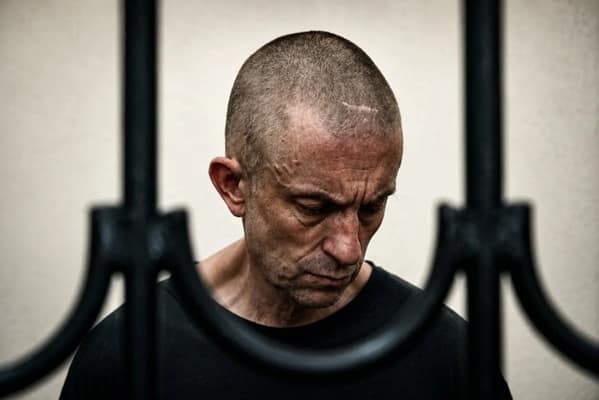
During the week of 9 June 2022, I stood in a cage in occupied Donetsk as a court of the self-proclaimed Donetsk People’s Republic sentenced me to death.
The verdict was never really in doubt; long before the cameras arrived, the outcome had already been decided.
Alongside fellow Prisoners of War Aiden Aslin and Brahim Saadoun, I had become part of a political theatre designed not to deliver justice, but to serve propaganda and shape tomorrow’s narrative. Russia wanted the world to see.
What I did not know at the time was that while the trial was unfolding, Russian state television personalities were openly debating my fate.
Vladimir Solovyov, one of Russia’s most prominent propagandists, discussed whether I should be hanged or shot. My life had become a talking point for entertainment and political theatre, a trial by public opinion reduced to a spectacle designed for a Russian domestic audience. The sentence was never about law, justice, or even us as individuals.
It was about legitimising an invasion, intimidating foreign volunteers, and demonstrating the power Russia believed it held over those who resisted it.
We were lawful combatants serving in the Ukrainian Armed Forces and protected under the Geneva Conventions, yet Russia and its proxies sought to use us as an example.
Read more related news:
Kremlin claims they’re ready for peace talks as Ukraine eyes Crimea
Putin’s capital will become the testing ground for Ukraine’s newest missile
Putin’s Black Sea fleet continues its transformation into an artificial reef
NATO chief tells Russians ‘you are being sold a raw deal’ and you ‘will die in the mud’
Kremlin adviser predicts 20 years of war as Russia locks into confrontation with West
The absurdity of the entire process was impossible to ignore. Hanging in the room next to the courtroom was a portrait of Vladimir Putin. At one point, as the judge shouted at me in frustration, insisting, “Do you see any Russians in this room?”, all I could do was smirk. The reality was obvious to everyone present. This was not an independent court acting of its own accord; it was part of a political process designed to produce a predetermined outcome. When our pleas of not guilty were met with sighs and disdain, and our lawyers explained that the only way home was to accept guilt, you realised the game was already up.
The trial was intended to intimidate foreign volunteers, legitimise the invasion in the eyes of ordinary Russians, and create a spectacle that could be broadcast across Russian state media. We were not defendants so much as props in a carefully orchestrated narrative, choreographed not only for a Russian audience but for an international one as well. The aim was to present us as proof of the Kremlin’s claims about Ukraine, regardless of the facts.
Western-accented reporters were brought in to help sell that narrative to foreign audiences, repeatedly referring to us as Nazis, mercenaries, and terrorists despite our status as serving members of the Ukrainian Armed Forces and the fact I had never left the country in which my Ukrainian family lived. Journalists such as Roman Kosarev of RT appeared less interested in reporting events than reinforcing the message Moscow wanted broadcast to the world, particularly in the United States.
The courtroom, the cameras, the interviews, and even the language being used all formed part of a broader information operation designed to blur the distinction between propaganda and journalism. Long before the verdict was announced, the story had already been written.
What made this even more disturbing was that the propaganda did not exist separately from the abuse. Russian state media figures and outlets were given extraordinary access to prisoners while we remained in captivity, often appearing as participants in the spectacle rather than independent observers. In doing so, they helped legitimise a system that international organisations, former prisoners, and human rights investigators have linked to torture, coercion, and serious abuses of detainees. Rather than holding power to account, they became part of the machinery that sought to justify and conceal it while often during my interrogations, they were present, with the abuser behind the camera and out of shot.
Some months later, I was fortunate enough to be exchanged and return home alive. Looking back, I suspect the only reason I am here to write these words today is because I became part of a prisoner exchange involving Viktor Medvedchuk, one of Vladimir Putin’s closest political allies in Ukraine. Medvedchuk was not only a key Kremlin figure, but widely regarded as the man Moscow hoped would play a leading role in governing Ukraine had Russia succeeded in achieving its objectives during the opening stages of the invasion. His value to the Kremlin was immense, and it is difficult not to conclude that his inclusion in the exchange ultimately saved my life.
Many others were not so fortunate.
Some prisoners never came home at all. Among them was Paul Urey, a British humanitarian worker who died in captivity after being subjected to abuse and mistreatment. His name is rarely mentioned now, lost amongst the countless tragedies of this war, but I still think about him often. In a conflict measured by statistics and daily casualty reports, it is easy to forget the individuals behind the numbers. Paul, like so many others who did not survive captivity, deserves to be remembered.
As this anniversary arrives in 2026, I find myself reflecting not only on that sentence but on the wider crime from which it emerged. The trial did not happen in isolation, but was the product of Russia’s invasion of Ukraine, the siege of Mariupol, and the machinery of occupation that followed in its wake.
Mariupol was the city where I lived, worked, and built a life. My wife and I called it home, a thriving, predominantly Russian-speaking city that had become one of Ukraine’s success stories after 2014. Today, much of that city exists only in photographs and memories. Entire districts were levelled, hospitals and schools reduced to rubble, and families disappeared beneath collapsed apartment blocks. Tens of thousands of civilians are believed to have been killed during the siege, although the true figure may never be known. The city became one of the defining symbols of Russia’s invasion and remains a stark reminder of what modern warfare looks like when civilian lives are treated as expendable.
For my wife, the loss was particularly cruel. Russia first stole her home in Crimea following the illegal annexation of 2014. Eight years later, it took another in Mariupol. Millions of Ukrainians share similar stories. According to international estimates, more than 10 million Ukrainians have been displaced by Russia’s full-scale invasion, including millions who remain internally displaced within Ukraine and millions more forced to seek refuge abroad. Families have been uprooted multiple times, communities scattered across continents, and an entire generation has been forced to rebuild their lives from nothing. The invasion has created one of Europe’s largest Displacement Crises since the Second World War, and its consequences will be felt for decades to come.
Yet the destruction of Mariupol was only one part of a much larger system. As Russian forces advanced across occupied territories, Filtration Camps emerged. I met people who passed through them, while others simply vanished. These were not humanitarian processing centres as Moscow attempted to portray them. They were instruments of control. Civilians were interrogated, searched, photographed, fingerprinted, and screened for any perceived connection to Ukraine’s military, government, media, or civil society. Some were detained, some deported, and others disappeared into a network of prisons and detention centres like the 19year old Mariupol train driver I was in isolation with, underground, and somewhere in Donetsk.
The United Nations, international investigators, and human rights organisations have documented allegations of Torture, Forced Transfers, and arbitrary detention linked to this system. It was all part of the same machinery that reduced Mariupol to ruins.
Which brings me to a question that has increasingly occupied my thoughts over the past year.
Why are people who were never there trying so hard to rewrite the history of this war?
The press scrum around Candace Owens says a lot about the world we live in.
Four years ago, I was facing a Russian death sentence after the destruction of Mariupol. Today, people who have never lived through the war are helping rehabilitate those responsible for it.
The… pic.twitter.com/xEqq7Tsn8r
— Shaun Pinner (@ShaunPinnerUA) June 4, 2026
A strange phenomenon has emerged as Russia’s invasion enters its fifth year. Influencers, podcasters, commentators, and social media personalities increasingly present themselves as neutral observers while helping rehabilitate the image of the invading state. Figures such as Candace Owens and the Tate Brothers have amplified narratives that minimise Russia’s responsibility, shift attention away from documented atrocities, or present the conflict as something other than what it plainly is: an unprovoked invasion of a sovereign nation.
The trend extends beyond social media personalities. Even the Trump administration’s decision to send a senior representative to the St. Petersburg International Economic Forum reflects a growing “business as usual” approach towards a country still waging the largest war in Europe since 1945. The optics were particularly striking. Among those in attendance was Steven Seagal, the ageing Hollywood action star who has spent years reinventing himself as one of Putin’s most loyal Western supporters. Whenever the Kremlin wants to project the image that Russia remains respected and admired abroad, the vastly overweight Seagal inevitably appears somewhere in the background, serving as a familiar prop in Moscow’s long-running effort to demonstrate that the West has not entirely turned its back on Putin.
The message may be subtle, but it is effective. The war continues, Ukrainian cities remain under attack, and an active arrest warrant hangs over Vladimir Putin from the International Criminal Court. Yet events such as SPIEF are designed to signal normality, suggesting that commerce, diplomacy, and international prestige can continue largely unaffected. For the Kremlin, that normalisation is almost as valuable as any military victory.
The effort to rehabilitate Russia becomes even harder to understand when one considers the status of Vladimir Putin himself. In March 2023, the International Criminal Court (ICC) issued arrest warrants for Putin and Russia’s Commissioner for Children’s Rights, Maria Lvova-Belova, alleging responsibility for the unlawful deportation and transfer of Ukrainian children from occupied territories. The warrants remain active today with Putin not just simply a controversial world leader, but an indicted war crimes suspect under international law.
Against this backdrop came President Volodymyr Zelensky’s recent appeal to Russia. Stripped of politics and rhetoric, the message was remarkably simple:
End The War.
Not because Ukraine is weak, not because Russia deserves concessions and certainly not because the world has forgotten.
End it because nobody can honestly explain what any of this was for.
It was a message clearly directed at Vladimir Putin, whose justifications for the invasion have shifted repeatedly over the course of the war. From claims of “denazification” and protecting Russian speakers to broader historical arguments questioning Ukraine’s sovereignty, many of the original narratives used to justify the invasion have been challenged by the realities that followed. Instead of a quick victory, Russia found itself embroiled in a prolonged conflict that has brought war, economic strain, and growing insecurity back to Russia itself.
What was once presented as a short operation has become a war measured in years, hundreds of thousands of casualties, rising costs, labour shortages, and increasing pressure on the Russian state. Ukrainian strikes now reach deep into Russian territory, critical infrastructure has come under repeated attack, and regions once considered distant from the conflict increasingly find themselves affected by it.
Viewed through that lens, Zelensky’s open letter to Vladimir Putin can be seen as offering the Russian president an off-ramp. Not a victory, and certainly not vindication, but an opportunity to end a war that has delivered enormous costs to both countries. It is a message that appears increasingly grounded in the realities now facing Russia itself.
The war that Putin once expected to be measured in days is now entering its fifth year. Ukraine has increasingly seized the initiative, combining long-range strikes, innovation, and asymmetric operations to challenge Russia far beyond the front lines. Strategic targets, military infrastructure, and even Putin’s home city of St. Petersburg are no longer insulated from the conflict. Meanwhile, despite committing vast manpower and resources, Russia continues to struggle to achieve decisive breakthroughs and has often found itself paying a heavy price for marginal territorial gains.
President Zelensky’s open letter to Vladimir Putin calls for the return of prisoners, civilians, and deported children, but it also poses a far broader challenge to the Kremlin.
If the original justifications for the invasion no longer withstand scrutiny, and if the costs continue to mount with no clear path towards achieving Russia’s stated objectives, then what exactly is the purpose of continuing the war?
That question is directed at Putin, but it is equally directed at the Russian people still being asked to pay the price. Every day, Russia continues to lose the equivalent of roughly two battalions of personnel, with Ukrainian estimates regularly placing Russian casualties at around 1,000–1,200 killed and wounded daily.They are sons, fathers, brothers, and husbands being fed into a war that was sold as a quick operation but has instead become a grinding conflict measured in years.
Nor is the cost confined to the battlefield. Labour shortages, economic pressures, demographic decline, sanctions, and increasingly frequent Ukrainian strikes deep inside Russia have all brought the consequences of the war closer to home. What was once presented as a distant military operation is now affecting everyday life across the country.
Four years ago, I stood in a courtroom in occupied Donetsk and listened as men acting on behalf of an invading power sentenced me to death. Today, I am alive to write these words while many of those caught up in this war are not.
People like Candice Owens or the Tate brothers were not there when Mariupol fell. They did not lose their homes, nor did they sit in prison cells wondering if they would ever see their families again. They certainly did not watch their country fight for survival or witness the brutality that saw more than 25,000 people killed in Mariupol alone, including women and children.
But many Ukrainians did.
Four years later, the least we can do is remember who started this war, what it cost, and why the truth still matters.
We should also be wary of those who seek to rehabilitate the aggressor, minimise documented atrocities, or help whitewash war crimes. History has a habit of judging such efforts harshly, but only if we are prepared to remember what happened in the first place.


Leave a Comment