
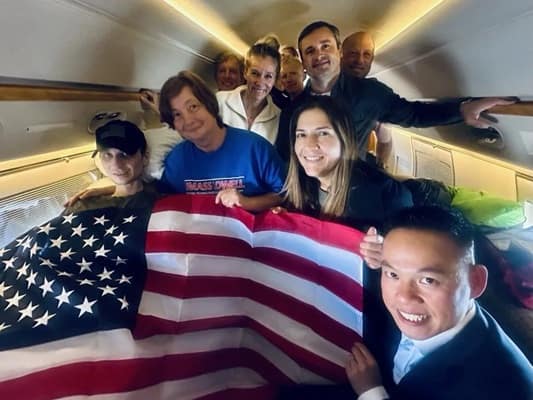
Robert Gilman is finally free after more than four years in Russian detention, but the political spectacle surrounding his release should make us deeply uncomfortable, but let me start with the most important thing; I am genuinely happy that Robert Gilman is free.
Any prisoner walking out of a Russian prison alive is something to celebrate, because not everybody does. Any family getting their son, father, brother or husband back after years inside that system deserves their moment.
Frankly, I don’t care which US administration secured his release. When you are sitting in a Russian prison wondering whether you will ever get out alive, domestic political point-scoring is utterly irrelevant.
Robert Gilman is home. That should have been the story. Instead, within hours of his release, his return was being turned into a political spectacle.
Gilman had spent more than four years in Russian detention and emerged visibly emaciated and seriously ill. His advocates said he had spent 47 days in a “dissociative stupor”, while Russian hospital records reportedly described his condition as “dire and life-threatening”.
Yet Donald Trump publicly thanked Russia. Steve Witkoff thanked Vladimir Putin for his “personal engagement”, while Marco Rubio’s State Department thanked Russia for working with the administration to secure Gilman’s release.
That language matters.
I know something about coming home from Russian captivity. When I was exchanged in September 2022, I had been tortured, starved, beaten, electrocuted, stabbed, psychologically abused and sentenced to death.
Coming home doesn’t instantly make you normal again.
You are exhausted, your senses are overloaded while you have spent months being told when to eat, sleep, stand, sit and use the toilet. You have been isolated from normal information and surrounded by propaganda.
At the point of release, you are thinking about food, family, safety and sleep, not the geopolitical significance of your release or which politician wants a photograph.
That is why I find the treatment of Gilman uncomfortable.
Perhaps he wanted the photographs and political attention, I hope somebody genuinely asked him.
But a prisoner’s release should not automatically make his face government property, and his suffering should not become political currency before he has even had time to understand what has happened to him.
More troubling, however, is the public thanking of Russia.
You can negotiate with Moscow, sometimes you have to negotiate with terrible regimes to get people home. I benefited from negotiations myself.
But there is an enormous difference between negotiating with somebody and morally laundering them afterwards.
Russia imprisoned Gilman. Russia controlled the prison system in which his health deteriorated catastrophically while his family and advocates have alleged torture, forced drugging and extreme punishment conditions.
You don’t get humanitarian credit for eventually releasing somebody from conditions under your control after they have nearly died.
You don’t thank the man holding the petrol can for putting out the fire.
And Gilman is not an isolated example.
I witnessed what the Russian detention system can do.
British humanitarian worker Paul Urey was captured in 2022 and held by the Russian-backed so-called Donetsk People’s Republic. He was diabetic and needed insulin. I know because he was imprisoned alongside me.
The Red Cross was unable to independently access him.
Paul eventually died in captivity. Russia claimed illness and stress, but when his body was returned, Ukrainian authorities reported possible signs of torture.
There was nothing “possible” about it from where we were sitting.
During my own captivity, no independent humanitarian organisation came to see me once.
No Red Cross. No independent observer checking my physical condition. Nobody privately asking whether I was being treated according to international law.
Your captors control everything: where you sleep, what you eat, who you speak to and even whether anybody outside knows what condition you are in.
Against that background, publicly thanking Putin is not harmless diplomatic courtesy.
It contributes to something much larger: the gradual normalisation of Russia.
Bit by bit, the language changes.
Russia invades Ukraine, but negotiations increasingly become about what Ukraine should surrender.
Russia commits atrocities, but war crimes become inconvenient because they complicate negotiations.
Russia holds an American for more than four years, he emerges dangerously ill, and Russia is thanked for releasing him.
The abnormal becomes normal.
Putin desperately needs that rehabilitation. He wants photographs with American officials, sanctions removed, economic relationships reopened and Russia again treated as a great power negotiating with Washington over Ukraine.
Most importantly, he needs Russian war crimes pushed into the background.
Robert Gilman’s release should be about Robert Gilman.
He deserves medical treatment, psychological support, privacy and time with his family. He should decide whether he ever wants to talk publicly about what happened to him.
Russia releasing a prisoner does not erase what happened to that prisoner.
A pardon does not disinfect a prison cell. Photographs will not restore four stolen years, and Vladimir Putin does not become a humanitarian because he finally allowed an emaciated American to fly home.
We can celebrate Robert Gilman’s freedom without celebrating Russia.
In fact, we absolutely should.


Leave a Comment