
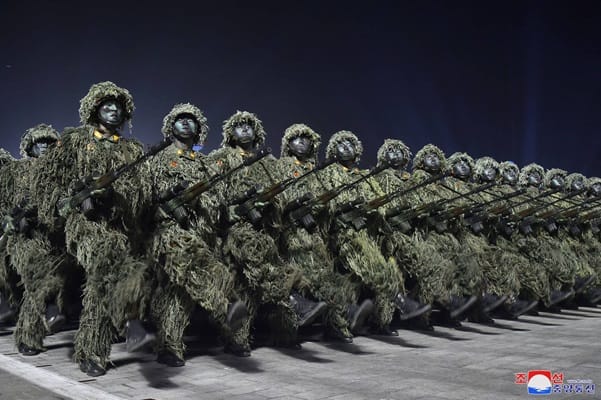
North Korea has expanded its military intervention in Russia’s war against Ukraine, sending another drone unit to support Moscow as the number of North Korean UAV operators assisting Russian forces reaches 400.
Major General Vadym Skibitskyi, deputy chief of Ukraine’s Defence Intelligence, told CNN that the latest deployment includes a North Korean unit capable of conducting both reconnaissance and attack-drone operations against targets in Ukraine.
The disclosure offers fresh evidence that Pyongyang’s role in the war is extending well beyond the supply of ammunition and ballistic missiles. North Korean personnel are now contributing specialist battlefield capabilities to Russia’s military campaign.
The total number of North Korean troops currently in Russia stands at about 8,500, according to Skibitskyi. Most are deployed in the Kursk region, including around 1,000 engineers and deminers and the newly identified force of 400 drone operators.
Ukrainian intelligence believes North Korean troops are unlikely to fight directly inside Ukraine. Instead, they are expected to reinforce Russian positions behind the front, allowing Moscow to release its own soldiers for offensive operations.
That distinction may offer Russia a significant manpower advantage at a time when its military is attempting to sustain pressure along multiple sectors of the front.
Read more related news:
Russian aircraft accused of breaching Finland’s airspace as NATO tensions surge
North Korea’s nuclear arsenal may be far bigger than Trump thinks
UN faces ‘collapse’ as Putin exploits veto to shield Russia from consequences
The world is foolishly ignoring North Korea’s dangerous entry into Europe’s war
North Korean forces have been using attack drones against targets in Ukraine since October 2025, according to Ukrainian intelligence.
Skibitskyi said the scale of the partnership was considerably larger than the current deployment, with roughly 25,000 North Koreans having already been deployed to or rotated through the Russian armed forces.
The figures underline the extent to which a relationship that once appeared opportunistic has developed into a sustained military partnership.
North Korea and Russia signed a mutual defence pact in 2024, and Pyongyang began sending troops to support Moscow’s war later that year.
The relationship could expand again dramatically.
Skibitskyi said Russia could request as many as another 50,000 North Korean troops during a planned meeting between the countries’ leaders in September.
For Kyiv and its Western allies, that prospect raises the possibility that Moscow is effectively outsourcing part of its manpower burden to an authoritarian ally thousands of miles away.
It also demonstrates how Russia’s war has become a vehicle for deeper military integration between Moscow and Pyongyang.
The partnership is not confined to personnel.
Russia is reportedly deploying new launchers for North Korean ballistic missiles in the Voronezh region, potentially extending the threat to seven Ukrainian regions. Pyongyang has also reportedly transferred more than 100 ballistic missiles and specialist missile units to Russia.
The consequences have already been deadly.
🇷🇺🇰🇵 NORTH KOREAN TROOPS REPORTEDLY ARRIVE IN RUSSIA WITH BALLISTIC MISSILES
Around 90 North Korean personnel operating KN 30 ballistic missiles have reportedly arrived in Russia’s Voronezh region alongside more than six modified launchers.
According to intelligence… pic.twitter.com/LKc3Vu8jNi
— Defense Intelligence (@DI313_) August 21, 2026
On July 30, Russian forces struck the settlement of Radushne near Kryvyi Rih with a North Korean ballistic missile, according to Ukrainian reports. A large family was killed in the attack, including the father, mother, seven children and a young grandson.
The incident illustrates the uncomfortable reality behind the increasingly formal military relationship: North Korean weapons are not merely being stockpiled or tested. They are being used in Russia’s war against Ukrainian civilians.
The deepening alliance is becoming an increasingly difficult issue for NATO governments, particularly as Washington recalibrates its own posture on the Korean peninsula.
US President Donald Trump has announced that military exercises with South Korea will be scaled back, citing a desire to avoid provoking Kim Jong Un and expressing interest in meeting the North Korean leader.
The juxtaposition is striking.
As Washington seeks renewed engagement with Pyongyang, North Korean troops, drone operators, engineers and missile units are becoming increasingly embedded in Russia’s war machine.
For Moscow, the arrangement provides manpower and specialist capabilities without requiring Russia to generate every soldier and operator itself.
JUST IN: 🇷🇺🇰🇵 North Korea’s “2.5-Ton” Missile Arrives In Russia
Ukrainian intelligence says Russia has received North Korea’s Hwasong-11C ballistic missile for the first time.
Pyongyang claims the heavier missile can carry a 2.5-ton warhead, potentially giving Russia access to… pic.twitter.com/5VNcPfKaDZ
— War Radar (@War_Radar2) August 21, 2026
For Pyongyang, the benefits are potentially even broader. Its forces gain operational experience in a major modern war, while its weapons are tested against Ukrainian forces equipped with Western technology.
The danger for Europe is that the Russia-North Korea relationship is no longer simply diplomatic or transactional.
It is becoming operational.
North Korea is supplying Russia with soldiers, drones and ballistic missiles, while Russia provides Pyongyang with a battlefield on which its military capabilities can be deployed and refined.
If another 50,000 troops are ultimately requested, the partnership would enter an entirely different phase.
What began as North Korean support for Russia’s invasion is increasingly resembling a joint military enterprise — one in which Ukraine is paying the human price.


Leave a Comment