
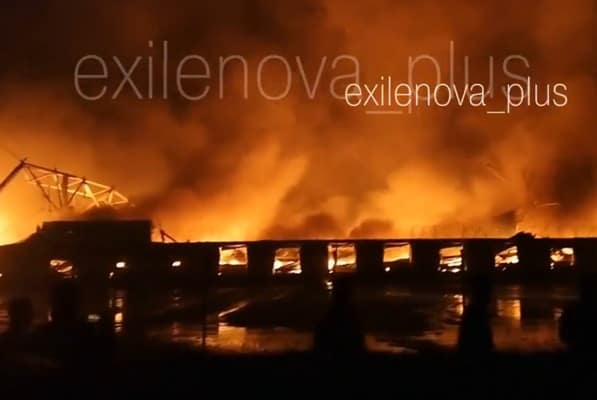
Russia’s sprawling e-commerce infrastructure is becoming an increasingly visible casualty of the country’s drone war with Ukraine, after a Wildberries logistics hub in Voronezh region was reportedly engulfed in flames following a series of overnight explosions.
Footage circulating on Telegram appeared to show the facility in Aleksandrovka consumed by fire, with thick black smoke rising above the industrial site.
Local officials said one person was killed and two others injured in the attack.
The strike marks another escalation in a campaign that is pushing Ukraine’s long-range drone operations beyond Russia’s traditional military and energy targets and towards the commercial infrastructure that keeps its wartime economy moving.
Read more related news:
North Korea is helping Putin manufacture a war Ukraine cannot intercept
Ukrainian drones ignite Crimea and strike deep inside Russia
Colombian drug cartels are allegedly sending fighters to learn killer drone warfare
Putin’s desperate ‘human cattle’ drive: Kremlin demands regions to recruit 409,000 new soldiers
Wildberries, often described as Russia’s equivalent of Amazon, is the country’s largest online retailer.
Before the invasion of Ukraine, the company had expanded beyond Russia into European and US markets. Its vast network of warehouses and distribution centres has since become an important component of Russia’s domestic logistics system.
The latest incident is particularly significant because it follows a separate strike on a Wildberries facility in the Ryazan region last month, during a wider Ukrainian drone assault that also targeted one of Russia’s largest oil refineries.
Ryazan’s governor Pavel Malkov described the July 29 attack as “massive”, saying air defence systems had been activated and that fires had broken out at industrial sites.
Residents reported explosions and shared footage appearing to show fires at both the Ryazan oil refinery and a Wildberries warehouse complex.
Wildberries subsequently restricted access to its Ryazan facility, warning customers and sellers that operations had been disrupted.
Another action-packed night for Ukraine's Armed Forces, targeting oil infrastructure and logistics facilities across Russia.
Among the targets was the 158,000m2 Wildberries facility in Voronezh, the country's 5th largest.
Important not only for its size but it's proximity to… pic.twitter.com/YHodPitmnx
— Jay in Kyiv (@JayinKyiv) August 11, 2026
The repeated targeting of the retailer’s infrastructure has raised questions over whether its warehouses are being treated by Ukraine as more than ordinary commercial facilities.
Ukrainian President Volodymyr Zelensky has previously alleged that Wildberries hubs have been involved in supplying Russia’s military with drone components, navigation equipment and other equipment. Kyiv has increasingly argued that civilian-looking industrial networks can form part of the wider Russian war machine.
Moscow has not publicly accepted that Wildberries facilities are legitimate military targets, while responsibility for individual attacks is often not immediately claimed by Kyiv.
For Russia, however, the economic consequences of the campaign are becoming harder to contain.
The country has invested heavily in air defences around Moscow, military installations, oil infrastructure and other strategic assets, but the sheer geographical reach of Ukraine’s drone campaign has created a more difficult problem: protecting the industrial arteries that connect factories, warehouses, retailers and consumers across the country.
A destroyed warehouse does not merely represent a damaged building. It can interrupt inventory flows, delay deliveries, disrupt thousands of sellers and force companies to reroute goods through already stretched networks.
Wildberries has responded to previous attacks by restricting access and promising updates once operations can resume. It has also launched an advertising campaign encouraging Russians to support sellers affected by warehouse strikes, with billboards reportedly appearing in occupied Crimea.
The symbolism is difficult to miss.
The war is increasingly being fought not only against oil refineries and military bases but against the infrastructure of everyday economic life.
For Ukraine, the calculation is that Russia’s vast logistics system can provide both strategic targets and economic pressure points. For Moscow, every successful strike creates another layer of cost — from repairing industrial facilities to rerouting goods and defending an increasingly dispersed network of critical infrastructure.
The burning Wildberries hub in Voronezh therefore represents something larger than another overnight fire.
It is evidence that the drone war is steadily moving into the commercial bloodstream of Russia’s economy.


Leave a Comment