
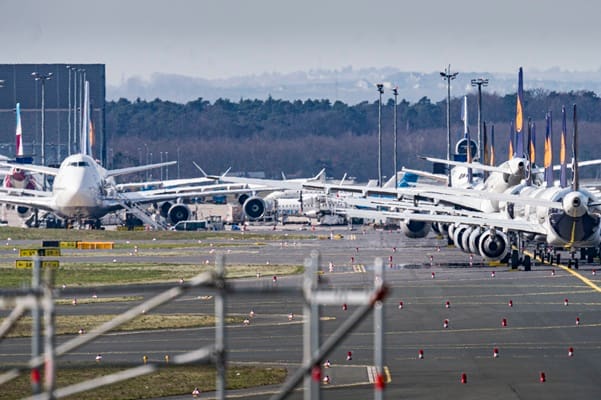
Britain’s aviation industry has warned that repeated failures in the country’s air traffic control network could trigger further disruption, after hundreds of flights were cancelled or delayed across Scotland, Northern Ireland and northern England.
The latest outage at the National Air Traffic Services (Nats) centre in Prestwick has raised fresh questions over the resilience of critical aviation infrastructure, with Edinburgh Airport’s chief executive warning that the disruption could extend into Tuesday.
Gordon Dewar, chief executive of Edinburgh Airport, told the Press Association: “The system is clearly not working – twice in the last few weeks. It’s national infrastructure that we’re all dependent upon.”
Dewar said the system was not sufficiently robust and that “something needs to change”.
He added: “Of course, when flights are cancelled, that means aircraft are in the wrong place for the next one. Potentially this could ripple through to tomorrow as well. So, we’re just working incredibly hard to look after people that are delayed or have to make other plans, make sure the operation can be the best it possibly can in the circumstances. And help the airlines get back on to the schedule – hopefully by later today.”
At least 200 flights arriving at or departing from UK airports had been cancelled by Tuesday, according to aviation analytics company Cirium.
EasyJet was the airline most affected, with 47, or 7 per cent, of its 670 scheduled UK departures cancelled.
The disruption was particularly acute in Northern Ireland and Scotland. By 1.45pm, 17.4 per cent of departures from George Best Belfast City Airport had been cancelled or classified as “no fly”, alongside 12.5 per cent at Belfast International Airport and 10.3 per cent at Glasgow Airport.
Cirium classifies flights as “no fly” when they have been delayed by more than three hours.
The latest incident is the second Nats disruption in September, prompting renewed criticism from airlines and travel groups over the resilience of the UK’s air traffic control infrastructure.
Yvonne Moynihan, managing director of Wizz Air UK, said the fact that Nats had described the two incidents as unrelated offered little reassurance.
“Last week, a Nats system failure brought widespread disruption to the south of the UK. Today, another failure has affected the north. Passengers and airlines are entitled to ask: which part of the country will be next?
“Nats claims the two incidents are unrelated. Far from offering reassurance, this raises an even more serious question: how many other hidden weaknesses remain within its systems? Repeated apologies are no longer enough.
“Nats must urgently fix these failures, demonstrate that robust back-up systems are in place and provide full transparency about how repeated outages can occur within such a short period.
“Airlines are once again being left to manage the operational and financial consequences of a failure entirely outside their control while passengers pay the real price through delays, cancellations and disrupted plans. This cannot continue.”
The disruption has also intensified calls for greater accountability for the costs imposed on airlines, tour operators and travel agents when Nats systems fail.
Luke Petherbridge, director of public affairs at travel trade organisation Abta, said the latest incident was the fourth in recent years and the second in a fortnight.
“This is the second Nats incident to cause disruption in the last fortnight, and fourth in recent years. It’s simply not good enough.
“The industry and travelling public will want answers – not only on what has gone wrong, but critically, how the system is going to be made more resilient to avoid future outages.
“These incidents cause inconvenience to travellers and significant financial costs for airlines and the wider travel industry, including additional work and costs for Abta’s tour operator and travel agent members.
“As these Nats issues are entirely outside of travel companies’ control, the Government should seriously consider whether Nats should be made to compensate the wider industry for such events.”
Airlines UK, the industry body, also called for the underlying weaknesses in the air traffic control system to be addressed.
Tim Alderslade, its chief executive, said: “Yet another Nats failure is causing delays and disruption for passengers and airlines alike, and comes just days after its report into the most recent major outage.
“The UK’s ATC (air traffic control) system is critical national infrastructure and it must be resilient enough to keep people moving.
“Passengers and airlines deserve better and the independent CAA (Civil Aviation Authority) report, together with the forthcoming Civil Aviation Bill, must address the underlying weaknesses in the system so that these failures stop happening.”
For airports and airlines, the immediate challenge is to restore aircraft and crews to their planned positions, limiting the disruption from cancelled flights from cascading through subsequent services.
But the frequency of the incidents is shifting the debate beyond individual outages towards the resilience of infrastructure on which a large part of the UK economy depends.
With airlines already facing rising operating costs and passengers bearing the consequences of cancellations and delays, the latest failure has increased pressure on Nats and the Government to demonstrate that the system can withstand further disruption.


Leave a Comment