
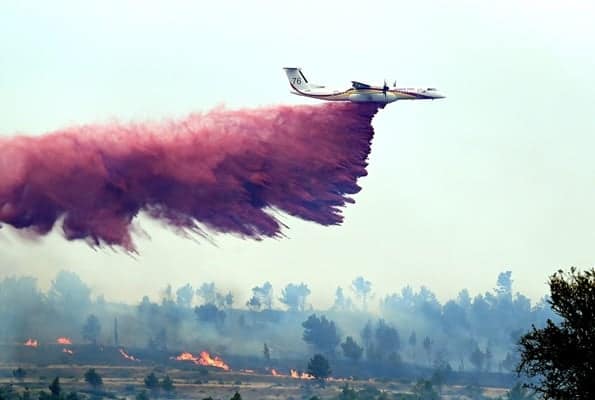
France’s unprecedented wildfire season is becoming more than an environmental disaster. It is increasingly exposing a vulnerability at the heart of Europe’s defence industrial base.
As vast fires continue to sweep through southwest France, concern is growing that flames could come dangerously close to facilities producing rocket propellants, missile components and military equipment, highlighting how climate-related disasters are emerging as a national security risk.
More than 360,000 people have been evacuated across France and Spain as wildfires consume hundreds of square miles of land, with French authorities describing parts of the crisis as “apocalyptic”.
While firefighters have managed to bring several major blazes under control, officials continue to battle flare-ups amid temperatures exceeding 40C and exceptionally dry conditions.
Among the most sensitive locations is Saint-Médard-en-Jalles, near Bordeaux, where aerospace and defence company ArianeGroup operates a 435-hectare facility manufacturing combustible materials used in Ariane launch vehicles and missile systems.
Nearby, another ArianeGroup site at Sainte-Hélène produces ammonium perchlorate, a highly energetic oxidiser widely used in solid rocket motors. Although industrial safety systems are designed to minimise risk, the proximity of major wildfires has prompted heightened concern.
ArianeGroup said it had implemented “all necessary measures” to prevent the fires reaching its facilities.
Prime Minister Sébastien Lecornu said additional protective measures had been deployed around the sites “given the nature of the products stored there”, underlining the strategic importance of the installations.
The fires are also threatening the area around Souge military camp, home to the 13th Parachute Dragoon Regiment, and close to facilities operated by Dassault Aviation, one of Europe’s leading manufacturers of military aircraft.
While officials insist there is no immediate danger to these strategic sites, the episode illustrates a growing challenge facing governments across Europe.
Climate-related events are increasingly intersecting with critical infrastructure, forcing policymakers to consider risks that extend beyond civilian communities and into energy, logistics and defence production.
The fires have already burned through an area reportedly several times the size of Paris, while authorities recorded multiple new flare-ups even after declaring parts of the southwest under control.
President Emmanuel Macron described the emergency as more severe than any faced by France since the Second World War, warning that the coming weeks would remain difficult as prolonged heat and drought continue to create ideal conditions for new fires.
For Europe, the immediate priority remains containing the blazes.
But the broader lesson may prove more enduring: as climate extremes intensify, protecting strategic industrial assets is becoming an increasingly important component of national security planning.


Leave a Comment