
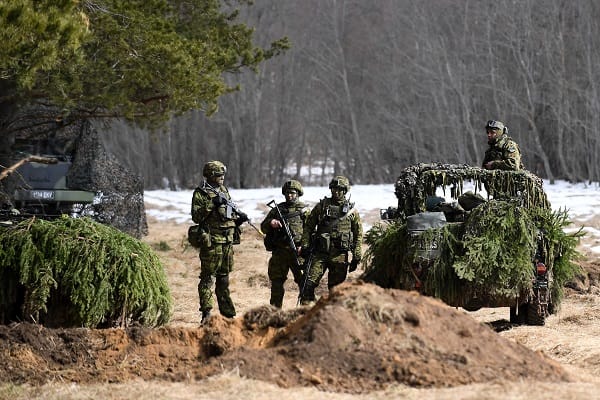
British soldiers stationed on NATO’s eastern flank have rehearsed simulated attacks on one of Vladimir Putin’s most symbolic cities as the Army transforms its approach to deterring Russia.
Troops deployed in Estonia have tested new £80,000 jet-powered drones capable of reaching deep inside Russian territory, including scenarios involving strikes against targets around St Petersburg — the city where Putin was born and raised.
The exercises underline the dramatic shift in modern warfare since Russia launched its full-scale invasion of Ukraine.
Heavy armour is increasingly being supplemented by cheaper, longer-range unmanned systems designed to overwhelm defences, disrupt supply chains and strike high-value targets.
The new Nyan one-way attack drones have a range of more than 150 miles, placing several key Russian military sites within potential reach from Britain’s base at Tapa in northern Estonia.
A Royal Artillery gunner revealed troops had tested the aircraft during a military exercise to assess whether they could reach St Petersburg in a conflict scenario.
Read more related news:
UK prepares for Russian attack as emergency plans go nationwide
Putin to mobilise half-million troops raising fears of escalation as Kyiv’s defence is in crisis mode
Britain and France prepare troops as Europe draws a red line over Ukraine
Russia’s greatest threat may no longer be Ukraine, but exhaustion at home
“On an exercise we tested whether it can reach St Petersburg from here,” the soldier said.
“It all depends on enemy air defences and electronic warfare, which affects how much we would have to dog-leg around.”
The comments highlight the growing importance of long-range precision weapons as NATO prepares for a potential confrontation with Russia.
The drones are expected to replace the role previously filled by Britain’s Challenger 2 tanks stationed in Estonia, as UK forces transition from a traditional armoured battlegroup into a more flexible Mobile Anti-Armour Force from April next year.
The Ministry of Defence said the restructuring reflects the realities of modern warfare and lessons learned from Ukraine, where drones have become among the most decisive weapons on the battlefield.
The British deployment in Estonia is also set to expand, with troop numbers increasing from around 800 to 1,200 personnel.
The new force will be designed to “deploy, disperse and demonstrate combat readiness more rapidly than a traditional armoured formation”, according to the MoD.
A senior Army source summarised the changing battlefield equation bluntly.
“A tank can deny Russia ground, a drone can punish them.”
The shift comes as NATO intensifies preparations for a more dangerous security environment in Europe. Secretary-General Mark Rutte has warned Russia could be capable of testing the alliance by 2030, with the Baltic states viewed as among the most exposed regions.
For Moscow, the message from Estonia is clear: NATO’s eastern frontier is no longer defended only by tanks and troops, but by a new generation of weapons capable of reaching further, striking faster and complicating any potential Russian military advance.
Britain’s Challenger 2 tanks will return to the UK for future roles, with 148 vehicles due to be upgraded to the more advanced Challenger 3 standard.
The battlefield lesson from Ukraine is reshaping Europe’s defence strategy: the next war may be won not by the largest weapons, but by the fastest and most intelligent ones.


Leave a Comment