
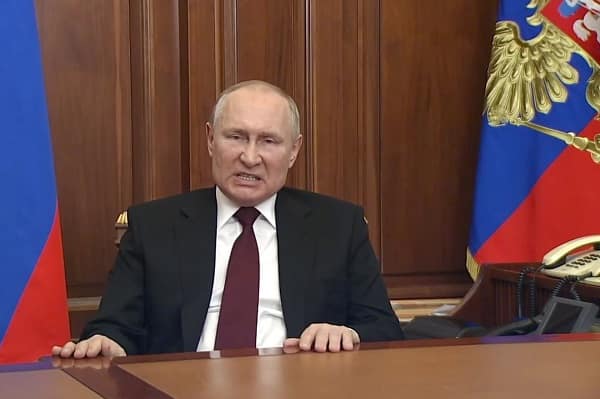
Vladimir Putin has threatened that any deployment of European troops to Ukraine after a peace agreement would be treated as a threat to Russian security, casting fresh doubt over the prospects of ending the war as Donald Trump’s envoys held talks with the Russian president in Moscow.
In a pointed intervention during a meeting with Steve Witkoff and Jared Kushner, Trump’s special representatives, Putin insisted that foreign forces on Ukrainian territory would be “absolutely unacceptable” to Moscow.
He went further, warning that their arrival after a peace deal would amount to “the continuation of the war”.
The remarks underline the gulf between Russia’s demands and the security guarantees Ukraine’s allies are discussing. European governments have considered a postwar military presence to deter renewed Russian aggression, but Putin is seeking to rule out that option before any settlement is reached.
Read more related news:
‘We must be ready to fight’ as Royal Navy unveils huge expansion as threat of conflict grows
Experts sound the alarm as UK’s cyber war threat is spreading from power grids to supermarket shelves
‘Played for a fool’: Trump savaged for berating Ukraine while Putin gets the red-carpet treatment
‘In 14 years, Vietnam cost America 56,000’: Putin’s war machine chewed up by Ukraine
“We have said from the very beginning that the presence of any foreign troops on Ukrainian territory is absolutely unacceptable to us. Because we believe it threatens Russian security,” he said, according to Russian state news agency Tass.
Putin claimed that this position had effectively been accepted by all sides, including during negotiations in Istanbul in 2022. He urged Washington to “work with European allies” to make them decide whether they wanted peace or war.
The Russian leader presented Moscow as committed to dialogue, accusing European governments of breaking off contact with the Kremlin. He claimed Russia had always been “in favour” of talks and wanted a settlement that would last “forever and ever”.
Yet his insistence that European troops would be unacceptable risks placing a central obstacle in the path of any durable agreement: Ukraine and its partners want guarantees that Russia cannot simply resume its invasion once fighting stops.
Putin also rejected the idea of maintaining so-called “grey zones” along the front line, arguing that there could be only one demarcation between Russia and Ukraine: the internationally recognised state border.
“There is only one line of demarcation between Russia and Ukraine – the state border,” he said.
He claimed that leaving disputed areas in an ambiguous status would undermine any settlement. “Maintaining ‘grey zones’ will lead to instability in any agreements, and there will be no lasting peace,” he added.
The comments came as Witkoff and Kushner met Putin in Moscow on November 12, with discussions focused on the outcome of trilateral negotiations in Abu Dhabi aimed at ending the war.
But the diplomatic momentum has yet to translate into agreement on the central questions of a ceasefire, territory and security. According to sources cited by RBC-Ukraine, the Russian delegation refused to discuss a ceasefire, territorial issues, energy and security in the Black Sea on the second day of the Abu Dhabi talks.
Instead, attention shifted towards the future security architecture of Europe, with the war itself taking a back seat.
David Arakhamia, a member of Ukraine’s delegation, acknowledged that the negotiations had been difficult because of the instructions Russian representatives brought to the table. He said discussions about the postwar settlement had helped establish dialogue, however, and that there was positive momentum towards finding a solution before the beginning of next year.
That optimism faces a formidable test. Moscow has reiterated demands that Ukraine make sweeping territorial concessions, extending beyond the Donbas region, according to reporting by RBC-Ukraine citing an assessment of Russia’s negotiating position. Kyiv has previously rejected demands that would amount to surrendering control over its territory.
Putin also raised the possibility of organising a humanitarian mission in Kostiantynivka, drawing a comparison with an operation carried out in Oleshky, in the Kherson region, in late October.
The Kremlin’s message is therefore twofold: it says it wants a permanent peace, but is seeking to dictate the terms of Ukraine’s postwar security and territorial arrangements. Its opposition to foreign forces would leave Kyiv facing a difficult choice over how to deter another invasion.
For European capitals, the warning is a reminder that a ceasefire alone may not resolve the conflict. The question is whether a settlement can offer Ukraine credible protection without provoking Moscow to reject it outright — a contradiction Putin’s latest remarks have done little to ease.


Leave a Comment