
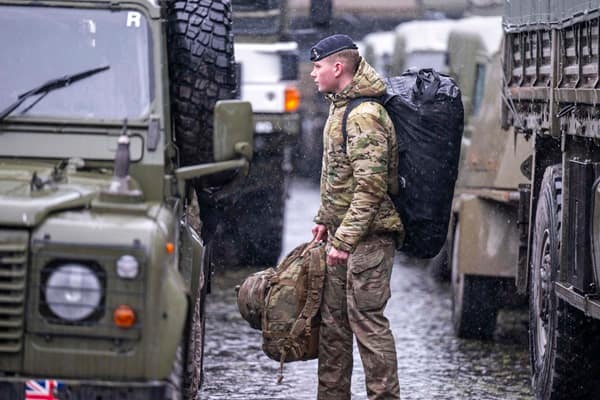
Rishi Sunak has called for a radical overhaul of national service, arguing that Britain must mobilise a new generation of volunteers to defend the country against cyberattacks, foreign sabotage and the growing threat of hybrid warfare.
The former prime minister said the traditional model of compulsory military service would be impractical, but urged the Government to establish a modern “resilience corps” capable of protecting critical infrastructure and supporting communities during national emergencies.
His intervention follows cyberattacks affecting supermarket and food-supply systems across Europe, which left refrigeration units at several British meat suppliers malfunctioning and raised questions about the vulnerability of the country’s essential services.
Read more related news:
‘Give up Donbas to join NATO?’: Zelensky reveals stunning question from Trump’s negotiators
‘High risk of a direct armed conflict’ as RAF spy missions surge after Kremlin’s chilling nuclear warning
Putin talks as if he owns Ukraine and warns Europe that foreign troops is ‘absolutely unacceptable’ to Moscow
Zelensky warns ‘Putin wants to redraw the borders’ in Europe to force NATO out
Writing in The Times, Sunak warned that the public needed to become more conscious of the threats facing Britain, arguing that panic-buying and government advice on keeping emergency supplies at home would not be enough to protect the country.
Instead, he wants a broader national effort to strengthen the infrastructure and skills needed to withstand attacks that can disrupt everyday life without a conventional military confrontation.
“We all need to become more aware of the threats we face,” he said, calling for “some kind of resilience corps” to help protect Britain against hostile activity.
Sunak said the Government should abandon the idea of simply reviving the national service model associated with the Cold War. When he was prime minister, he said, military leaders had warned that the armed forces lacked the capacity to recruit and train more than 800,000 18-year-olds.
“Whenever I raised national service as Prime Minister, the armed forces were quick to stress that this kind of scheme wouldn’t help them,” he said.
“What is actually required is an updated version of national service designed to enhance our resilience, strengthen our society and remind us all that citizenship brings with it responsibilities as well as rights.”
Under his proposal, young people could choose from a range of forms of service rather than being funnelled into the armed forces. A small, selective group could pursue military training, while others would work with search and rescue organisations, St John Ambulance or Meals on Wheels. Some could receive specialist training in cybersecurity.
The proposal is intended to create a wider pool of people able to support the country in a crisis, from digital attacks on essential services to emergencies requiring practical assistance on the ground.
Sunak also presented the scheme as a response to Britain’s growing problem of young people outside education, employment or training. Almost one million young people fall into the NEET category, he said, arguing that a structured programme of national service could offer them skills, discipline and a sense of purpose.
“It would make us more resilient and more cohesive, give the almost one million young people not in education, employment or training a sense of purpose, and remind us all that citizenship brings responsibilities as well as rights,” he said.
The proposal is likely to reopen a politically sensitive debate about the cost of national service and the state of Britain’s armed forces.
Labour dismissed the intervention as an expensive review rather than a workable policy, accusing the Conservatives of weakening the military during their years in government.
A party spokesperson said: “This is not a plan — it’s a review which could cost billions and is only needed because the Tories hollowed out the Armed Forces to their smallest size since Napoleon.”
The argument comes against the backdrop of a series of cyber incidents affecting European food suppliers and retailers. Earlier this month, several British meat businesses reported problems with refrigeration systems after software used by supermarkets and suppliers across Europe was targeted.
The Association of Independent Meat Suppliers said some of its roughly 300 members had “unexpectedly become collateral” in the incident.
In some cases, refrigeration systems began defrosting overnight. One supplier reportedly found that a unit’s temperature had risen to 100C, threatening the safe storage of perishable goods.
Businesses in France, Belgium and Sweden were also affected, suggesting that the disruption extended beyond Britain’s borders.
The incidents illustrate how attacks on digital systems can have consequences far beyond computer networks. A compromised piece of software can disrupt refrigeration, threaten food stocks and expose weaknesses in supply chains that consumers and businesses rely on every day.
They also highlight the challenge facing governments as the distinction between military and civilian security becomes increasingly blurred. Foreign states and hostile actors can potentially cause disruption through cyber operations, sabotage and attacks on infrastructure without deploying conventional forces.
Sunak’s proposal seeks to turn that vulnerability into a broader national preparedness agenda, drawing on civilian organisations and specialist skills as well as military resources.
But questions remain over how such a corps would be funded, organised and recruited, and whether voluntary service could provide the scale of capability required. Labour has already signalled that it regards the proposal as costly and politically motivated.
For Sunak, however, the central argument is that national security can no longer be left solely to the armed forces. In an era when a cyberattack can threaten food supplies as readily as military equipment, he believes resilience must become a responsibility shared across society.


Leave a Comment