
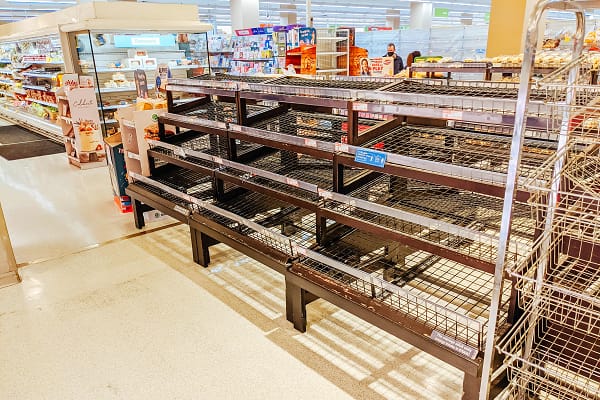
A confidential assessment from Whitehall has warned that Britain could face shortages of chicken, pork, and other supermarket staples within weeks if tensions in the Middle East escalate further.
The assessment, codenamed “Exercise Turnstone” and commissioned by Keir Starmer, examined the potential consequences of a prolonged disruption to the Strait of Hormuz—a critical route for global energy supplies—amid the ongoing conflict involving Iran.
Coordinated through the government’s emergency committee, COBRA, officials modelled a “reasonable worst-case scenario” for June in which the shipping route remains blocked, and no diplomatic breakthrough is achieved.
Central to the concern is a potential collapse in the supply of carbon dioxide (CO2), an often overlooked yet essential component of the UK’s food system.
In the outlined scenario, CO2 availability could fall to just 18% of current levels, triggering widespread disruption across the food supply chain. CO2 plays a crucial role in extending the shelf life of packaged goods, including meat, salads, and baked products.
More critically, it is used in the humane slaughter of nearly all pigs and the majority of chickens in Britain, raising the prospect of severe bottlenecks in meat production.
Officials fear that the impact would first be felt in agriculture and hospitality before spreading to supermarket shelves, resulting in reduced product choice rather than outright shortages. The brewing industry could also be affected since CO2 is essential for carbonation.
The structure of the supply chain compounds the risks. Much of the UK’s CO2 is derived as a by-product of ammonia and fertiliser production, both of which are highly sensitive to gas prices. A simultaneous spike in energy costs and a shutdown at a major domestic plant could therefore create a sudden and severe shortfall.
Healthcare has been identified as the top priority for allocating limited supplies. CO2 is vital for producing dry ice, which is crucial for preserving blood supplies, transplant organs, and vaccines. Disruption in this area could pose direct risks to life and may have knock-on effects on parts of the energy system, including nuclear generation.
Ministers are now preparing contingency plans under the Civil Contingencies Act, which grants sweeping emergency powers. These could include compelling factories to switch production toward CO2, relaxing competition rules to prioritise critical sectors, and fast-tracking emergency legislation within days.
The financial implications are significant, with compensation for affected companies expected to reach tens of millions of pounds. To bolster supply, the government has already confirmed that the Ensus bioethanol plant on Teesside will be restarted for three months. Meanwhile, diplomatic efforts are underway, with Britain co-hosting a summit involving more than 40 countries aimed at reopening the Strait of Hormuz.
Despite the severity of the modelling, officials stress that widespread food shortages are not the central expectation. However, visible disruptions—especially during high-demand periods such as the FIFA World Cup 2026—could dent public confidence and expose the fragility of critical supply chains.


Leave a Comment