
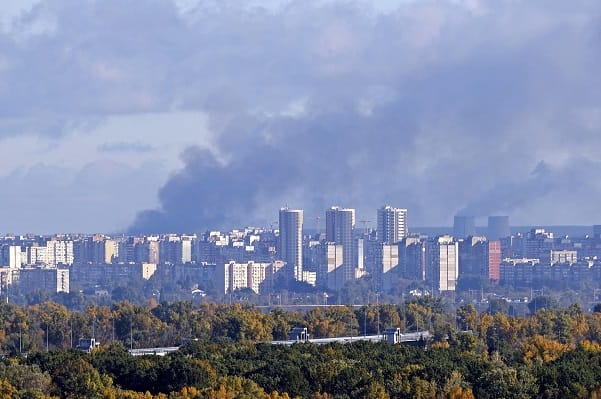
Just days after finding ourselves among the first on the scene of a Russian missile strike less than 1.5 kilometres from our apartment in Kyiv, I returned to Dnipro.
Nothing had changed.
Another night brought another wave of ballistic missiles, cruise missiles and attack drones aimed at Ukrainian cities. Air raid sirens echoed across the city while reports of explosions filtered in from across the country.
💥 Another jet-powered drone has just struck the city of Dnipro this morning. We’ve endured drone attacks throughout the night, with multiple explosions reported across the city.
It has been another long and dangerous night for residents as Russia’s aerial campaign continues.… pic.twitter.com/5x7vl8xsGH
— Shaun Pinner (@ShaunPinnerUA) August 3, 2026
After more than four years of war, this has become routine.
That, perhaps, is the most dangerous development of all.
Russia isn’t conducting an indiscriminate terror campaign. It has adapted its strategy, rather than relying on individual weapons to penetrate Ukraine’s air defences, Moscow now launches combinations of ballistic missiles, cruise missiles, attack drones and decoys in overwhelming numbers, designed to exhaust a finite stock of interceptor missiles before the most dangerous weapons arrive.
The figures from recent attacks illustrate the challenge.
During the overnight assault on 1 August, Russia launched 27 Iskander-M and North Korean KN-23 ballistic missiles, alongside cruise missiles, anti-radiation missiles and 185 attack, reconnaissance and decoy drones. Ukrainian air defences neutralised more than 150 drones, an impressive achievement under extraordinary pressure.
The ballistic missiles told a different story.
Only one of the 27 ballistic missiles was intercepted.
This is not a failure of Ukraine’s air-defence crews, however, it is the consequence of simple arithmetic.
Patriot interceptor missiles remain one of the few systems capable of reliably engaging ballistic threats. They are expensive, difficult to manufacture and available only in limited numbers, unfortunately, Ukrainian commanders therefore face increasingly impossible decisions over which cities receive protection and which must simply hope they are not targeted next.
Russia understands this.
Rather than slowing its missile campaign, Moscow has expanded it while increasingly drawing upon North Korean missile production and stockpiles to sustain the tempo of attacks.
Meanwhile, Western defence industries continue to struggle to manufacture Patriot interceptors quickly enough to replace those being fired.
This industrial imbalance is becoming one of the defining battles of the war with the consequences measured in civilian lives.
According to the United Nations Human Rights Monitoring Mission, civilian casualties during the first half of 2026 increased by 37% compared with the same period last year, with long-range missiles, attack drones and guided aerial bombs responsible for much of that rise.
Those statistics become very different when you are standing in the street moments after a missile has struck.
Being among the first on the scene means checking whether people are trapped beneath collapsed buildings before emergency services arrive. It means hearing eyewitnesses describe neighbours who were inside moments earlier while hoping they escaped. It means recognising that every successful interception prevented another family from suffering the same fate.
If you’re visiting Ukraine and know how to use a tourniquet, carry at least two with you, even if you’re just going to the shops.
You hope you’ll never need them. But if the worst happens, they could save your life or someone else’s.
Don’t be a fool. 🇺🇦 https://t.co/Hzei3FIbhX
— Shaun Pinner (@ShaunPinnerUA) August 2, 2026
This is why the debate surrounding Patriot interceptor missiles matters far beyond military planning.
Political statements suggesting renewed support for Ukraine offer reassurance, but wars are not won by headlines. They are won by industrial capacity, production lines and missiles inside launch canisters when ballistic threats appear on radar.
Today, Russia is exploiting a widening gap between how quickly it can replenish its missile arsenal and how quickly the West can replace the interceptors Ukraine depends upon.
That is the uncomfortable reality facing Ukraine.
The Kremlin has recognised that the country’s greatest vulnerability is no longer manpower along the front line.
It is mathematics.
Unless that equation changes, Russia’s strategy of saturation will continue to place growing pressure on Ukraine’s air defences, while civilians across the country pay the price every night the sirens begin to sound.
And Winter is coming……


Leave a Comment