
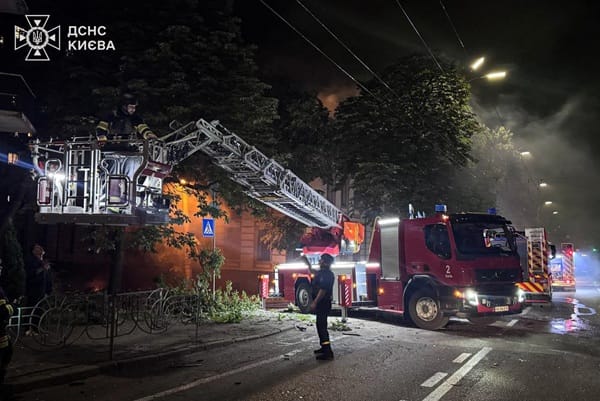
Russia launched one of its most intense aerial assaults on Kyiv in recent months just as Ukraine finds itself navigating an increasingly sensitive political moment at home.
The overnight attack once again demonstrated that the Kremlin’s campaign extends far beyond the front line, targeting not only infrastructure but also public confidence and national resilience.
Beginning shortly after 1:30am, Russia fired a coordinated mix of ballistic missiles, hypersonic Zircon missiles, S-400 missiles and waves of Shahed attack drones, supported by decoy UAVs designed to complicate Ukraine’s air defence response.
The barrage lasted for hours, striking multiple districts across the capital.
According to Ukrainian officials, residential buildings, commercial premises, vehicles and infrastructure were damaged as firefighters battled blazes across the city.
Read more related news:
The Kremlin’s biggest threat is not NATO it’s Ukraine’s ability to adapt
Ukrainian drones smash Moscow oil hub as Russia’s ‘invincible’ defences collapse
Putin to mobilise half-million troops raising fears of escalation as Kyiv’s defence is in crisis mode
Wartime leadership crisis deepens as general Syrskyi’s future hangs by a thread
Putin’s big lie exposed as Russia’s ‘stable’ fuel market exists only on Kremlin TV
Emergency crews rescued residents trapped inside burning buildings while air raid sirens echoed across Kyiv through the night.
Kyiv Mayor Vitali Klitschko and the city’s military administration repeatedly urged residents to remain in shelters as successive waves of missiles approached, highlighting the increasingly complex nature of Russia’s aerial campaign.
Saturation over precision
The latest attack reflects a clear evolution in Russian strategy.
Rather than relying on individual precision strikes, Moscow increasingly combines ballistic missiles, cruise missiles, hypersonic weapons and large numbers of drones in a single coordinated assault. Decoy drones force Ukrainian operators to distinguish genuine threats from false targets while multiple missiles approach simultaneously from different directions.
The objective is not simply destruction.
It is to overwhelm Ukraine’s air defences and steadily deplete valuable interceptor missiles.
Even when Ukrainian forces intercept the majority of incoming threats, only a handful of missiles need to penetrate the defensive shield to inflict damage and maintain pressure on the civilian population. That has become the grim arithmetic behind Russia’s long-range campaign.
The growing strain on interceptor stocks has also intensified discussion among Ukraine’s partners about expanding production capacity. Patriot PAC-3 interceptors remain one of the world’s most sophisticated air defence missiles, yet production struggles to keep pace with rising demand as Europe, the Middle East and the Indo-Pacific all seek to strengthen their own defences.
For Ukraine, every interceptor carries enormous value.
Politics under pressure
The strikes came during an unusually tense period inside Ukraine.
Kyiv has recently witnessed rare public demonstrations following the dismissal of former Defence Minister Mykhailo Fedorov, with thousands gathering despite the continuing threat posed by Russian missile attacks.
At the protests again tonight; significantly more people are here, probably double the turnout from yesterday.
The crowd is angry but well-behaved, as is typical for a Ukrainian protest. pic.twitter.com/Udr9qRQwzY
— Jimmy Rushton (@JimmySecUK) July 17, 2026
There is no evidence that Russia specifically targeted those demonstrations, and it would be irresponsible to suggest otherwise.
However, Russia has consistently shown throughout the full-scale invasion that it is willing to strike civilian areas regardless of who happens to be there. Apartment blocks, shopping centres, railway stations, hospitals and city centres have all been repeatedly targeted.
That reality alone raises understandable concerns whenever large crowds gather in the capital during periods of intensified bombardment.
Ukraine’s democracy remains one of the clearest distinctions between Kyiv and Moscow. Ukrainians continue to openly criticise political decisions, protest government policies and exercise democratic rights despite living under the constant threat of missile attack.
Yet those same freedoms inevitably carry additional security risks during wartime.
Information warfare follows the missiles
While emergency crews were still responding across Kyiv, attention quickly shifted to Ukrainian drone strikes against Wildberries logistics facilities inside Russia.
President Volodymyr Zelensky said the warehouses were being used to supply sanctioned components supporting Russia’s military production. If civilian infrastructure becomes integrated into military logistics, it occupies a more complicated legal and operational position than purely civilian facilities.
That distinction has often been absent from online debate.
Throughout the war Russia has repeatedly targeted Nova Poshta depots, fuel stations, commercial warehouses and civilian logistics infrastructure across Ukraine with little apparent distinction between civilian and economic targets.
Against that backdrop, selective outrage over similar facilities inside Russia inevitably raises questions about consistency.
The information battle quickly followed the military one.
Overnight, Russia carried out one of its largest ballistic missile attacks on Kyiv. The enemy launched more than 40 missiles of various types – most of them against the capital – and 120 attack drones.
As of now, one person has been reported killed in Kyiv and the region, and 16… pic.twitter.com/YMWDlB6wGA
— Volodymyr Zelenskyy / Володимир Зеленський (@ZelenskyyUa) July 19, 2026
Pro-Kremlin commentators portrayed the Wildberries strikes as attacks on civilians while omitting years of Russian attacks on Ukrainian commercial infrastructure. Such messaging demonstrates how modern information warfare frequently relies less on outright falsehoods than on carefully removing context to shape public perception.
Narratives now spread almost as rapidly as missiles.
Beyond the battlefield
Having experienced Russian propaganda firsthand during my own captivity in occupied Donetsk, I have seen how information operations form part of a much broader campaign alongside military action. Controlling the narrative remains a strategic objective long after the explosions have stopped.
The overnight assault on Kyiv served as another reminder that this war is no longer fought solely across trenches or along the front line.
It is fought above Ukraine’s cities, against critical infrastructure, across international media and increasingly within the battle for public confidence itself.
As Ukraine enters what could prove to be another pivotal phase of the war, maintaining resilience will be as important as military capability. Russia continues seeking opportunities to create uncertainty through missile strikes, psychological pressure and information operations.
There is no evidence that the latest attack was linked to Kyiv’s recent political demonstrations. But Moscow has repeatedly demonstrated that it is prepared to exploit instability wherever opportunities emerge.
In today’s war, the battlefield extends well beyond the map. It also encompasses public confidence, democratic resilience and the contest to shape tomorrow’s narrative before the world has fully understood today’s events.


Leave a Comment