
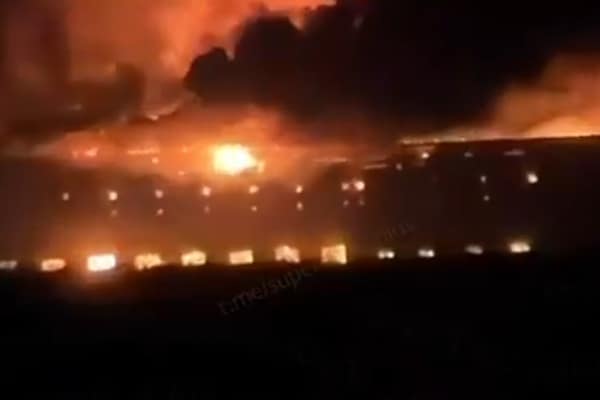
Ukraine has widened its campaign against Russia’s economic and logistical infrastructure, striking at least three Ozon logistics centres and several other facilities across southern Russia and occupied Crimea in a third consecutive night of attacks on the e-commerce giant.
The overnight strikes on August 23-24 came as Ukraine marked its 35th Independence Day, underlining Kyiv’s increasingly ambitious effort to carry the war deep behind Russia’s front lines.
A facility belonging to home goods retailer Kuchenland in Krasnodar caught fire during the attacks, according to the independent Russian Telegram channel Astra.
Veniamin Kondratyev, governor of Krasnodar Krai, said falling drone debris struck a childcare centre, killing two children and injuring seven others and two adults. Debris also hit residential buildings and apartment blocks under construction, while warehouse facilities caught fire.
The reports could not be independently verified.
The strikes extended hundreds of kilometres into Russian territory. Krasnodar lies about 250km from occupied Berdiansk and roughly 365km from Ukrainian-held territory near Orikhiv, illustrating the geographical reach of Ukraine’s long-range drone campaign.
💥🔥 Russia’s logistics network is taking another hammering.
Warehouses belonging to Ozon are under attack and burning in the Stavropol and Krasnodar regions overnight.
That follows Ozon facilities hit in Samara and Orenburg over the previous two day 🇺🇦 pic.twitter.com/5OeSoG72ku
— Shaun Pinner (@ShaunPinnerUA) August 24, 2026
An Ozon logistics centre near Enem in the Adygea Republic was also reportedly hit, while another Ozon hub in Nevinnomyssk, Stavropol Krai, caught fire after a reported drone strike.
Vladimir Vladimirov, governor of Stavropol Krai, confirmed that drones had targeted the industrial zone around Nevinnomyssk and said Russian air defences had intercepted some of them, without identifying the facilities affected.
A third Ozon site in Tyube, Dagestan, was reportedly engulfed in flames.
In occupied Crimea, a radar tracking facility also caught fire following four strikes, according to the pro-Ukrainian Telegram channel Crimean Wind.
None of the individual reports could be independently verified.
The attacks nevertheless form part of a sustained campaign rather than an isolated overnight raid.
Ozon logistics centres in Samara Oblast were struck on August 22, while another facility in Orenburg was reportedly hit the following night.
The campaign has increasingly focused on Russia’s vast e-commerce infrastructure, with Wildberries, the country’s largest online retailer, previously coming under sustained attack.
Ukrainian forces said on August 16 that operations had disabled seven of Wildberries’ 10 largest logistics centres. Kyiv has accused the company of supplying components to Russia’s military, although the extent of any direct military role is disputed.
Ozon and Wildberries dominate Russia’s rapidly expanding online retail market and have effectively become the country’s Amazon-scale logistics networks.
BREAKING:
Ukrainian long-range drones just struck another 4 Russian logistics centers:
– A 130 000 sqm Ozon logistics center in Dagestan is engulfed in flames
– A 100 000 sqm Ozon logistics center near Stavropol has been hit
– A 100 000 sqm Ozon logistics center near… pic.twitter.com/1SP3QVp7gk
— Visegrád 24 (@visegrad24) August 24, 2026
Their warehouses represent attractive targets because disrupting them can create consequences far beyond a single military installation: supply chains are interrupted, inventory destroyed and transport networks forced to absorb the shock.
The strategic calculation is increasingly visible.
Rather than concentrating exclusively on Russian military bases and oil infrastructure, Ukraine is targeting the commercial arteries that keep the Russian economy moving.
For Moscow, the attacks present a more complicated defence problem. Logistics centres are dispersed across a vast territory and are generally designed for commercial distribution rather than military protection.
The result is a campaign in which Ukraine is forcing Russia to defend an ever-expanding list of targets — from refineries and rail infrastructure to warehouses and retail distribution hubs.
And the repeated targeting of Ozon suggests Kyiv is not merely seeking spectacular individual strikes.
It is testing whether sustained pressure on Russia’s commercial logistics network can impose a cumulative economic and operational cost on the Kremlin’s war machine.


Leave a Comment