
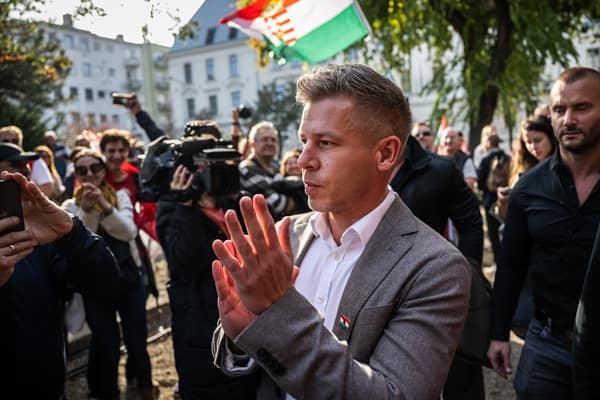
Hungary’s opposition leader Péter Magyar has set out a cautious foreign policy position on Ukraine and Russia, saying Kyiv should determine the terms of any peace settlement while warning against accelerating Ukraine’s path to European Union membership.
He told reporters: “No one should tell Ukraine under what conditions it must enter peace or sign a peace treaty.
“We cannot ask any country to give up its territory. If they do, they would be considered traitors.”
In remarks on Monday, Magyar acknowledged that Ukraine is the victim of the war with Russia, but said he would not support fast-tracking its accession to the EU while the conflict continues.
His comments mark a departure from the prevailing position among many European leaders, who have backed Ukraine’s long-term integration into the bloc as part of its post-war reconstruction and geopolitical alignment away from Moscow.
Magyar also addressed his approach to diplomacy with Russia, saying that while he would not seek contact with President Vladimir Putin, he would not refuse a call if one were made.
“If Vladimir Putin calls me, I will pick up the phone,” Magyar said.
“I will not call him myself, but if we do talk, I can tell him to please stop the killing now, after four years.”
On energy policy, he signalled continuity with Hungary’s current pragmatic approach, stating that his government would aim to diversify energy supplies but stop short of fully severing ties with Russian imports.
Hungary remains one of the most Moscow-dependent EU states for energy, a position that has repeatedly placed it at odds with other European capitals seeking to reduce reliance on Russian oil and gas since the start of the war in Ukraine.
Magyar’s comments are likely to feed into ongoing debates within the European Union over enlargement strategy, energy security, and the bloc’s long-term approach to Russia, particularly as divisions persist among member states over the pace and scope of policy towards Kyiv.
“It is absolutely absurd for a country at war to be admitted to the European Union,” he said.
The remarks also underscore the balancing act facing Central European governments, which must weigh domestic energy costs and security considerations against broader EU political alignment on Ukraine and sanctions policy.
“Russia stays here, Hungary stays here,” he said. “We will always get oil as cheaply and safely as possible.”


Leave a Comment