
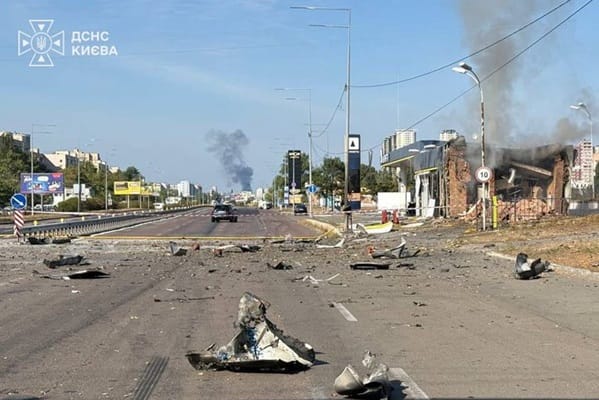
Russia is increasingly extending its war against Ukraine beyond the battlefield, targeting the civilian infrastructure that keeps the country functioning while preparing the manpower and military capacity needed to sustain pressure on the front.
In recent days, Russian strikes have hit passenger trains, petrol stations, shops, residential buildings, civilian vehicles and energy infrastructure, while Moscow’s drone campaign has expanded into western Ukraine, hundreds of kilometres from the main fighting.
On September 12, Russian attacks killed at least nine people and wounded dozens, according to Ukrainian authorities. President Volodymyr Zelensky said Russia had launched almost 500 drones during the day.
Putin’s battlefield fantasy cracks as Ukraine retakes ground around Lyman
Three civilians were killed in separate attacks on private cars in Kramatorsk within about 90 minutes. A grocery store in the Zhytomyr region was also struck, killing two people, while petrol stations came under attack. Odesa suffered another major bombardment, with about 40 people reported injured.
The attacks have increasingly focused on infrastructure used by ordinary Ukrainians. Petrol stations, supermarkets and transport networks are not merely economic assets: they are essential to maintaining civilian life and sustaining the wider war effort.
Ukraine’s railway system is under growing pressure. Ukrainian Railways, known as Ukrzaliznytsia, has identified Kharkiv, Sumy, Dnipropetrovsk, Zaporizhzhia, Mykolaiv and Odesa as the regions where trains are attacked most frequently. Analysis of 363 trains between August 21 and September 9 found widespread disruption, although the company has continued to operate long-distance services.
Another terrorist act as a Russian drone struck a passenger train at Lutsk railway station in western Ukraine, approximately 650 kilometres (400 miles) from the nearest active frontline in northern Sumy Oblast and more than 800 kilometres from the Donbas front.
Passengers were… pic.twitter.com/Tv4QYQRDUU
— Shaun Pinner (@ShaunPinnerUA) September 12, 2026
A Russian drone subsequently struck a passenger train in Lutsk after passengers had been evacuated. The wider attack targeted Volyn and Rivne, regions bordering Belarus and Poland and far removed from the eastern battlefield.
More than 10 drones entered Volyn during an attack lasting more than four hours, while Rivne suffered power outages.
The geography matters. Lutsk lies roughly 650–700km from active fighting in Donetsk and about 500km from the nearest active northern fighting in Sumy, illustrating how Russia’s drone campaign is eroding the distinction between Ukraine’s frontline and rear.
I keep saying, Putin’s terrorism is now in the open, attacking women and children, no plausible deniability, no longer under the cover of darkness, just straight out terrorism.
He is killing anybody and anyone. 🇺🇦 pic.twitter.com/y3gKy055S8
— Shaun Pinner (@ShaunPinnerUA) September 13, 2026
Zelensky said Moscow was expanding the war away from the frontline, “where they have no success,” and targeting the economy and infrastructure required to sustain Ukrainian society.
At the same time, Kyiv is preparing for the possibility that Russia could generate additional military capacity along its northern frontier.
Ukrainian intelligence says Moscow intends to recruit at least 18,500 foreign nationals during 2026, while about 8,000 North Korean troops are currently in Russia’s Kursk region. Kyiv believes that figure could eventually approach 50,000. More than 28,000 foreign fighters have been recruited by Russia overall, according to Ukrainian intelligence.
Ukrainian officials also say Russia has prepared options for mobilising another 600,000 personnel — 300,000 in 2026 and a further 300,000 in 2027 — including training some troops in Belarus.
Based on the indicators we are seeing, Russia is likely preparing the operational environment for a renewed offensive, potentially this winter if conditions remain favourable, but more probably by spring.
The increased targeting of critical civilian infrastructure, fuel… https://t.co/HNeIlbFiR4
— Shaun Pinner (@ShaunPinnerUA) September 12, 2026
There is no public evidence that a new mobilisation has been ordered or that a major Russian ground offensive from Belarus is imminent. But the preparations would give Moscow additional options at a critical stage of the war.
The pressure is already visible in Russia’s casualty figures. Ukraine’s General Staff recorded more than 42,000 Russian casualties in both July and August, while British Chief of the Defence Staff Air Chief Marshal Sir Richard Knighton has estimated Russia’s total casualties at about 1.5mn, including more than 500,000 killed.
The Kremlin has sought to maintain the appearance of battlefield momentum despite the cost. Putin recently claimed Russian forces controlled Sviatohirsk, near Lyman, only for Ukrainian troops to demonstrate their presence there.
Even Russian military bloggers have criticised what they describe as a culture of sending “beautiful reports” up the chain of command.
That does not mean Russia is collapsing. Moscow retains substantial manpower, missile and drone production and the ability to inflict severe damage across Ukraine.
But the emerging strategy is increasingly stark: sustain pressure on the front while attacking the infrastructure behind it, regenerate forces through foreign recruitment and potentially mobilisation, and keep Ukrainian society under constant pressure.
With winter approaching, the consequences could become more severe.
The war is no longer confined to trenches and contested towns in the east. Russia is increasingly testing Ukraine’s ability to move people, maintain power, obtain fuel and keep its economy functioning.
The objective, in other words, is not simply to defeat Ukraine’s army.
It is to make the country itself harder to live in.


Leave a Comment