
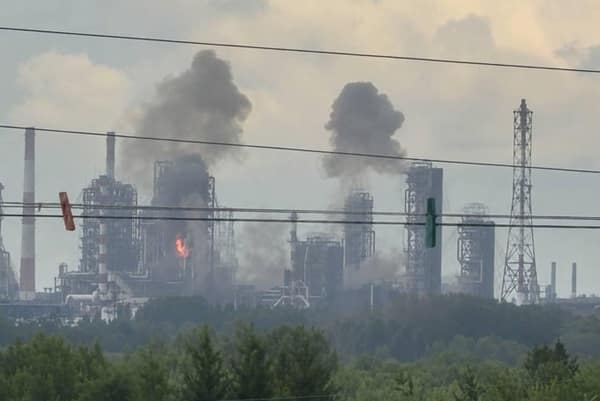
Ukraine has once again demonstrated that distance is no longer a guarantee of safety for Russia’s strategic infrastructure.
A Ukrainian long-range strike has reportedly targeted the Omsk Oil Refinery, Russia’s largest oil refinery and one of the biggest in Europe, marking another milestone in Kyiv’s expanding campaign against Moscow’s energy sector.
While the full extent of the damage remains to be independently verified, the strategic significance is already clear.
Owned by Gazprom Neft, the Omsk refinery processes approximately 22 million tonnes of crude oil annually, equivalent to around 440,000 barrels per day, accounting for almost 9% of Russia’s total refining capacity. Producing petrol, diesel, aviation fuel and other refined petroleum products, it plays a vital role in supporting both Russia’s civilian economy and its military logistics.
Located deep in Siberia, thousands of kilometres from Ukraine, Omsk had long been viewed as beyond the reach of Ukrainian strikes.
That assumption no longer holds.
The attack comes amid mounting pressure on Russia’s energy infrastructure. Over the past eighteen months, Ukraine has steadily expanded its long-range drone campaign, striking refineries, fuel depots, pumping stations and logistics hubs across Russia.
Well, it was inevitable, and it happened.
Time and again, Russia brings down another Ukrainian apartment building with a missile in the middle of the night, burying entire families beneath the rubble.
Ukraine strikes one of Russia’s largest and most strategically important oil… pic.twitter.com/1lJvBlE4pM
— Shaun Pinner (@ShaunPinnerUA) July 6, 2026
Each individual strike may appear manageable in isolation, but together they are steadily increasing pressure on Moscow’s fuel distribution network while forcing the Kremlin into an increasingly reactive posture.
Every refinery temporarily taken offline reduces refining capacity, complicates logistics and forces Russia to redistribute fuel supplies across the world’s largest country. Maintenance schedules are disrupted, exports become harder to guarantee and regional fuel shortages have become increasingly difficult to conceal.
Russia continues producing crude oil.
The growing challenge is refining it, transporting it and delivering sufficient quantities to sustain military operations while maintaining domestic supply.
For armed forces consuming vast quantities of diesel, aviation fuel and lubricants every day, those pressures matter.
Yet while Ukraine continues demonstrating remarkable innovation in offensive operations, the imbalance in defensive capability remains equally striking.
Almost every week Russia launches another large-scale missile and drone assault against Ukrainian cities, targeting apartment buildings, hospitals, railway infrastructure and power stations using combinations of ballistic missiles, cruise missiles and hundreds of attack drones.
Intercepting many of those threats increasingly depends upon one system above all others — the Patriot.
Its PAC-3 interceptors remain among the few proven systems capable of defeating advanced ballistic missile threats, including Russia’s Iskander-M missiles.
Ukraine has repeatedly demonstrated exceptional proficiency operating Patriot batteries.
The limitation has never been Ukrainian capability.
It has been availability.
Every Patriot engagement not only protects Ukrainian civilians but also provides the United States and NATO with invaluable operational intelligence. Every intercepted ballistic missile generates real-world combat data on Russian missile performance, flight characteristics, electronic signatures and guidance systems under battlefield conditions that cannot be replicated during peacetime testing.
Ukraine is no longer simply receiving Western military assistance.
It has become one of NATO’s most valuable sources of operational intelligence on Russian military technology.
That raises a broader strategic question.
Rather than continuing to debate how many Patriot interceptors can be transferred, should Ukraine now be licensed to manufacture elements of the Patriot system itself?
Such a move would represent a significant shift in Western defence policy.
Technology transfer involving one of America’s most advanced missile-defence systems has always been politically sensitive. Yet Ukraine has already demonstrated an ability to manufacture increasingly sophisticated drones, missiles, electronic warfare systems and battlefield technologies while adapting Western equipment under constant combat conditions.
The industrial capability increasingly appears to exist.
The greater challenge may be political.
The debate comes as NATO leaders gather in Turkey, where President Donald Trump is expected to meet Ukrainian President Volodymyr Zelensky amid renewed discussions over Europe’s long-term security and future military support for Ukraine.
The Trump administration has adopted a more cautious approach towards assistance to Kyiv than many European allies, while continuing to argue that Europe must assume greater responsibility for its own defence.
That could, however, create an unexpected opportunity.
If European defence is to become more self-reliant, enabling Ukraine to manufacture advanced air-defence systems under licence could strengthen both Ukraine and NATO while simultaneously benefiting the United States through increased defence production, licensing revenue and expanded industrial capacity.
For an administration that places considerable emphasis on burden-sharing and strengthening American industry, such a proposal may prove more attractive than continually drawing down finite US interceptor stockpiles.
Rather than viewing Ukraine solely as a recipient of military aid, NATO increasingly has an opportunity to view it as an integral part of Europe’s future defence-industrial base.
That would represent a strategic setback for the Kremlin far greater than another refinery fire.
The strike on Omsk is therefore about far more than damage to one refinery.
It illustrates how this war is becoming a contest of industrial endurance, technological innovation and manufacturing capacity as much as battlefield manoeuvre.
Ukraine has already demonstrated it can strike deep inside Russia.
The question now facing NATO is whether it is prepared to invest with equal ambition in Ukraine’s ability to defend Europe for the decades ahead.


Leave a Comment