
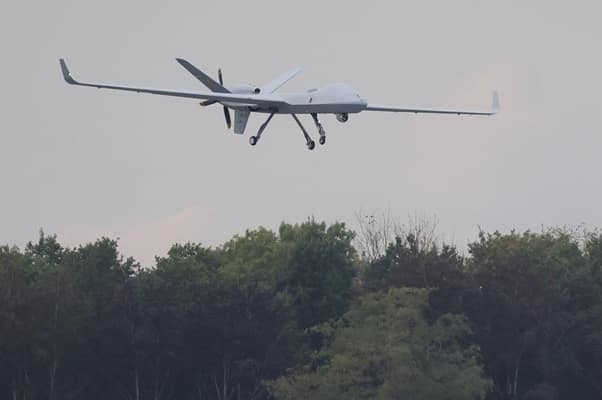
The Ministry of Defence told Parliament that an RAF surveillance drone that flew over the English Channel on 14 October was operating in support of defence objectives rather than assisting the Home Office.
Louise Sandher-Jones, Minister for the Armed Forces, clarified this in response to Conservative MP Ben Obese-Jecty, who asked why an RAF Protector RG-1 had been tasked to support the Home Office in the Channel on that date.
“The deployment the hon. Member refers to was conducted in support of Defence aims, not in support of the Home Office,” Sandher-Jones said.
She added that the Ministry of Defence “regularly and routinely monitors our waters to protect UK interests, contribute to domestic maritime security, and act as a deterrent against potentially malign activities”.
Read more related news:
‘Brace for battle’: British and French troops unite in major NATO drill against drone warfare
‘Root causes’: Putin reaches for the same old excuse to demand more from NATO
Brits told ‘our nation is going to need you’ as Britain prepares for war and the ‘unthinkable’
Brits warned ‘we have a little over 1,000 days’ to prepare for war with Russia
The answer distinguishes the RAF’s military activity over the Channel from a separate surveillance programme the Home Office commissioned to monitor small-boat crossings, UK Defence Journal reported.
The Protector RG-1 is Britain’s version of the General Atomics MQ-9B SkyGuardian. The UK has ordered 16 aircraft to replace its MQ-9A Reaper fleet, which was retired after two decades of operations over Afghanistan, Iraq and Syria.
With a wingspan of about 24 metres, an endurance of over 30 hours, and a maximum operating altitude above 40,000 feet, the Protector combines long-range surveillance with the ability to carry precision weapons, including Brimstone 3 missiles and Paveway IV bombs.
Its equipment includes electro-optical and infrared sensors and a maritime search radar, allowing it to monitor activity over land and sea.
The aircraft is also designed to operate in ordinary airspace alongside civilian traffic. Its NATO-standard airworthiness certification, detect-and-avoid system, lightning protection and de-icing equipment distinguish it from the Reaper, which required segregated airspace or designated danger areas for domestic sorties.
The RAF’s Protector fleet is based at RAF Waddington in Lincolnshire, where 31 Squadron operates the aircraft through ground control stations.
The Home Office has separately contracted commercial operators to conduct surveillance of small-boat crossings in the Channel.
Portugal-based Tekever has operated its AR5 maritime surveillance aircraft over the area since 2020 under Home Office contracts. The wider framework has been reported as worth up to £1bn and has been renewed repeatedly.
The twin-engine AR5 can stay airborne for more than 12 hours and carries maritime and synthetic aperture radars, day-and-night cameras, and receivers that can identify vessels and detect distress beacons.
Paul Webb, managing director of Tekever UK, has argued that the technology can also support rescue operations.
“Drones can identify humans in distress in a much faster way and help rescue teams,” he has said.
Tekever has since supplied the same system to the Portuguese government and expanded its uncrewed-aircraft business into Ukraine.
The minister’s parliamentary answer does not establish what specific activity the Protector conducted on 14 October. It does, however, make clear that the Ministry of Defence classified the deployment as supporting defence objectives, rather than as a Home Office tasking to monitor small-boat crossings.


Leave a Comment