
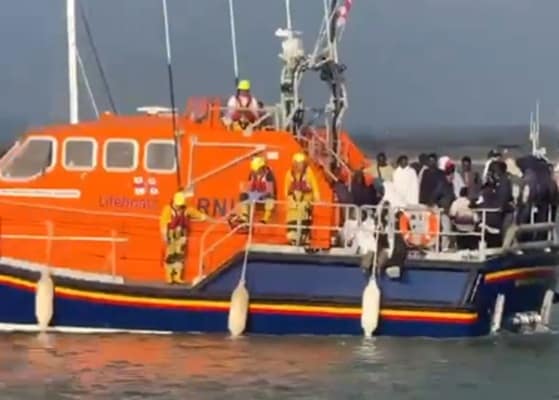
Britain’s Border Force chief has warned that a mass-casualty disaster in the English Channel is “only a matter of time”, as thousands of migrants gather along the French coast and people-smuggling networks turn to increasingly dangerous crossing routes.
Major General Duncan Capps told MPs that about 3,800 migrants were currently spread across makeshift camps near Dunkirk and Calais, roughly double the number normally present, according to French estimates. The growing concentration of people, combined with increasingly crowded boats and changing launch points, has heightened concerns over the risk of a deadly incident.
“It is only a matter of time till we have a mass casualty event in the Channel,” Maj Gen Capps told the Home Affairs select committee. “It is extraordinary that it hasn’t happened so far.”
His warning comes as French police pressure on established departure beaches has forced smuggling networks to adapt, pushing some crossings towards more remote stretches of coastline and longer journeys across open water.
The border chief said officers had encountered a boat carrying 230 people this year, a striking illustration of the numbers being crammed into vessels attempting the crossing.
The danger, he warned, could become acute as winter approaches.
“If people try that in the winter, we are going to have loss of life,” he said, describing the prospect as his foremost concern.
Smugglers move to more dangerous routes
Increased police patrols along French beaches have significantly reduced launches from traditional departure points, according to Maj Gen Capps. But the pressure has not eliminated the operations: instead, smugglers have shifted towards alternative locations, including Belgium and Normandy.
The latter can involve a journey of nearly 60 nautical miles, extending the time passengers spend exposed to the elements in small, often overcrowded inflatable boats.
The shift presents a difficult challenge for authorities on both sides of the Channel. Preventing launches from familiar beaches may disrupt smuggling networks, but moving departures further along the coast can create new surveillance and rescue demands.
Maj Gen Capps described one recent rescue in which British Border Force officers worked alongside French counterparts to save 168 people from a single vessel in French waters. Nobody drowned in the operation, which he called “quite an extraordinary thing”.
The warning is underscored by the toll of previous crossings. More than 50 people died attempting to cross the Channel in 2024, according to French coastguard records, making it the deadliest year since the crisis began.
The prospect of a larger tragedy now hangs over operations involving vessels carrying hundreds of people, particularly if deteriorating winter conditions make rescue efforts more difficult.
Just 5 per cent of arrivals returned
The committee hearing also exposed the scale of the challenge facing the government in removing people who arrive in Britain by small boat.
Since crossings began, only about 5 per cent of arrivals — fewer than 7,000 people — have been returned, Maj Gen Capps said.
He attributed the difficulty partly to the absence of formal returns agreements with many countries of origin, leaving the authorities with limited options for arranging removals through conventional channels.
The now-closed one-in-one-out arrangement with France had made a “big difference”, he said, because it enabled Britain to return people from countries including Afghanistan, Iran, Yemen and Somalia in circumstances where removals had previously been more difficult.
Maj Gen Capps suggested that participation in a wider European returns agreement could improve the government’s ability to remove people who have arrived irregularly. He also indicated that the Home Office might revisit the idea of establishing returns hubs overseas.
The figures highlight the gap between the effort required to intercept crossings and the difficulty of reversing them once people have reached British territory.
Government insists its strategy is working
The warning comes as ministers defend their approach to tackling small-boat crossings and people-smuggling gangs.
Andy Burnham has argued that crossings are falling significantly year on year, telling GB News: “The numbers can fluctuate but overall boat crossings are down, down quite significantly year on year. So that does suggest that the plan is working.”
The prime minister has vowed to intensify action against the criminal networks organising the journeys.
“We will now change our tactics and we will be relentless in chasing them down,” he told GB News.
The government has also defended its £662mn agreement with France, which links payments to results. Burnham said the deal had helped increase enforcement on the French side of the Channel, arguing that there was more law enforcement in place in summer 2026 than during the previous summer.
But he acknowledged that the current results remained insufficient, saying: “That’s not good enough.”
The prime minister has similarly conceded that more work is required to restore control of the border, describing it as a public priority.
“The public wants to see control being exerted, and while we’ve made progress, there is more to do, and I recognise that completely,” he said.
For Border Force, the immediate concern is more urgent than the political debate over targets and returns. With thousands of people gathered in northern France, smugglers shifting departure points and boats carrying ever larger numbers, the margin for error in the Channel remains dangerously narrow.
Maj Gen Capps’s warning is not a prediction of a specific disaster on a specific date. It is a stark assessment of the risks facing an increasingly hazardous crossing — and of the consequences if overcrowded vessels encounter severe weather before rescue teams can reach them.


Leave a Comment