
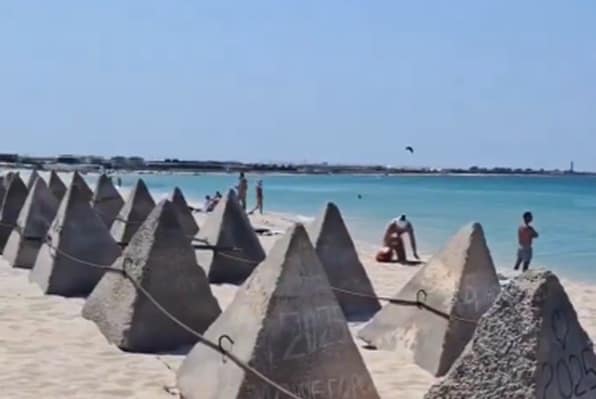
The image of Crimea as an untouchable Russian stronghold is facing its most serious challenge since Moscow annexed the peninsula in 2014.
Following weeks of increasingly intense Ukrainian strikes against fuel depots, energy infrastructure, air-defence systems and transport links, Russian-installed authorities have been forced to introduce emergency measures that would once have been unthinkable.
Civilian fuel sales have reportedly been suspended, electricity consumption is being restricted and parts of the peninsula have experienced power outages following attacks on energy infrastructure.
Read more related news:
Crimea plunged into darkness as strikes takes out energy grid
Ukraine’s ‘borscht recipe’ to cook Crimea into wasteland
Zelensky gives Belarus one week to switch off Putin’s drones or we will
Explosions rock Kerch sea port as Kyiv has just kicked in Putin’s front door
Taken together, the measures represent a striking admission that Crimea’s logistical resilience is under growing strain.
For much of the war, Crimea functioned as Russia’s secure rear area — a heavily defended hub supporting military operations across southern Ukraine. Protected by the Kerch Bridge, extensive air-defence networks and its distance from the front line, the peninsula was widely viewed as one of Moscow’s safest strategic assets.
That assumption is increasingly being tested.
⚡️ Following overnight Ukrainian drone strikes, a massive traffic jam formed at the exit from occupied Crimea via the Kerch Bridge.
Reports indicate that around 650 vehicles were stuck in line.
Glory to Ukraine. 🇺🇦
Please keep our Armed Forces of Ukraine in your prayers as… pic.twitter.com/r9NebZmMCM
— zharynka (@tak_ya_anna) June 21, 2026
Rather than attempting a costly direct assault on Crimea, Ukraine appears focused on a strategy of isolation. The objective is not necessarily immediate liberation through military breakthrough, but the gradual degradation of Russia’s ability to supply, defend and administer the territory.
Recent strikes have targeted infrastructure on both sides of the Kerch Strait, including fuel terminals, transport facilities and air-defence assets. The cumulative impact is becoming more difficult for Russian authorities to conceal.
The suspension of civilian fuel sales is particularly significant. Fuel is not merely an economic commodity in wartime; it is the foundation of military mobility, logistics and civil administration. Any prolonged disruption raises difficult questions about Russia’s ability to balance military requirements with civilian needs.
The pressure extends beyond fuel. Appeals from occupation officials for residents to reduce electricity consumption suggest concern about the stability of parts of the peninsula’s energy system. While emergency repairs continue, the requests themselves illustrate a growing vulnerability.
Whether these developments ultimately lead to the return of Crimea to Ukrainian control remains uncertain. Russia retains substantial military forces on the peninsula and continues to view Crimea as central to both its strategic position and political legitimacy.
Rybar outlines the 3 phase plan for Ukraine to blockade Crimea
1. Stopping shipping in the Black Sea
2. Eliminating fuel reserves in Crimea
3. Disrupting logistics along the land corridor pic.twitter.com/lb6g73Ob4k— Preston Stewart (@prestonstew_) June 21, 2026
However, what appears increasingly clear is that Crimea can no longer be considered insulated from the war.
The conflict is reaching deeper into the peninsula’s infrastructure, economy and daily life. For Moscow, that presents an uncomfortable reality: holding Crimea is becoming more expensive, more complicated and more vulnerable to disruption than at any point since the invasion began.
The strategic contest for Crimea may not be decided by a single military offensive. It could instead be determined by a longer struggle over logistics, energy and the ability of each side to sustain pressure.
What was once presented as Russia’s most secure territorial gain is now becoming one of its most exposed vulnerabilities.


Leave a Comment