
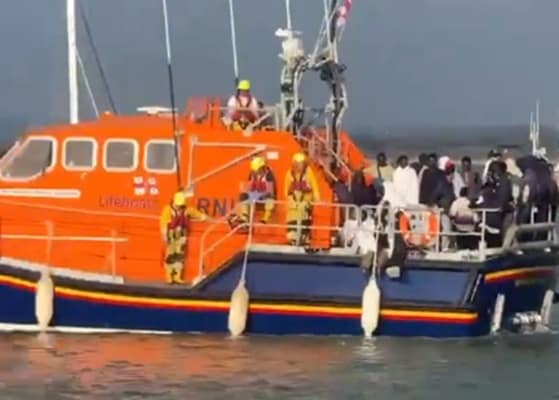
Britain’s handling of Channel migration has come under renewed political scrutiny after government figures revealed that almost 1,000 hijabs were distributed to asylum seekers in the first six months of this year, highlighting the expanding welfare infrastructure surrounding arrivals who cross the Channel in small boats.
Home Office figures obtained by the Daily Mail show that 974 Muslim headscarves were handed out between January and June — equivalent to roughly 162 a month.
If that rate continued, the annual total would approach 2,000, turning what might ordinarily appear a minor welfare provision into another flashpoint in the increasingly bitter debate over the cost and management of irregular migration.
The Home Office said the provision formed part of its legal obligations to people held in short-term facilities. Under the Short-term Holding Facility Rules, officials must provide basic clothing where necessary, while accommodating cultural and religious requirements “so far as is practicable”.
Read more related news:
Gosport on a knife edge: Hampshire police under fire as migrants ‘get more protection than the King’
Brutal ‘insult to hard-working taxpayers’ as migrant households claim record £11.9bn in benefits
Labour’s migration headache deepens as Iranian small-boat arrivals face terror charges
Burnham government loses its grip as a small migrant boat shifts West
A Home Office source said: “All arrivals receive a basic dry clothing pack where required. The items available form part of standard welfare arrangements.”
The figures have nevertheless provoked an angry political response, particularly from Reform UK, which has made reducing irregular migration central to its political platform.
Andrew Rosindell, the Reform MP, told GB News: “I don’t know why we should be giving these people anything.
“They’re coming in illegally, and if they’re coming in illegally, we shouldn’t be incentivising people by making them feel like they’re getting everything given to them on a plate.
“You couldn’t make it up. The British state is acting in a way that is encouraging people to come to this country.
“Don’t they realise that British people have had enough? They don’t want all these people coming to this country illegally.”
Chris Philp, the shadow home secretary, went further, arguing that ministers should immediately end the provision of religious clothing.
“The Government must stop handing out hijabs to illegal immigrants immediately,” he told the Mail.
“It’s an insult to hard-working British taxpayers that they’re funding religious items for people who have broken into our country. It should not be for us to fund someone else’s religious practices.”
Philp also linked the issue to the wider argument over Britain’s ability to remove people whose asylum claims fail, calling for withdrawal from the European Convention on Human Rights.
“Many illegal immigrants actually hate our values. Many come here for free accommodation and a life on benefits at our expense,” he said.
The clothing figures have also become part of a broader argument over the demographic profile of Channel arrivals. More than 10,000 male clothing packs were distributed, compared with 2,670 for women, 773 for boys and 829 for girls.
The figures suggest that men represent a substantial proportion of those arriving through the Channel route, challenging political claims that irregular migration is predominantly driven by women and children.
Almost 20,000 people have crossed the Channel in small boats so far this year, although the government stressed that the number is 42 per cent lower than during the same period in 2025.
“We have made progress tackling the small boats. Crossings are down significantly,” a Home Office spokesman said.
“We have just recorded the fewest summer arrivals since 2020.”
For ministers, the decline offers evidence that enforcement measures are beginning to have an effect. But the continuing arrival of thousands of people, combined with the costs of accommodation, processing and basic welfare, ensures that migration remains one of the most politically combustible issues facing the government.
The dispute over hijabs is therefore less about the cost of a headscarf than what it represents: a state increasingly required to provide for people who have entered the country through an irregular route, while taxpayers and politicians argue over where the obligations of government should end.
With Channel arrivals continuing despite the fall in numbers, that argument is unlikely to disappear with the summer.




Leave a Comment