
For much of the world, Kherson has disappeared from the headlines, but for those still living there, every trip to buy bread, collect water or open a market stall can become a fight for survival.
This week, the world watched footage that should have led every international news bulletin.
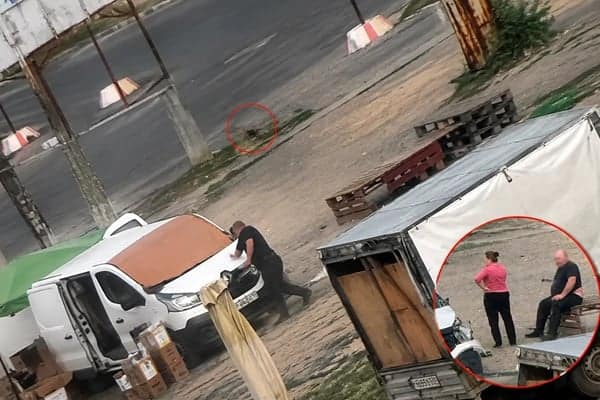
A 52-year-old fruit seller was stalked through the streets of Kherson by a Russian first-person-view (FPV) drone.
As terrified shoppers scattered, the drone repeatedly circled his van before exploding beside him.
He survived with shrapnel wounds, but has the detonation occurred little more than a metre closer, he almost certainly would have been killed.
The incident was verified by Reuters, while Ukrainian President Volodymyr Zelensky condemned what residents have come to describe as Russia’s “human safari” campaign against civilians.
But for Kherson’s remaining population, there was little surprise.
Read more related news:
A chilling escalation: North Korean missile unit takes position inside Russia
Inferno at Russian mega-warehouse as Ukraine’s deep-strike campaign reaches new target
‘He was only selling vegetables’: Fury as Putin’s drone ‘hunts’ defenceless civilian at market
NATO on alert after explosive drone found near Ukrainian aircraft in Germany
This has become daily life.
Russian FPV drones now patrol the city looking not for tanks or artillery, but for pedestrians, cyclists, market traders, delivery drivers and anyone unfortunate enough to find themselves outdoors.
Local journalist Zarina Zabrisky, one of the few foreign correspondents still regularly reporting from Kherson, has documented the phenomenon for years, describing residents as being “hunted… as if caught in some macabre human safari.”
🔴 EXCLUSIVE: An interview with the human safari survivor.
Yuri, 52, was sorting out garlic at his farmers market stand when a Russian drone started to chase him. It pursued Yuri around in circles and then struck him.
Yuri and his doctor spoke to me at a hospital in Kherson🧵 pic.twitter.com/f2CCZiM34M
— Zarina Zabrisky 🇺🇸🇺🇦 (@ZarinaZabrisky) August 4, 2026
The attacks are disturbingly simple. Sometimes FPV drones crash directly into civilians; other times they drop grenades from above. There is often little or no attempt to distinguish between military targets and ordinary people, but the objective appears clear: to make Kherson uninhabitable through constant terror, forcing those who remain to live under the permanent threat of death every time they step outside.
I had only just come off the phone with Zarina when she described the latest reality facing the city. She had managed to find a mobile signal after yet another Russian strike.
“The substation’s just been hit,” she told me. “There’s no water, no power.”
As we spoke, gunfire crackled in the background.
“That’s the Wi-Fi and internet gone as well,” she said. “At least for a couple of days. It’s going to make reporting a real problem.”
Her call was a reminder that in Kherson, even documenting the war has become part of the battle. Journalists are working in a city where electricity disappears without warning, communications are routinely cut, and stepping outside to report can place them in the sights of an FPV drone.
Ambulances rushing to the wounded have themselves reportedly become targets, while emergency responders increasingly risk death simply by trying to save lives. International investigators have previously concluded there are strong grounds to believe many such attacks amount to war crimes and crimes against humanity.
The horror unfolding in Kherson is only one part of a much broader escalation.
Across Ukraine, Russia continues to launch waves of ballistic missiles, Shahed drones and increasingly destructive guided aerial bombs against cities far from the frontline.
Apartment blocks in Kramatorsk have once again been reduced to rubble.
Kyiv has faced repeated ballistic missile attacks, with Ukrainian officials reporting the use of at least one missile carrying a cluster warhead, scattering submunitions across densely populated districts of the capital.
Russia used cluster munitions against densely populated areas of Kyiv. The pattern of these attacks points to an effort to destroy not only lives, but also Ukrainian culture, identity, and the ability of Ukrainians to live freely in their own country. pic.twitter.com/lhVkPT6TyE
— Shaun Pinner (@ShaunPinnerUA) August 5, 2026
Meanwhile, the growing use of heavy guided glide bombs, some carrying hundreds of kilograms of explosives, has allowed Russian aircraft to devastate urban neighbourhoods while remaining outside the range of many Ukrainian air defence systems.
According to United Nations figures, more than 16,000 civilians have now been confirmed killed since Russia’s full-scale invasion began.
The real figure is widely believed to be significantly higher.
The UN has warned that civilian casualty levels during 2026 are now approaching those recorded during the opening months of the invasion in 2022, driven by the growing intensity of long-range missile strikes, drones and aerial bombardment.
That campaign has also been strengthened by North Korean supplies of ballistic missiles and ammunition, allowing Moscow to sustain an unprecedented pace of attacks despite years of sanctions.
Yet perhaps the most shocking aspect is that little of this is hidden.
Many of these attacks are filmed.
Some are celebrated online by pro-war Russian channels.
The evidence no longer relies solely on satellite imagery or eyewitness testimony. Increasingly, civilians are recording their own attempts to survive while drones circle overhead.
The violence is accompanied by increasingly uncompromising rhetoric from Moscow.
Russian President Vladimir Putin has repeatedly denied Ukraine’s separate nationhood, insisting Russians and Ukrainians are “one people” and declaring that “where the foot of a Russian soldier steps, that is ours.”
At the same time, Russia continues to pursue policies in occupied territories that include forced passportisation, replacing Ukrainian education with Russian curricula, suppressing the Ukrainian language and deporting Ukrainian children.
Those allegations have already resulted in the International Criminal Court issuing an arrest warrant for Putin over the unlawful transfer of children from occupied Ukraine, while European states have agreed to establish a Special Tribunal to prosecute Russia’s leadership for the crime of aggression.
For many Ukrainians, however, legal proceedings remain painfully detached from reality.
Their concern is far more immediate.
How does a civilian safely sell fruit when drones deliberately hunt him?
How does an ambulance reach the wounded if rescuers themselves become targets?
How does any city continue functioning when leaving home may simply place you in the sights of an operator sitting safely dozens of kilometres away?
Those are no longer hypothetical questions.
In Kherson, they have become part of everyday life.


Leave a Comment