
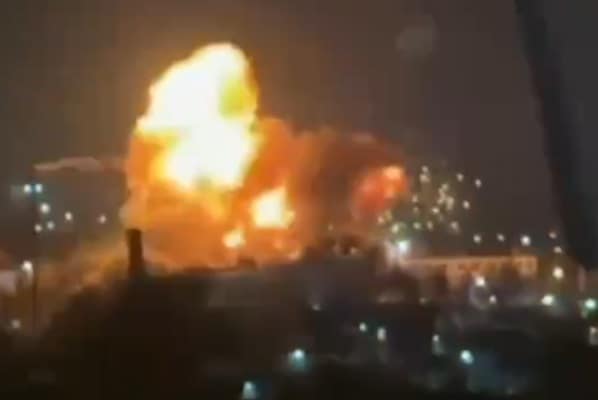
Last night, Russian forces launched a fresh wave of terror across Ukraine, drones and ballistic missiles raining down on cities from Odesa to Kharkiv, killing civilians and damaging critical infrastructure, even as Moscow’s foreign minister spun a story about “American sabotage” of diplomacy.
According to Ukraine’s military, Russia fired 11 ballistic missiles and 149 drones overnight.
Ukrainian air defenses managed to intercept or neutralise the majority of these targets, but not before they struck residential zones, gas pipelines, power lines and other civilian sites.
At least four civilians were killed, including a woman and her 10-year-old son in the Kharkiv region, a 71-year-old man in Chernihiv, and one person in Odesa itself, with multiple others wounded, including a 13-year-old girl. The strikes also knocked out electricity for tens of thousands of people in the Volyn region.
In Odesa, officials confirmed that one civilian was killed and at least two others were injured when Russian drones hit residential buildings overnight.
Under kvällen attackerades Odessa massivt med shaheder och lägenhetshus träffades. En person har rapporterats dödad hittills.
Under eftermiddagen och kvällen har dessutom uppåt 9 ballistiska robotar angripit Vasylkiv, söder om Kiev. Luftvärnet hat det tufft nu. pic.twitter.com/BvFSN4MNqE— Fria Ukraina (@FriaUkraina) February 9, 2026
Let’s be clear: this is war, but it’s not just kinetic. There’s an information offensive underway too, and Russia’s Foreign Minister Sergei Lavrov’s recent remarks are a classic example of how Moscow tries to shift blame away from its own actions.
Lavrov’s narrative
Lavrov now claims that after talks in Anchorage there was supposed to be “extensive cooperation” between Moscow and Washington, but that the U.S. somehow sabotaged its own proposals. In his telling, America’s ideas have become “too much for Washington” itself, while Russia insists that only the American position matters, not Ukraine’s, and not the EU’s “hardcore Russophobes.”
This is no accident or misstatement. It’s a pattern we’ve seen repeatedly. Russia commits an escalation on the ground and then aims its diplomatic guns at Washington, painting the U.S. as both instigator and obstacle. By erasing Ukraine and Europe as meaningful actors in the negotiation process, Moscow tries to frame the conflict as a binary standoff, Russia vs. America. That story might play for audiences already inclined to believe it, and an audience who thinks it’s already at war with NATO, but it has nothing to do with the reality facing Ukrainians under bombardment.
The reality on the ground
Statistically, attacks like last nights are part of a grim continuum:
- Earlier waves of Russian missiles killed dozens in Odesa in previous strikes — for example, a missile assault in late 2025 killed at least eight people and wounded nearly thirty around the port area.
- Over the course of the war, civilian deaths from Russian attacks have continued to rise sharply. United Nations monitoring showed that civilian casualties in 2025 were nearly 50% higher than the same period in 2024, with missiles and drones playing a major role.
- Odesa itself has suffered repeated waves of violence since 2022, with earlier strikes killing scores of civilians, including children. For example, a massive March 15, 2024 missile attack killed at least 21 people and injured over 70 in one of the deadliest incidents in the city’s history.
These figures remind us that Russia’s strategy isn’t limited to “strategic targets.” Residential areas, critical infrastructure and civilian lives repeatedly pay the price, even in supposed diplomatic pauses.
The blame game, and the delay tactic
Lavrov’s attempt to pin the blame on Washington is more than just spin; it’s a delay tactic.
By insisting that the U.S. is the real problem, Moscow tries to:
- Shift Responsibility: Suggest Russia is a cooperative partner frustrated by Western intransigence.
- Marginalise Ukraine: Insist Kyiv’s position doesn’t matter — so any peace proposal can ignore Ukraine’s sovereignty and security concerns.
- Divide Western Allies: Drive wedges between America and Europe by accusing Washington of pushing an agenda Europe doesn’t share.
Meanwhile, Moscow continues to launch missiles.
This tactic also serves another obvious purpose, to create ambiguity around negotiations. If Russia can claim it wanted peace but was thwarted by Washington’s own plans, it buys time and dodges accountability for its own refusal to accept realistic terms on Ukraine’s independence and territorial integrity.
But Russia’s credibility is collapsing
Not even Russia’s own population fully buys this narrative anymore. Independent reporting from Ukrainian journalists and OSINT communities continues to expose the widening gap between Kremlin claims and reality on the battlefield. Damage to infrastructure, logistical failures, and thwarted offensives are not hidden from ordinary Ukrainians, or from global audiences with access to multiple sources of real-time information, even Russian’s with VPN access are able to get access to alternative new sources.
🚨BREAKING NEWS
The Russian army launched a powerful offensive on Odessa last night, and explosions and fires have resumed.
▪️According to local channels, one of the drones landed near a military unit close to the 6th station. pic.twitter.com/vhN19C2O1k
— Aleksey Berezutski 🇷🇺🎖 (@aleksbrz11) February 9, 2026
So long as missiles continue to fall on cities like Odesa, the idea that Russia is a reluctant partner in peace will ring hollow. You cannot have peace on the backs of bombed civilians.
You cannot substitute missile barrages with diplomatic excuses.
And you cannot blame America for Russia’s war, not while Ukrainian families bury their dead.
Missiles hit Odesa last night, civilians died and somewhere in Moscow, Lavrov is blaming America.
That’s not diplomacy. That’s deflection.


Leave a Comment