
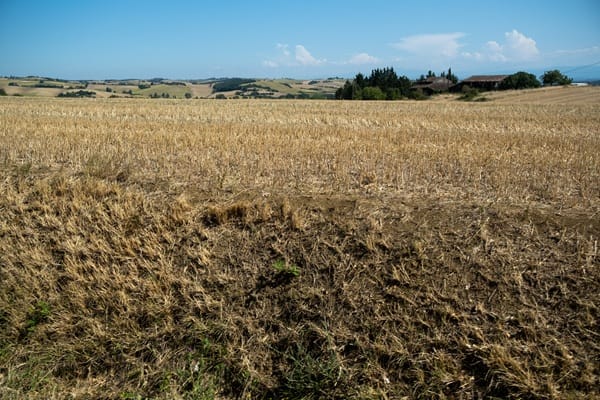
As a result of importing a high proportion of its food from overseas, the UK is particularly vulnerable to food price shocks. In recent years we have seen these occur due to climate change, geopolitical instability and volatile global markets, increasing
the importance of domestic production and improved resilience of the UK’s food supply.
Although predominantly self-sufficient in its production of grains, meat, milk and eggs, the UK imports 40% of all its food, 80% of its fruit and 47% of its vegetables, particularly from countries that are vulnerable to climate change.
The UK has one of the lowest food self-sufficiency ratios among large Western European countries and a significantly higher import dependence than France, Germany or Spain. In fact, it has one of the highest reliance rates on imported fruit in Europe.
This is a serious issue as the IPCC forecast that if no action is taken to improve resilience higher temperatures will lead to yield losses, heat stress, and quality drops in global fruits, vegetables, and annual crops. Declines in fruit and veg yields and crop suitability are especially projected in tropical and semi-tropical regions, with the Mediterranean, North Africa, South and Central America key global regions with high vulnerability.
With fewer than one in three adults and less than one in ten 11-18 year olds currently eating their 5 a day, it is important that government takes action to make these healthy products more accessible, instead of waiting until the UK is faced with shortages. The report states that government should aim to boost consumption of fruit and veg in the UK at the same time as increasing domestic production. Currently government recommends 41% of our diet should be fruit and veg, and yet they make up only 7% of the food groups we produce domestically).
As well as improving access to healthy produce, the UK has a major economic opportunity to expand the horticulture sector, which could add billions to the economy, create over 20,000 jobs, and add 3% to farm profits across the country, bringing benefits to farmer livelihoods, local economies and public health.
As changing weather patterns are also impacting the UK, the report makes it clear that there simultaneously needs to be much greater focus on climate adaptation at home, building resilience on farms, as well as strengthening local food systems and supply chains.
The government’s forthcoming horticulture Sector Growth Plan is an important opportunity to build a food system that’s fit for the future. This should ensure affordable, healthy food for all, fair prices for British farmers, and a plan to help the UK adapt to changing weather patterns at home and abroad. It should also be backed by long-term statutory targets to increase the national average consumption of fruit and vegetables and increase the proportion of the fruit and vegetable supply which is produced in Britain.
Anna Taylor, Executive Director, The Food Foundation, said: “Whilst the UK has been experiencing successive heatwaves and drought across much of the country, it is important to acknowledge that most of the countries we import our staple, healthy foods from are in an even more vulnerable position as we see the impacts of climate change ramp up across the globe.
“There is a risk this will drive up prices in the future, putting nutritious foods further out of reach for many, so it is important government takes action now to prevent this from happening.
“Government must invest to increase consumption of fruit and veg, to ensure we are growing more of these foods domestically, and to support farmers so they are able to adapt to changing weather patterns in the UK.”
Ali Capper, Executive Chairman, British Apples and Pears Ltd, added: “This report shines a light on how to deliver the government statement, ‘Food Security is our National Security.’
“We have an excellent growing climate in the UK and can create much greater food security by growing more fruit and vegetables here. We know from the growers we represent that they are ambitious to grow their British businesses.
“To do so they need the certainty that good government policy can deliver – certainty on continued and increased access to the Seasonal Workers Scheme; water for food; an agile planning regulation; competitively priced energy. Growers also need market certainty – long term agreements and profitable returns.
“Our society deserves to be able to buy a homegrown 5 a day. The Horticulture Sector Growth Plan is the ideal initiative to make this happen.”
Professor Paul Behrens, British Academy Global Professor, Oxford Martin School, University of Oxford said: “I spent a decade living in the Netherlands, a country with nearly twice the UK’s population density and the same maritime climate.
“It is the world’s second-largest agricultural exporter by value. Dutch growers have put around 1,770 hectares under glass for tomatoes alone while the UK’s entire protected vegetable area comes to 866 hectares. The Dutch growers became a powerhouse from four decades of consistent, innovation-led policy.
“This report describes what Britain has lost by never making that choice and, perhaps more importantly, the urgent choices ahead and large opportunities we have by taking action on horticulture.”


Leave a Comment