
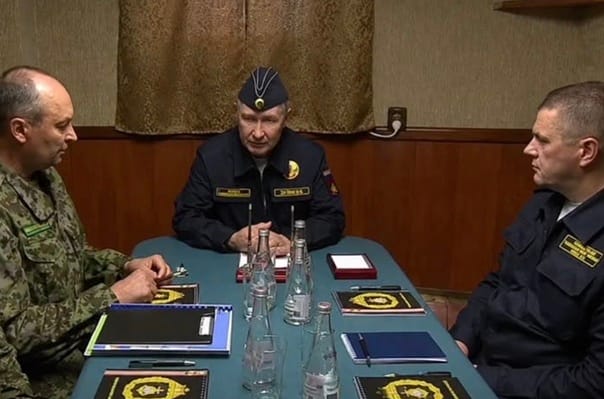
Russia has begun one of its largest nuclear emergency exercises, sending more than 1,000 personnel into a simulated atomic disaster in the Urals — in the same broad region as a heavily fortified underground complex linked by investigators to Moscow’s nuclear retaliation system.
The two-day exercise at the Beloyarsk Nuclear Power Plant in Sverdlovsk region began on Tuesday and involves plant personnel, emergency workers, doctors, police, government officials and Russia’s military radiation, chemical and biological protection forces.
The scenario envisages simultaneous emergencies affecting two reactors, with responders practising evacuations, firefighting, rubble clearance, medical assistance and the protection of the surrounding population.
Rosatom, Russia’s state-owned nuclear energy corporation, has described the exercise as a routine test of emergency preparedness.
More than 1,000 people are participating, while residents of nearby Zarechny have been warned that they may hear sirens and see military and emergency vehicles, evacuation operations and decontamination points. The plant’s reactors will continue operating normally during the exercise.
Russia says exercises of this scale are conducted annually at different nuclear power stations.
Read more related news:
UK warned we are in the ‘most dangerous era’ as war with Russia may all ready be under way
Europe already in a form of ‘World War III’ as Burnham faces pressure to strengthen defences
Estonia moves brigade near to Russia’s border to prepare for ‘the first battles’
Labour is playing with British lives as Burnham leaves defence dangerously underfunded
Yet the timing and location are likely to attract scrutiny.
The Beloyarsk plant sits in Sverdlovsk region, where a separate recent investigation has uncovered extensive modernisation of an underground nuclear command facility inside Mount Kosvinsky Kamen.
Known as Facility 1335, or “Grot”, the complex has been linked to the Soviet-era Perimeter system, better known in the West as “Dead Hand” — a nuclear command-and-control mechanism designed to preserve Russia’s ability to retaliate if conventional communications with its leadership were destroyed.
Procurement records examined by Danwatch, The Sunday Times and the Dossier Center indicate that Russia undertook extensive work at the facility between 2018 and 2024.
The quantities involved are extraordinary: at least 22,000 tonnes of steel, more than 56,000 tonnes of cement and around 600 kilometres of electrical cable were procured, alongside ventilation systems, power infrastructure and equipment associated with an extensive underground complex.
The scale of the work has revived questions about the future of Perimeter and Moscow’s preparations for a nuclear conflict.
But the precise capabilities of the system remain disputed.
Some analysts have described Perimeter as a mechanism capable of ensuring a retaliatory strike if Russia’s leadership and conventional command structures were destroyed. Others stress that the system should not be portrayed as a simple autonomous machine that can independently decide to launch Russia’s nuclear arsenal.
Reuters has previously reported that the system is intended as a worst-case backup and that Russia’s president retains ultimate authority over nuclear weapons.
That distinction is important.
The existence of a nuclear emergency drill at Beloyarsk does not demonstrate that Russia is preparing for nuclear war, nor does it establish any operational connection between the exercise and Facility 1335.
But it does provide an unsettling backdrop to a broader period of heightened nuclear tension between Moscow and the West.
Russia has repeatedly used nuclear rhetoric during the war in Ukraine, while tensions with NATO have intensified. Last week, Moscow warned that attempts to isolate Kaliningrad could carry nuclear consequences, illustrating how quickly conventional disputes can become entangled with Russia’s nuclear signalling.
Against that backdrop, scenes of radiation-protection troops, evacuation exercises and decontamination teams moving through a Russian city inevitably carry a significance beyond the technical purpose of civil-defence training.
One Russian Telegram channel, Insider-T, interpreted the exercise as a message to Western intelligence services, arguing that the deployment of chemical-protection personnel demonstrated that Moscow was preparing psychologically and physically for a conflict involving weapons of mass destruction.
That interpretation is not evidence of Russian intentions, and the authorities themselves have presented the exercise as routine.
But it highlights the uncomfortable strategic environment in which the drill is taking place.
Russia is simultaneously modernising nuclear command infrastructure, maintaining the world’s largest nuclear arsenal and issuing increasingly explicit warnings about the consequences of confrontation with NATO.
The United States and its European allies, meanwhile, are attempting to deter Moscow without allowing the war in Ukraine or wider military confrontation to spiral into a direct conflict between nuclear powers.
That makes the resilience of command systems, emergency services and civil-defence infrastructure more than a technical concern.
It is part of the architecture of deterrence itself.
The frightening reality is that the exercise at Beloyarsk may be entirely routine.
The more unsettling question is why, in the current security environment, a routine nuclear disaster drill now looks so much less routine.
For Russia, preparing for catastrophe is part of maintaining strategic resilience.
For the West, the challenge is understanding where genuine preparedness ends — and nuclear signalling begins.



Leave a Comment