
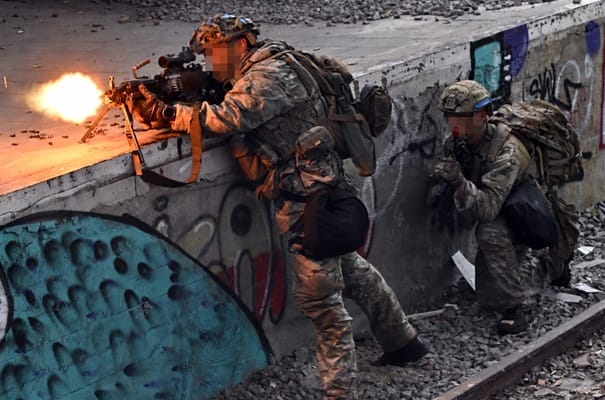
Europe is already in a form of “World War III” against Russia, according to a former military officer and security expert who argues that the immediate danger to civilians is more likely to come from hybrid warfare than mass mobilisation for a conventional conflict.
Ramón Cuerda Riva, a Spanish security expert and former military officer, said the prospect of a direct Russian war against the European Union was being overstated, arguing that Moscow lacked the conventional military capacity to launch such an offensive.
“Russia does not have the capacity to launch a conventional war against the European Union,” he wrote in Escudo Digital.
Read more related news:
Putin is conducting ‘aggressive actions below the threshold of war’ to disrupt Europe
Intelligence warns of a possible Russian ‘false-flag’ operation against NATO
Britain prepares high-readiness forces to deploy if Suwałki Gap is cut by Belarus and Russia
Russia prepares for ‘stealth’ mobilisation as Europe readies for hybrid attacks on NATO
His assessment comes as governments across Europe reassess military preparedness following Russia’s full-scale invasion of Ukraine and growing warnings that Moscow could seek to test NATO through drones, missiles, sabotage and other forms of pressure below the threshold of open war.
Riva argued that Russia’s military reputation had been badly damaged by more than four years of fighting in Ukraine.
“For decades, Kremlin propaganda has projected the image of colossal, modern and invincible Russian armed forces. However, the invasion of Ukraine, launched in 2022, has been a sobering reality check for analysts around the world.
“Russia not only failed to take Kyiv in three days, as it had planned, but has also become trapped in a brutal war of attrition that has shredded its conventional military capability.”
He argued that Russia’s attrition had strengthened Europe’s relative military position.
“Europe has developed the capacity to wipe out any Russian army that attempted to invade it across the three traditional domains: land, sea and air.”
But Riva’s argument does not amount to a dismissal of the wider security threat. Instead, he believes Moscow is increasingly likely to operate in the grey zone, where cyber attacks, sabotage, infrastructure disruption and disinformation can impose costs without immediately triggering a conventional military response.
“We are already in a hybrid world war III – there will be no conventional one, at least with Russia.”
The assessment comes amid growing pressure on Prime Minister Andy Burnham’s government to accelerate Britain’s defence preparations.
Former Conservative MP Simon Clarke, director of the Onward think tank, has criticised the government’s decision to delay setting out a plan for higher defence spending.
“The Government cannot sustain its position on deferring ‘even setting out a plan’ for increased defence spending until next year”.
He added: “Things may be about to become very serious indeed – much more so than is widely appreciated.”
Poland has issued some of the starkest recent warnings. Prime Minister Donald Tusk said intelligence from several sources was “very consistent and convincing” and that Russia could seek to test Nato’s willingness to respond to attacks against its eastern members.
“We know he is plotting something bad. However, for us the most important task is to prepare for various scenarios,” Tusk told parliament.
“We will certainly not naively accept such messages that Russia has goodwill and will start behaving properly. There is no indication of this.”
He added: “There is a real risk that drones or other types of missiles could penetrate the territory of one or more countries on the eastern flank and even cause damage, while the official explanation will be that there was an accident.”
For Britain, the warnings have been reinforced by Air Chief Marshal Sir Richard Knighton, the Chief of the Defence Staff, who described the current security environment as the most dangerous of his career.
“This is the most dangerous time I have known in my working life. In my 35-year career, this is the most dangerous period that I have known. And the risks and threats to this country are greater than I have known since the Cold War.”
Speaking to BBC Radio 4’s Today programme, Knighton said decades of British military planning had been shaped around shorter, geographically limited conflicts.
“Over the last two decades, we have been preparing for shorter wars and for conflicts that are confined and limited. What we need to ready ourselves for is potentially much greater, longer conflicts, as we’ve seen in Ukraine.”
He said the implications extended beyond defence policy, arguing that a more dangerous security environment could force Britain to reconsider national priorities.
“It is important that society and all of us recognise and understand that, and that may mean that we need to make different choices and different priorities.”
For European governments, the central question is therefore increasingly less whether a conventional Russian invasion of EU territory is imminent, and more how far Moscow can exploit the space between peace and war.
Riva’s assessment is that Russia’s conventional weakness makes a direct confrontation less likely, while increasing the incentive for the Kremlin to use cheaper and harder-to-attribute methods of coercion.
That distinction may offer some reassurance to civilians worried about conscription, but it also points to a security challenge that is harder to deter and more difficult to define: a confrontation fought not only on battlefields, but through infrastructure, information networks and national resilience.


Leave a Comment