
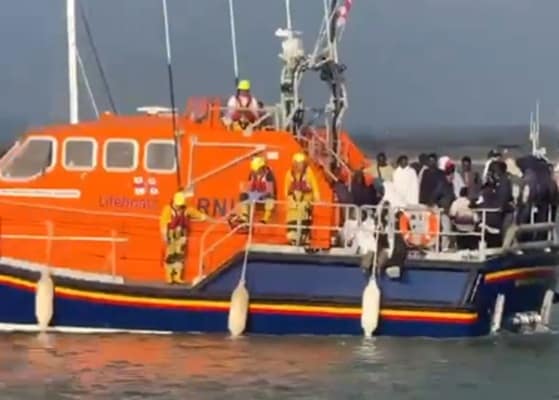
Channel migrant crossings have resumed amid reports of a migrant boat launching from Belgium, while people-smuggling prices have fallen to as little as £840, raising fresh questions over efforts to disrupt the criminal networks moving people towards Britain.
The green, white and red dinghy, reportedly styled to resemble the Kurdish flag, was spotted off the Belgian coast with dozens of people aboard as several hooded men struggled to start its engine. Belgian police officers watched from nearby but did not intervene, according to the account.
Reform UK leader Nigel Farage criticised the response, saying: “The boats are now launching from Belgium. The Belgian authorities, like the French, are just standing and watching.”
He added: “This boat is even custom-made to match the Kurdish flag. The gangs are laughing at us.”
The incident comes as British border officials warn that thousands of migrants are waiting in northern France, even as enforcement measures make it harder for smuggling networks to organise crossings.
Almost 4,000 migrants waiting in northern France
Duncan Capps, the UK Border Security Commander, told a parliamentary committee that French estimates put the number of people in two camps in the Calais-Dunkirk area at almost 3,800, roughly double the usual level of about 2,000.
“I think the French estimate at the moment is that there are almost 3,800 people between those two camps,” he said, adding that the figure was “almost double what we would normally expect”.
The increase presents a complicated picture for the authorities. A large population waiting to cross suggests that demand remains strong, but officials argue that the difficulty of launching boats may also be preventing migrants from making the journey.
Capps said French enforcement had made it particularly difficult to cross from the Dunkirk-Calais area. The government’s strategy, he explained, was to make the operation increasingly unprofitable for the criminal groups involved.
“There is a moment with this from a criminal perspective where it stops being particularly viable,” he said.
Channel crossing prices fall to £840
Despite the enforcement pressure, prices for Channel crossings have reportedly dropped to as little as £840, according to Capps — a strikingly low figure for an operation involving dangerous sea journeys and criminal intermediaries.
Rob Jones, director general of operations at the National Crime Agency, said the economics of people-smuggling were coming under pressure as the likelihood of arrest and equipment seizure increased.
“The fact that there are more migrants in northern France is not a good thing — it shows the intent is high but it shows they are struggling to make the crossing,” Jones told the committee.
He said the smugglers’ “business model is starting to shake”, adding: “It’s more likely than ever that you’re going to get arrested.”
Jones also warned that equipment was increasingly likely to be seized and that attempting a crossing was becoming “riskier and riskier for everybody that’s involved”.
The cost of the boats themselves remains substantial. Jones said the unsafe dinghies used by traffickers typically cost about £14,000, leaving criminal networks exposed to significant losses when equipment is confiscated.
Smuggling networks face growing pressure
Iraqi-Kurdish criminal gangs are understood to control parts of the smuggling trade between Calais and Dunkirk, with territory reportedly divided according to regional origins, including Erbil, Sulaimaniya, Ranya and Sharazoor. Criminals from Ranya are said to control a substantial area.
The reported Belgian launch could signal an attempt to adapt routes as enforcement increases elsewhere, although the circumstances of the incident and the extent of any shift in smuggling operations remain unclear.
For British authorities, the challenge is to turn disruption into a sustained reduction in dangerous crossings. The latest figures suggest that demand remains high, while lower prices could make the journey accessible to more people.
The central test will be whether stronger enforcement can raise the financial and operational risks for smugglers faster than criminal networks can adapt.
For now, thousands remain in northern France, reported crossing prices have fallen sharply, and the appearance of a boat off Belgium underlines the possibility that the Channel smuggling trade could evolve rather than disappear.


Leave a Comment