
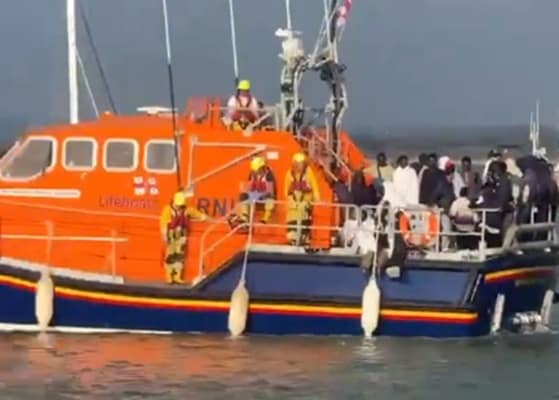
Dozens of migrants are expected to be brought ashore at a south coast port after another chaotic Channel crossing, with police preparing for a potentially volatile reception in Gosport.
The latest incident follows a dinghy that spent more than 30 hours at sea before being intercepted by two RNLI lifeboats and transferred to the larger HMC Vigilant cutter.
Riot police were seen arriving in Gosport, Hampshire, amid growing expectations that the migrants would be brought ashore there, raising fears of a repeat of the disorder that followed a major migrant landing in nearby Portsmouth earlier this month.
The September 6 arrival of about 120 migrants at Portsmouth triggered a protest involving more than 200 people, with police deploying dispersal powers as demonstrators attempted to prevent coaches carrying the migrants from leaving the harbour.
The latest crossing began from the Normandy coast after the vessel left the area near Vierville-sur-Mer, west of Bayeux. French rescue services were mobilised after the 12-metre craft put to sea, with four French lifeboats, the tugboat Abeille Liberté and a French Navy search-and-rescue helicopter involved in monitoring the vessel.
A source said the boat was “in a very bad way” and “very low in the water”, with only a single small outboard motor.
“The sea was calm, and weather conditions were good, but the decision was taken to escort the boat, without intervening,” the source said.
The priority, the source added, was maritime safety rather than preventing the vessel from reaching Britain.
Because of currents and winds, the boat initially travelled along the French coast instead of directly towards Britain before eventually turning towards English waters.
“Gendarmes were also involved in monitoring the boat from the shoreline, and – at around 3pm – there was a movement towards English waters,” the source said.
The prospect of a landing in Gosport has triggered an angry response from local politicians, who argue that the town is poorly equipped to absorb the additional policing and logistical demands.
George Madgwick, Reform leader of Hampshire County Council, said: “Honestly before this boat lands tonight you need to understand the dynamics here.
“Someone at the Home Office for some bizarre reason chose Gosport as the place to allow an illegal boat to dock.
“After the utter logistical failure in Portsmouth they’ve determined Gosport, with one road on and off, and a proud naval area with huge levels of social housing – is the smart place to land them.”
Madgwick added: “Gosport is an area where many will come out their houses and many will be very unhappy. I pray this is peaceful tonight but I have to really wonder why this decision was made.”
The Hampshire police and crime commissioner, Donna Jones, has also urged Border Force to take responsibility for the arrival, warning that local policing resources are already under strain.
“Hampshire is not prepared or set-up to process people travelling into Britain this way, and the burden on the police to deal with the arrival and potential protest activity is unsustainable,” she said.
Jones said the Portsmouth landing had required hundreds of officers to be drafted in to manage protests and warned that Hampshire and Isle of Wight Constabulary “cannot repeatedly divert its resources to manage landings the county was never designed to receive”.
The September protests demonstrated the increasingly combustible atmosphere surrounding small-boat arrivals. Police faced masked demonstrators attempting to block roads and prevent migrant coaches from leaving Portsmouth, while officers and vehicles were subsequently targeted during clashes.
The government has sought to counter the rise in crossings by deepening co-operation with France.
Under the UK-France agreement announced in April, Britain committed £500mn to strengthen policing and surveillance in northern France, with a further £161mn earmarked for new measures whose funding can be redirected depending on their effectiveness. The agreement is intended to increase French personnel deployed against crossings by 53 per cent.
The Home Office said in August that French authorities had prevented 185 small-boat crossing events during the first three months of the new arrangement, representing 61 per cent of reported events over that period.
But the latest incident highlights the difficulty of preventing increasingly long and unconventional journeys across the Channel.
The government has also faced criticism over the scale of British financial support for France, with ministers committing a further £160mn to test new tactics, including proposals involving deportations from the French coastline.
Shadow home secretary Chris Philp said: “This latest fiasco shows that the French are not even trying to stop the illegal immigrants’ boats in French waters – instead they are escorting them here.
“Our border security has descended into chaos with migrants crossing at will over ever larger distances and in ever larger boats.
“The Labour’s government’s claim to smash the gangs is laughable and their deal with the French is clearly not working.”
The government argues that joint enforcement is already preventing thousands of crossings and says the number of small-boat arrivals has fallen this year.
The immediate concern, however, is no longer simply how the vessels are intercepted at sea, but where they can safely be brought ashore.
With Gosport now potentially facing the consequences of an increasingly unpredictable crossing route, the pressure on coastal authorities is moving further west — and the political and policing consequences are following it.


Leave a Comment