
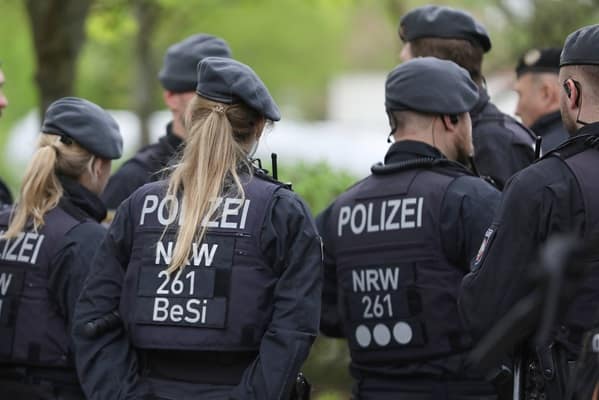
At least two people have been injured after an explosion near the main railway station in Augsburg in southern Germany, as a separate dispute over alleged Russian sabotage has intensified fears about the country’s exposure to hostile attacks.
Police said an unidentified object exploded in a passageway near Augsburg’s main train station in the early hours of Wednesday.
German tabloid Bild reported that a hand grenade had detonated outside a Turkish jeweller. Die Zeit identified those injured as two Ukrainian citizens, aged 17 and 18, who suffered “acoustic trauma” in the blast.
Bavaria state police later shut the city’s main railway station after a second suspicious object was discovered nearby. A bomb disposal expert and a robot were deployed to the scene, according to local reports.
Streets surrounding the station were also closed and public transport disrupted, with Schwaben North Police saying a major operation remained under way at 7am BST.
Windows were reportedly shattered by the initial explosion and several nearby businesses, including a bank, sustained minor damage.
Police received reports of a detonation at 3.15am local time, or 2.15am BST. Investigators have yet to establish who was responsible or disclose what device was involved.
Bild reported that the station itself did not appear to have been the intended target. A police spokesperson said details surrounding the device remained unclear.
The incident comes against a backdrop of growing concern in Germany over alleged hostile operations linked to Russia.
Stefan Thumann, a senior German defence executive whose company Donaustahl supplies combat drones to Ukraine, has said Germany and Russia are already effectively at war, arguing that a sustained campaign of suspected Russian sabotage has moved beyond what European governments have traditionally described as “hybrid warfare”.
“Germany and Russia are at war,” Mr Thumann told Politico.
His comments followed Berlin’s decision to formally accuse Moscow of responsibility for an alleged sabotage operation involving explosives at Leipzig/Halle Airport, a major international freight hub with an important role in supporting Ukraine and Nato operations.
German authorities said Russia was responsible for an attempted attack on August 4, when a drone carrying explosives was discovered near a Ukrainian aircraft at the airport and subsequently defused.
Alexander Dobrindt, Germany’s interior minister, said the incident formed part of an established pattern of Russian activity across Europe.
Referring to what he described as “Russian hybrid operations”, Mr Dobrindt said the government “comes to the conclusion that Russia is responsible for the hybrid attack in Leipzig on Aug. 4”.
The accusation marks a significant hardening of Berlin’s public position towards Moscow.
Germany has previously accused Russia of espionage, cyber attacks and sabotage on German territory, but the latest case has triggered direct diplomatic consequences and renewed debate over whether Moscow’s activities should now be treated as part of a broader conflict rather than below-threshold confrontation.
The Augsburg explosion had not been publicly linked to Russia as of Wednesday morning, and police had not identified a motive or suspect.
But the incident comes at a sensitive moment for Germany, where concerns over sabotage and attacks on critical infrastructure have risen alongside the country’s expanded military and logistical support for Ukraine.
The combination of a live police operation in Augsburg and increasingly explicit government accusations against Moscow is likely to intensify scrutiny of Germany’s preparedness for attacks conducted away from the battlefield, particularly against transport networks and other infrastructure.
For Berlin, the challenge is to distinguish criminal or isolated incidents from organised hostile activity while maintaining public confidence in the security of key civilian sites.
The debate is becoming increasingly urgent as German officials adopt more direct language about the threat posed by Russia and defence companies warn that the boundary between peace and conflict in Europe is becoming harder to define.


Leave a Comment