
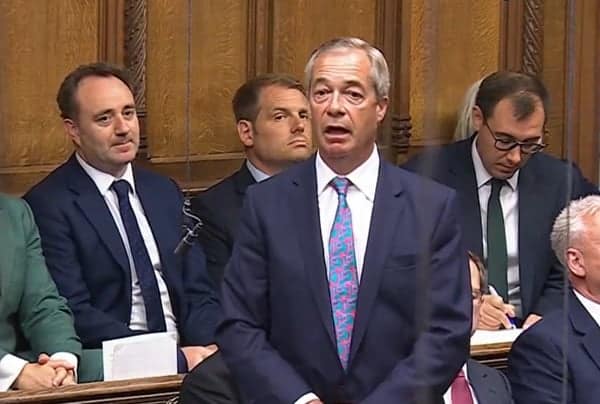
Keir Starmer has launched a blistering attack on Nigel Farage during a heated Prime Minister’s Questions (PMQs) exchange over the murder of Henry Nowak and the subsequent violent protests in Southampton, accusing the Reform leader of “exploiting tragedy” and fuelling division.
The confrontation came as tensions escalated in Parliament following days of unrest linked to the case, with officers injured and arrests made after clashes outside a police station in Southampton.
Addressing MPs, Sir Keir said he had been “shocked” by Mr Farage’s response, warning that political rhetoric risked inflaming an already volatile situation at a moment of national grief.
“I don’t believe there’s two-tier policing in this country,” the Prime Minister said, rejecting claims made by the Reform leader.
He added that Mr Farage’s remarks stood in contrast to the wishes of Henry Nowak’s family, who have appealed for restraint and warned against their son’s death being used to “create further division, hatred or tension”.
“These are the words of a grieving father who has lost his son,” Sir Keir said. “We all need to reflect on those words. A grieving family has asked us not to respond in the way the Leader of Reform has responded.”
The Prime Minister went on to accuse Mr Farage of deliberately stoking grievance, saying: “Exploiting this tragedy to create grievance and division would be wrong in any circumstances, but to do it when the family are expressly saying ‘please don’t’ is unforgivable.”
The remarks triggered a furious reaction across the chamber, with MPs shouting as Mr Farage responded to an unscheduled question granted by the Speaker.
The Reform leader insisted that Britain was now living under “two-tier policing”, arguing that police guidance and decision-making risked treating different ethnic groups differently in practice.
“It is now clear to growing millions in this country that we are living under two-tier policing,” he said, calling on the Prime Minister to take action to restore public trust.
Mr Farage struggled at times to continue as MPs repeatedly called on him to condemn violence against police officers following disorder in Southampton. Reform UK has not formally done so.
He warned that public anger risked escalating further if confidence in policing collapsed, saying: “If the public loses trust in being treated fairly by the police, this is in danger of getting considerably worse.”
The exchange followed a night of violent unrest in Southampton, where protests outside a police station turned disorderly, with objects thrown at officers and damage caused to property. Hampshire and Isle of Wight Constabulary confirmed that 11 officers and a police dog were injured.
Chief Constable Alexis Boon said some attendees had arrived “intent on causing disorder and trouble”, adding that bottles, makeshift weapons and flares had been used against officers.
“What we cannot accept are the violent scenes we saw in Southampton last night,” he said, warning that arrests would increase as investigations progressed.
The force said additional patrols would be deployed in the coming days as it sought to restore order and identify those responsible for the violence.
The political fallout from the case has now drawn in senior figures across Westminster, with competing narratives emerging over policing standards, public trust, and the handling of sensitive racial and criminal justice issues.
For Downing Street, the immediate priority is to contain the unrest and prevent further escalation. For Mr Farage and Reform UK, the issue has become a defining political battleground over law and order and institutional trust.
As Parliament’s exchanges showed, however, the debate has now moved far beyond policy — and into one of the most combustible political arguments of the moment.


Leave a Comment