
Britain risks being unable to protect its own merchant ships from Russian seizure attempts because years of cuts have left the Royal Navy without enough vessels to police global trade routes, former senior commanders have warned Andy Burnham.
The warning follows an escalation in rhetoric from Moscow after Britain and European allies intercepted vessels suspected of belonging to Russia’s shadow fleet.
Vladimir Putin has threatened to “respond in kind”, while Viktor Liina, commander of Russia’s Pacific Fleet, told the Kremlin that Russian forces were prepared to “inspect and detain” ships from countries Moscow considers hostile.
Britain was explicitly identified as a potential target.
Mr Liina claimed Russian authorities had conducted a “detailed analysis” of shipping, including 26 vessels linked to Britain that had sailed near the disputed Kuril Islands between Russia and Japan.
The prospect of Russian maritime interdiction in the Indo-Pacific has caused particular concern among British military planners because the Navy’s permanent presence in the region is remarkably thin.
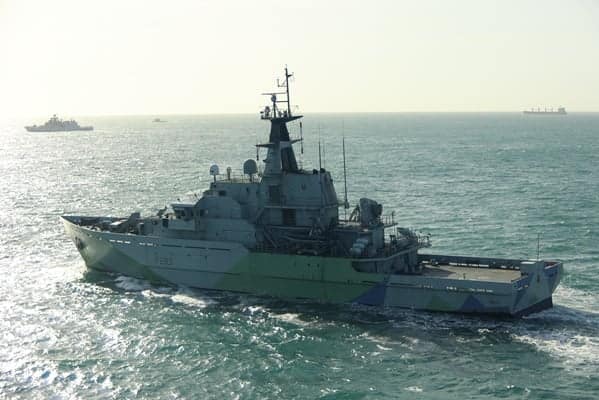
Only two patrol vessels, HMS Spey and HMS Tamar, are currently deployed there.
Lord West, the former First Sea Lord, said the vessels were designed principally to provide a presence rather than defend a convoy against a determined state adversary.
“Our Navy has been reduced and reduced and reduced and we do not have enough ships to fulfil our role to look after global shipping,” he said.
Three decades ago, he argued, four or five British warships would have been operating across the region rather than two.
The implications extend beyond the Navy itself. Britain is a trading nation whose economic security depends on maritime routes stretching from the North Atlantic to the Indo-Pacific.
Sir Ben Wallace, the former Conservative defence secretary, said Britain would need to rely heavily on allies if Russia attempted to seize British commercial vessels.
“The first response to Putin’s comments should be to work with allies such as France to ensure we burden-share across the globe, escort or protection duties,” he said.
The warning comes as the Royal Navy struggles with wider questions over fleet size, availability and readiness following years of defence reductions.
The government insists the decline is being reversed through a £298bn four-year Defence Investment Plan, alongside a commitment to establish a pathway towards spending 3.5 per cent of GDP on defence by 2035.
The Ministry of Defence also points to eight Type 26 anti-submarine warfare frigates and five Type 31 general-purpose frigates being added to the fleet, with a new warship expected to emerge from British production approximately every nine months by 2029.
But those ships will not solve the immediate problem.
Russia does not need to sink a British aircraft carrier to disrupt British trade. A single confrontation involving a merchant ship thousands of miles from home could expose the gap between Britain’s global economic interests and its ability to defend them.
For a country whose prosperity still depends heavily on the sea, the uncomfortable question is no longer whether Britain has a navy.
It is whether it has enough of one when the shooting stops being hypothetical.


Leave a Comment