
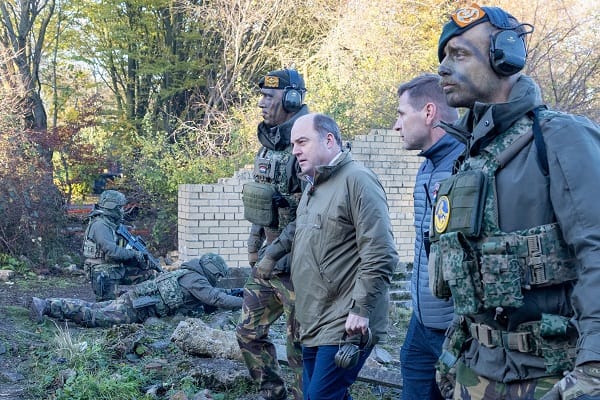
Russia has issued an arrest warrant for former British defence secretary Sir Ben Wallace in the latest display of Kremlin paranoia and political theatre as Vladimir Putin’s regime struggles to project strength amid mounting military and economic pressure.
The warrant, issued by Moscow’s notorious Basmanny district court, accuses Sir Ben of “justifying terrorism” over remarks he made calling for Ukraine to target Russian military infrastructure in occupied Crimea, including the Kerch Bridge — a structure widely viewed as both a logistical artery for Moscow’s war effort and a personal vanity project for Putin himself.
The move immediately drew ridicule across diplomatic and defence circles, not least because Sir Ben joins a growing list of Western politicians, military officials and commentators whom Russia has symbolically “charged” while possessing absolutely no realistic means of enforcing such warrants outside friendly authoritarian jurisdictions.
Sir Ben responded with characteristic bluntness, dismissing the case as another “Russian stunt” from a regime increasingly consumed by failure abroad and repression at home.
“The whole world knows that Russia illegally invaded Ukraine four years ago,” he said, accusing the Kremlin of sacrificing thousands of Russian lives “for the sake of Putin’s ego”.
The comments which triggered Moscow’s fury were delivered during the Warsaw Security Forum in Poland, where Sir Ben urged Western allies to help Ukraine make Crimea “unviable” for Russian occupation forces.
“We need to smash the Kerch Bridge, because that’s a statue to Putin’s ego,” he declared.
Few pieces of infrastructure carry greater symbolic importance for the Kremlin. Opened personally by Putin in 2018 after Russia’s illegal annexation of Crimea, the 12-mile bridge physically links occupied territory to mainland Russia and has repeatedly been targeted during the war. Damage to the crossing has humiliated Moscow on multiple occasions, exposing vulnerabilities in one of Putin’s most prized geopolitical trophies.
The Kremlin’s reaction has been predictably theatrical.
Russian state media figures branded Sir Ben a “terrorist” and “extremist”, while pro-war propagandists openly discussed the prospect of detaining him should he ever enter a country willing to cooperate with Moscow.
Igor Korotchenko, one of the regime’s more aggressive television attack dogs, suggested Sir Ben should be “captured” and transported to Russia for trial.
The spectacle says as much about the Kremlin’s current mindset as it does about Sir Ben himself.
Unable to secure decisive battlefield victories in Ukraine despite four years of catastrophic losses, Moscow has increasingly leaned on intimidation, propaganda and symbolic retaliation against Western figures who have strongly backed Kyiv. Arrest warrants, sanctions and criminal investigations have become tools not of credible law enforcement, but of political messaging aimed at domestic audiences.
Russia’s wartime information strategy now relies heavily on portraying itself as the victim of Western “aggression” while simultaneously threatening NATO countries with escalation, nuclear rhetoric and legal retaliation.
Sir Ben has long occupied a particularly hated position within Kremlin circles.
During his tenure as defence secretary under Boris Johnson, Liz Truss and Rishi Sunak, Britain became one of Ukraine’s earliest and most aggressive military backers, supplying anti-tank missiles, artillery systems, Storm Shadow cruise missiles and extensive training for Ukrainian troops long before some larger European allies fully committed themselves.
His unapologetically hawkish stance on Russia repeatedly infuriated Moscow.
At one stage during the war, Russian state television personalities routinely referred to him by name while discussing strikes against Britain and NATO escalation scenarios. Pro-Kremlin commentators accused London of acting as one of the principal architects behind Western military support for Kyiv.
The timing of the arrest warrant is also revealing.
It comes amid growing evidence that Russia’s much-vaunted military machine has become bogged down in a grinding war of attrition with no decisive breakthrough in sight. Despite repeated offensives, Moscow has failed to achieve its original strategic objectives. Ukraine still stands. NATO has expanded. Western military production is increasing. And Russia remains increasingly reliant on Iran, North Korea and Chinese economic lifelines to sustain its war effort.
Against that backdrop, the Kremlin has intensified both its domestic repression and its external propaganda campaigns.
Inside Russia, laws targeting “fake information” about the war have enabled authorities to imprison critics, seize assets and silence dissent. Abroad, Moscow increasingly seeks symbolic confrontations with Western politicians in an attempt to project strength to its own population.
Yet for many observers, the Ben Wallace warrant simply underlines how far Russia has drifted into political absurdity.
A nuclear power that once styled itself as a geopolitical superpower capable of reshaping Europe in days now spends considerable energy issuing performative arrest notices against retired British ministers while struggling to break Ukrainian resistance on the battlefield.
And perhaps most damaging of all for the Kremlin, the spectacle only reinforces the very image Putin has spent years trying to avoid: a regime increasingly driven not by confidence, but by insecurity, grievance and humiliation.


Leave a Comment