
Poland has evacuated two border crossings with Ukraine and placed its military on heightened alert after a major Russian missile and drone barrage struck targets across western Ukraine, prompting fresh warnings from Warsaw that Europe must prepare for a difficult winter.
The Dorohusk and Zosin crossings were temporarily evacuated on Thursday as Russian attacks unfolded close to Poland’s frontier. The measures lasted roughly 30 minutes around midday before traffic resumed, according to Polish media reports.
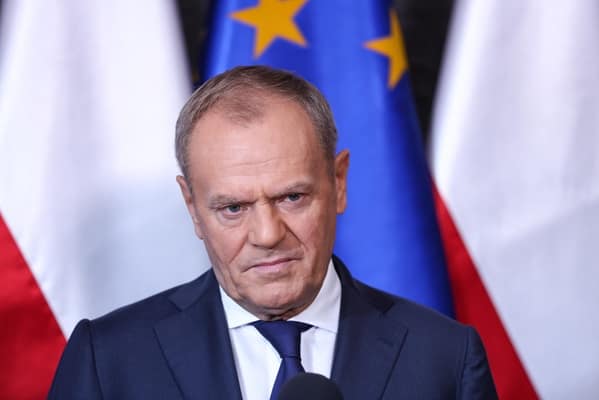
Polish Prime Minister Donald Tusk said the latest strikes showed European governments need to prepare for a prolonged period of heightened security risk.
Read more related news:
A second NATO country is preparing emergency evacuations as Europe braces for war
US deploys ‘large numbers’ of troops and tanks ‘on NATO’s eastern flank’
Russian drones trigger alerts across NATO airspace scrambling fighter jets
“During my talks with Prime Minister Radev, Russia again attacked Ukraine near the Polish border. We evacuated the border crossings in Zosin and Dorohusk,” Tusk said after talks in Warsaw with Bulgarian Prime Minister Rumen Radev.
“This situation means we must act consistently and warn our European partners that this is a difficult time and that we must prepare well for the coming months.”
Tusk added that autumn and winter could prove “truly critical”, as Russia continues to intensify its attacks on Ukrainian infrastructure and logistics.
The overnight assault was among the largest recent Russian air attacks on Ukraine. Ukraine’s air force said Russia launched 282 attack drones alongside Zircon missiles, Iskander-M and other ballistic missiles, as well as additional weapons. Ukrainian air defences reported neutralising 227 aerial targets, including four Zircon missiles, three ballistic missiles and 219 drones.
The main targets were in Kyiv and Odesa regions, although the scale and geography of the assault again forced neighbouring NATO states to monitor their airspace closely.
Poland has already responded to repeated Russian attacks on Ukraine by deploying military aviation and placing ground-based air defence and radar units on heightened readiness. The Polish military described those measures as preventive steps intended to protect Polish airspace.
The latest escalation comes only days after Tusk warned that Russia could seek to test NATO’s willingness to respond to attacks or incursions presented as accidental. US and NATO intelligence, according to Tusk, indicated that Moscow could use drones or missiles in hybrid operations against countries supporting Ukraine, including Poland.
The warnings have increasingly extended beyond military installations and into civilian preparedness.
Polish Foreign Minister Radosław Sikorski said he had already prepared basic supplies at home and identified his nearest shelter.
“I have stocks of rice, I have a hand pump at home, and I have also made preserves from fruit from my own garden,” he said.
“I have the safety instructions, and I have also thought through where the nearest place of shelter is. Everyone should also know how to apply a dressing. That is useful even in peacetime.”
Asked whether Poles should prepare emergency bags, Sikorski urged citizens to follow official guidance when the government advises them to prepare for periods of instability.
“That is my appeal — to listen to it,” he said.
The preparations are not confined to Poland.
Lithuania, another NATO member on Russia’s eastern flank, has drawn up evacuation plans covering a range of possible security scenarios. Prime Minister Mindaugas Sinkevičius told the BBC that authorities were considering how vulnerable and elderly residents could be moved from cities efficiently while avoiding traffic congestion that could hinder an emergency response.
“We’re thinking about a variety of scenarios; not all of them are being discussed very much publicly,” Sinkevičius said.
“We face concrete threats, not on a daily basis, but we’re experiencing them, and it’s a true reality for us.”
He also made clear that evacuation planning was not being presented as an alternative to military resistance.
“If we are attacked, we will fight back. We will engage,” he said.
Lithuania’s concerns are heightened by its geography. The country shares borders with both Belarus and Russia’s Kaliningrad exclave and has experienced a series of airspace and hybrid-security incidents.
At the same time, Washington has reinforced its military commitment to the Baltic state. Lithuania’s President Gitanas Nausėda said on Tuesday that a new rotation of US troops was already heading to the country, describing the American presence as an “indispensable part” of regional deterrence and collective defence.
The developments underline a broader shift in eastern Europe: governments are increasingly combining military readiness with civilian contingency planning as Russian attacks on Ukraine continue and concerns grow over the possibility of spillover, accidental incursions or deliberate hybrid operations.
For Warsaw and Vilnius, the immediate priority is not predicting that a Russian attack on NATO is imminent, but preparing for the possibility that the boundary between the war in Ukraine and the security of NATO’s eastern flank could become increasingly difficult to maintain.


Leave a Comment