
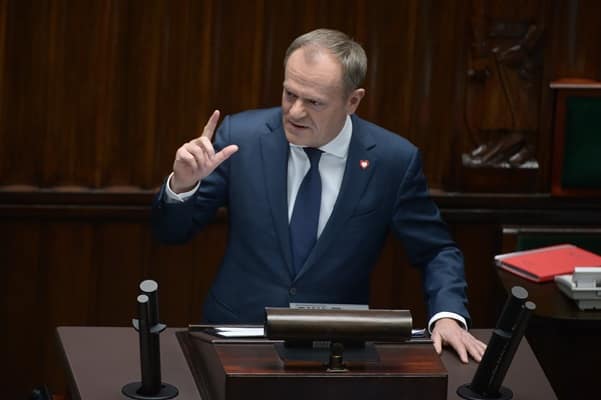
Poland’s prime minister Donald Tusk has vowed to press ahead with a controversial overhaul of the country’s constitutional court, escalating a confrontation with the nationalist opposition that has exposed deep divisions over the rule of law and the limits of executive power.
“In certain matters, there can be no compromise,” Tusk declared in a defiant prime-time television address on Saturday, following overnight protests that prompted the deployment of riot police to protect the court’s headquarters.
The confrontation marks a fresh and potentially destabilising chapter in Poland’s protracted struggle to repair its judicial institutions after eight years under the right-wing Law and Justice (PiS) party.
The constitutional tribunal, once central to the country’s democratic checks and balances, has been paralysed by political disputes for more than a decade and has become a focal point of successive clashes with Brussels over judicial independence.
Since returning to power in 2023, Tusk has sought to reverse the judicial changes introduced by PiS. But his efforts have repeatedly met presidential resistance. Earlier this year, President Karol Nawrocki refused to swear in five judges approved by parliament, deepening the institutional deadlock.
The latest crisis erupted on Friday when government-backed judges moved to assume procedural control of the tribunal, suspending its PiS-appointed chief judge and deputy. The intervention triggered protests and drew Nawrocki to the court building, where he sought to intervene personally.
Tusk dismissed the opposition’s objections, insisting that the tribunal in its existing form lacked legitimacy.
“There was never any doubt that the court in the form imposed by PiS was not a genuine court,” he said, pointing to adverse judgments by European judicial institutions.
In a particularly combative passage, he compared the opposition’s reaction to that of a thief caught stealing a handbag who then complains of being subjected to violence.
He also sought to frame the dispute as part of a broader geopolitical struggle, accusing domestic opponents of undermining democracy and drawing support from pro-Russian forces. Tusk pointed to Russia’s former president Dmitry Medvedev, who had criticised the changes as a “constitutional coup” and an attack on conservatives.
The prime minister reserved some of his sharpest criticism for Nawrocki, warning that even the head of state had no authority to intimidate judges or dictate the workings of a court.
“In a democratic state, no politician can enter a court to issue orders or intimidate judges – not even the president,” he said.
Yet Tusk’s determination to restore judicial independence has itself raised questions about the legality of the methods being deployed. Poland’s Helsinki Foundation for Human Rights said the legal basis for the temporary suspension of the court’s leadership was “questionable”, warning that the intervention would “not contribute” to restoring the institution.
Foreign Minister Radosław Sikorski acknowledged that events outside the court had been “not elegant”, but argued that the alternative was to accept what he described as an unconstitutional transformation of Poland into a presidential republic.
The European Commission on Saturday urged Nawrocki to swear in the newly approved judges, saying the court needed to function in accordance with Poland’s constitution and EU law.
There was little sign of an immediate resolution. Nawrocki held cross-party talks on Saturday, but no breakthrough emerged. His senior aide Zbigniew Bogucki subsequently accused Tusk of being “a pathological liar, who is setting Poland ablaze”.
The stakes extend well beyond the composition of the court. With parliamentary elections approaching next year and polls suggesting a closely fought contest between Tusk’s governing coalition and the nationalist right, control of the institutions charged with interpreting the constitution has become an increasingly consequential political battleground.
For Tusk, the confrontation is a test of whether his promise to restore the rule of law can survive the institutional resistance left behind by his predecessors — and whether the pursuit of that objective risks creating a new constitutional crisis in the process.


Leave a Comment