
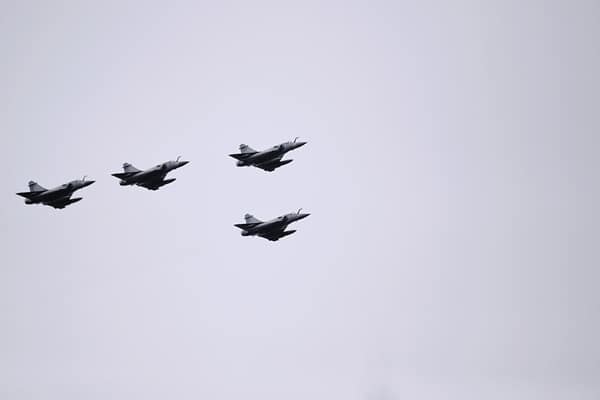
NATO fighter jets have been scrambled as drones linked by authorities to Russia’s attacks on Ukraine breached the airspace of Romania and Moldova, intensifying concerns over the conflict spilling beyond Ukraine’s borders.
A small drone entered Romanian airspace on Thursday morning before crashing near the town of Solca in Suceava county, according to Romania’s Ministry of National Defence.
The aircraft remained inside Romanian airspace for approximately four minutes before coming down near the town. There were no casualties or material damage and no fire was reported at the crash site. Romanian authorities secured the area and deployed an IAR-330 SOCAT helicopter from Bacău to monitor the situation.
Schools in several communities in Suceava county were temporarily suspended until 10am as authorities responded to the aerial alert.
Read more related news:
NATO chief refuses to reveal what would trigger Article 5
ISW warns Russia could try and seize Estonian city in a test of Article 5
UK warned we are in the ‘most dangerous era’ as war with Russia may all ready be under way
The incident came amid a wider series of drone alerts along NATO’s eastern flank.
Two Spanish F-18 fighter jets operating from Romania were also activated overnight after an alert involving drone activity near Chilia Veche in Ukraine, close to the Romanian border. The aircraft formed part of NATO’s air-policing mission and monitored the situation, although Romanian authorities said no further incursion was detected in that incident.
Czech JAS-39 Gripen fighters were separately scrambled from Pardubice under a NATO order to conduct combat air patrols over Poland.
The Czech Armed Forces said the aircraft were deployed to help protect Polish airspace and were prepared to respond to a potential threat. No intervention was ultimately required and the Gripens returned safely to their base.
The Czech military said: “We are part of NATO’s integrated air and missile defense. When the order comes, we are ready. Day and night.”
The deployments followed renewed Russian attacks on Ukraine and came just days after Poland increased its air-defence readiness during Russian aerial strikes.
The latest incidents have also reached Moldova, which is not a NATO member.
Moldovan President Maia Sandu said four Russian drones had violated the country’s airspace during Russia’s latest large-scale attack on Ukraine, with at least one exploding in the north.
“Russia’s massive attack on Ukraine reached Moldova again this morning: four Russian drones violated our airspace, and at least one exploded in the north,” Sandu said.
“Russia’s war endangers all of Europe. We condemn this war and stand with Ukraine.”
Moldovan authorities temporarily closed airspace in the north after the incursions. Officials reported explosions in northern areas and said investigations were continuing.
The incidents highlight the increasingly difficult air-defence environment facing countries bordering Ukraine.
Romania and Poland are NATO members and therefore covered by the alliance’s collective-defence arrangements, while Moldova is outside NATO but lies directly alongside Ukraine and has repeatedly experienced incursions during Russian attacks.
The developments also come against a backdrop of heightened concern among European officials about possible Russian attempts to test NATO’s response through drones, sabotage and other forms of hybrid activity.
Polish Prime Minister Donald Tusk has warned that Moscow could seek to conduct attacks on NATO territory while portraying them as accidents, while European intelligence officials have publicly debated the risk of Russia testing the alliance’s limits.
There is no indication from the latest Romanian incident that the drone deliberately targeted Romanian territory, and authorities have not publicly established the precise circumstances surrounding its entry into Romanian airspace.
But the geographical pattern is striking: drones associated with the war are repeatedly appearing beyond Ukraine, prompting NATO aircraft to take to the skies and forcing neighbouring governments to temporarily restrict civilian activity.
For Romania, Poland and other countries on NATO’s eastern flank, the challenge is increasingly one of maintaining airspace security while avoiding an escalation with Moscow.
For civilians living close to the alliance’s eastern borders, however, the latest alerts provide another reminder that the effects of Russia’s war are no longer confined to Ukrainian territory.


Leave a Comment