
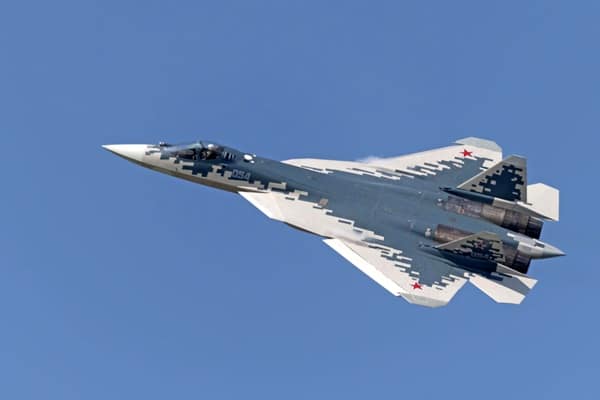
Russia has suffered a major embarrassment after one of its most advanced fighter jets crashed during takeoff in the Moscow region, raising fresh questions over the reliability of its prized military technology.
A Su-57 stealth fighter, considered Russia’s answer to America’s F-35 and one of the most sophisticated aircraft in the Kremlin’s arsenal, went down in the Odintsovo district of Moscow Oblast on Thursday, according to Russian state media.
The pilot reportedly ejected safely before the aircraft crashed in a remote area, causing no reported casualties or damage on the ground. However, the loss of the aircraft represents a significant blow for Moscow given the Su-57’s rarity and strategic importance.
The crash site was reportedly located near the villages of Lutsino and Shikhovo, several kilometres from Zvenigorod and close to the Kubinka military airfield, one of Russia’s key aviation bases.#
Read more related news:
Russia’s fuel crisis deepens as Ukraine’s drone war strikes another blow
Maersk retreats from Ukraine port as Russian strikes push Black Sea shipping to the brink
Ukraine’s greatest strength was never its weapons it is their ability to change
Radiation levels soar 80 fold in Ukraine as Russia is using radioactive drones
The Su-57 has been presented by President Vladimir Putin as a symbol of Russia’s advanced military-industrial capability. Designed as a fifth-generation stealth fighter, it is intended to compete with Western aircraft through low observability, advanced sensors and long-range strike capabilities.
But the programme has faced years of delays, production challenges and limited deployment numbers. Analysts estimate each aircraft costs between $100 million and $120 million, making every loss particularly damaging for Moscow.
The aircraft has been used during Russia’s war against Ukraine, primarily carrying long-range missiles including the Kh-59 and Kh-69, allowing Russian forces to strike from distance while reducing exposure to Ukrainian air defences.
Ukraine has repeatedly targeted Russia’s military infrastructure and high-value assets as part of its broader campaign to weaken Moscow’s war machine.
The Kremlin has invested heavily in portraying the Su-57 as proof that Russia remains a leading military power despite Western sanctions and battlefield setbacks.
The crash, however, risks reinforcing a different narrative: that Russia’s most ambitious weapons programmes remain vulnerable to technical failures and operational pressures after more than three years of war.
For Moscow, the loss is not only financial. It is a symbolic dent to one of Putin’s most carefully marketed displays of military superiority.


Leave a Comment