
Vladimir Putin has spent more than three years trying to prove one thing: that Ukraine cannot withstand the pressure of a long war.
He has failed to break its army. He has failed to crush its national will. He has failed to force Kyiv into submission.
But wars are not won only with missiles, artillery and territory.
They are also fought through exhaustion, distrust and political fracture.
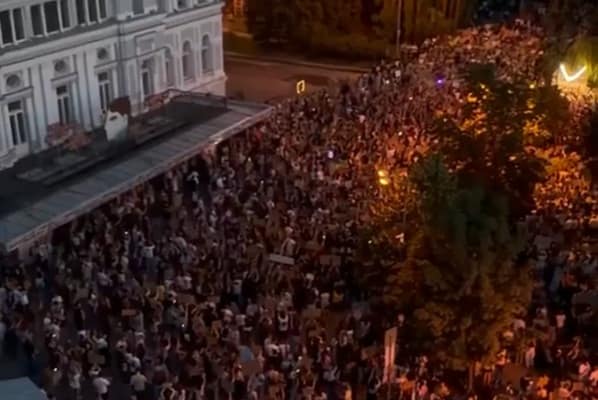
That is why the protests spreading across Ukraine following President Volodymyr Zelensky’s dismissal of Defence Minister Mykhailo Fedorov matter far beyond one personnel decision.
For the Kremlin, the images are politically valuable.
Read more related news:
Russia’s greatest threat may no longer be Ukraine, but exhaustion at home
Putin’s nightmare campaign as Russia tries to break Ukraine one missile at a time
Putin’s big lie exposed as Russia’s ‘stable’ fuel market exists only on Kremlin TV
Ukraine’s two fronts: Striking Russia while fighting for trust at home
A nation at war questioning its own leadership provides Moscow with exactly the narrative it has spent years trying to manufacture: that Ukraine is divided, unstable and losing faith in those leading the fight against Russia.
Every protest. Every disagreement. Every political dispute.
All will be amplified by Russian propaganda as evidence that Kyiv’s system is weakening.
Putin would welcome nothing more than ordinary Ukrainians turning against their own government.
That would represent the kind of victory Russia has been unable to achieve through military force.
But the reality is far more complex.
The greatest danger for Ukraine is not that its citizens protest.
The danger is if they stop believing their voices matter.
Ukraine’s greatest strategic advantage has never been only its weapons or its Western support. It has been the idea that it represents a fundamentally different political model from Putin’s Russia.
In Ukraine, leaders can be questioned.
Kyiv🇺🇦✊️
Third day of protests against the dismissal of Fedorov and for the resignation of Syrsky.https://t.co/gnUiMeYzIm pic.twitter.com/L5fKnq0qz9— Гакрукс (@Gakruks1) July 18, 2026
Decisions can be challenged.
Power can be held accountable.
That democratic instinct is precisely what millions of Ukrainians believe they are defending.
Yet wartime democracy comes with extraordinary tensions.
Zelensky faces a dilemma familiar to leaders throughout history: how to make urgent decisions under extreme pressure while maintaining public confidence in those decisions.
Military necessity often demands speed and secrecy.
Democratic legitimacy requires explanation and trust.
The gap between those two realities is where governments become vulnerable.
The dismissal of a senior defence figure without sufficient public explanation risks creating something more dangerous than political disagreement: a credibility deficit.
And credibility deficits are opportunities for adversaries.
Russia understands that battlefield setbacks can sometimes be reversed. Political trust, once damaged, is far harder to rebuild.
The Kremlin’s most effective weapon is not always a missile.
Sometimes it is uncertainty.
The unanswered question.
The suspicion that something is being hidden.
The belief that ordinary citizens no longer have a say.
The irony is that Ukraine’s openness creates both its vulnerability and its strength.
In Russia, political opposition is suppressed before it can become a genuine challenge. Independent voices are restricted, protests are broken up and criticism of the Kremlin can carry severe consequences.
In Ukraine, citizens can criticise their president while their country remains under daily attack.
That is not weakness.
It is the very argument Ukraine says it is fighting for.
But it is also a test.
Zelensky’s challenge is not to silence criticism.
It is to answer it.
Because Putin’s long-term strategy depends on convincing Ukrainians that democracy is too fragile, too chaotic and too expensive to survive wartime.
Ukraine must demonstrate the opposite: that democracy is not a luxury reserved for peaceful times, but the reason the struggle exists at all.
Putin may see Ukraine’s protests as an opportunity.
Whether they become one will depend on Kyiv’s response.
A government that listens, explains and rebuilds confidence can emerge stronger.
A government that dismisses public concerns risks giving the Kremlin the opening it has been seeking since the beginning of the invasion.
The battlefield will decide who controls territory.
But trust will decide whether Ukraine can endure the war that remains.


Leave a Comment