
Monday morning, and what a weekend it has been.
I deliberately stayed away from firing off half-formed reactions across social media as events unfolded at breakneck speed almost every time I opened my laptop.
One moment there was talk of a ceasefire, then no ceasefire, then suddenly a ceasefire again, followed by discussions of a “1000 for 1000” prisoner exchange, presidential decrees and rapidly shifting political messaging from Moscow, Kyiv and Washington alike.
Amid all the noise, confusion and theatrics, one thing became unmistakably clear:
The Kremlin’s Victory Day weekend did not unfold as planned.
What was supposed to be another carefully choreographed display of strength, inevitability and patriotic unity instead became overshadowed by Ukrainian drone strikes deep inside Russia, airport shutdowns, airspace disruption and growing questions over Moscow’s ability to control the narrative surrounding the war itself.
In the days leading up to the parade, Russia intensified its aerial bombardment campaign against Ukraine with some of the largest coordinated attacks seen in recent months. Massive multi-package strikes involving Shahed drones, Kalibr cruise missiles and Iskander ballistic missiles were launched against Ukrainian cities in waves designed to overwhelm air defences and exhaust the civilian population.
Night after night, air raid sirens sounded across Kyiv, Kharkiv, Dnipro, Odesa, Zaporizhzhia and Kherson as civilians spent hours underground waiting for successive waves of drones and missiles. In one of the largest attacks before the parade, Ukraine’s Air Force reported Russia launched more than 160 aerial weapons in a single night.
For ordinary Ukrainians, previously, Victory Day week was not about remembrance, but survival. Yet despite Russia’s attempt to frame the period around Victory Day as proof of Russian strength and resilience, the situation quickly began to unravel for Moscow itself.
This year’s parade unfolded under unprecedented pressure from Ukraine, with repeated drone strikes, infrastructure attacks and airport shutdowns creating one of the most disruptive periods for Russian domestic aviation since the opening days of the full-scale invasion, with particular attention focused on Rostov-on-Don, a city central to Russia’s military logistics and deeply symbolic for many Ukrainians and former prisoners of war.
Reports indicated Ukrainian drones struck infrastructure connected to the “Aeronavigation of Southern Russia” facility, disrupting regional air traffic control systems and triggering widespread restrictions across southern Russian airspace.
The consequences quickly spread, at least 13 airports were temporarily closed or heavily restricted, including airports in Sochi, Volgograd, Stavropol, Mineralnye Vody, Astrakhan, Vladikavkaz, Makhachkala, Nalchik, Magas and Grozny. Russian authorities blamed “airspace safety concerns” linked to drone activity, but the scale of the disruption exposed an ever growing reality for the Kremlin: Ukraine is now capable of creating serious pressure far beyond the frontline and deep inside Russian territory itself.
Hundreds of flights were delayed or cancelled, passengers stranded and transport systems thrown into chaos during one of the most politically sensitive weekends of the Russian calendar.
Even the parade itself reflected the strain.
The traditional image of heavy armour rolling through Red Square was notably absent, with observers pointing to the lack of tanks and the visibly scaled-back nature of the event compared to previous years.
For an occasion designed to project military strength and historical inevitability, the optics were difficult to ignore.
Politically, perhaps the most uncomfortable reality for Moscow was the simple fact the parade effectively happened because Ukraine allowed it to happen.
Ukrainian President Volodymyr Zelenskyy effectively signed the decree permitting Victory Day to proceed without further escalation, despite Ukraine having already demonstrated the capability to create significantly greater disruption had Kyiv chosen to intensify attacks further.
Yes, theatrical as it may have been, the reality still left the Kremlin embarrassed, with even Kremlin spokesperson Dmitry Peskov visibly uncomfortable addressing the situation publicly.
Only a few years ago, the suggestion Ukraine could place major Russian cities under sustained pressure during one of the Kremlin’s most important propaganda events would have sounded absurd. Now Moscow stages Victory Day under the threat of Ukrainian drones, airspace disruption and growing internal vulnerability.
For myself personally, the contrast is difficult to ignore.
Sitting in Rostov-on-Don four years ago during my own prisoner exchange after the siege of Mariupol, the idea Ukraine would one day be placing this level of pressure on a major Russian city would have sounded unimaginable.
Back then, Russia appeared untouchable inside its own borders.
That illusion is now steadily collapsing.
For years, the Kremlin sold the war to the Russian public as something distant and detached from ordinary life inside Russia itself. Ukraine’s expanding long-range strike capability is dismantling that illusion in real time.
Drone alerts, flight cancellations, internet disruptions and explosions inside Russian territory are becoming increasingly normalised.
Even Moscow itself operated under heightened security conditions ahead of the parade, with electronic warfare systems activated, mobile internet disruptions reported and visible anti-aircraft deployments reinforcing the sense that the Kremlin no longer fully controls the battlespace surrounding its most symbolic national event.
The atmosphere around the capital reflected a city preparing not for celebration, but for potential disruption. Rooftop air defence systems remained visible across parts of Moscow, internet blackouts were reported in several areas and security measures around Red Square were among the heaviest seen in years.
Against that backdrop, Vladimir Putin attempted to project confidence during his Victory Day speech, claiming Russia remained “united” behind what he continues to describe as the “special military operation” and insisting that “truth and justice are on our side.” Yet the contrast between the rhetoric and the reality surrounding Moscow was difficult to ignore.
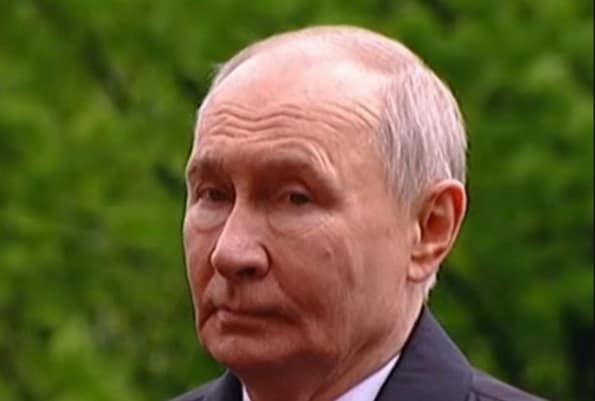
While Putin spoke of strength, sacrifice and historical destiny, Russian airports were closing, drones were disrupting airspace deep inside the country and the Kremlin itself was operating under visible defensive pressure. Even Putin himself appeared noticeably aged, tired and increasingly vulnerable as he stood watching the scaled-back spectacle unfold around him, a stark contrast to the carefully cultivated image of strength and control the Kremlin has spent years trying to project.
The weekend also saw renewed discussion surrounding a proposed “1000 for 1000” prisoner exchange, which US President Donald Trump publicly appeared eager to take ownership of as supposed momentum builds toward negotiations.
However, almost immediately after the proposal gained attention, familiar uncertainty emerged as the Kremlin introduced ambiguity surrounding the process and raised further doubts over Moscow’s reliability regarding negotiations and prisoner exchanges.
Later, President Volodymyr Zelenskyy stated on X and Telegram that the exchange lists had already been prepared, while the United States effectively assumed responsibility for overseeing the process. Trump himself quickly took to social media to publicly back the initiative and, naturally, claim political ownership of it.
At the same time, Moscow’s much-publicised ceasefire surrounding the Victory Day commemorations once again demonstrated the gap between Russian rhetoric and reality. Despite declarations of restraint, reports of continued shelling, strikes and attacks emerged throughout the supposed pause.
Regions including Kherson, Zaporizhzhia and areas across Dnipropetrovsk and Sumy continued experiencing violence despite Russian claims of a temporary ceasefire.
After more than four years of war, the Kremlin increasingly finds itself confronting a reality it can no longer conceal behind patriotic imagery and Soviet nostalgia.
Ukraine still stands.
NATO is larger than before the invasion.
Russia’s dominance in the Black Sea has been challenged.
Ukraine is striking targets deep inside Russian territory with growing frequency.
Victory Day was meant to showcase Russian control and inevitability, but mounting losses, often estimated at more than 1.3 million casualties, are becoming increasingly difficult to disguise, even as wounded and visibly injured veterans marched through commemorations across many regions of Russia itself.
Instead, the weekend exposed vulnerability, disruption and the uncomfortable reality that the war is now reaching further into Russia itself than the Kremlin ever expected.
For years, the Kremlin sold Russians the illusion that this war could be controlled, contained and kept safely beyond their borders.
Victory Day 2026, in my opinion, shattered that illusion.
The tanks were gone, the airports were closing, drones circled Russian skies and Moscow staged its most important propaganda event knowing it only proceeded because Ukraine allowed it to. For all the speeches, flags and patriotic music on Red Square, the message left hanging over the Kremlin was brutally simple:
The war Putin promised would break Ukraine is now steadily breaking Russia’s image of strength itself.
So where does it go from here?


Leave a Comment