
Iran has issued a stark threat of retaliation against the United States, warning that any further attack will trigger a “faster, heavier and more painful response” as the six-month conflict between the two countries threatens to escalate again.
Mohammad Baqer Qalibaf, speaker of Iran’s parliament, said Washington must recognise that the rules of confrontation had changed before it was too late.
“From now on, any attack against Iran’s interests and security will receive a faster, heavier and more painful response,” Qalibaf said in comments published on Telegram.
His warning came just a day after the US struck three Iranian tankers in the Gulf, including one near Kharg Island, Iran’s most important crude export hub.
The latest exchange threatens to push the conflict into an even more dangerous phase, with Iran already demonstrating its ability to attack US interests across the region and threaten shipping through the Strait of Hormuz.
The waterway is critical to global energy markets: before the conflict, roughly one-fifth of the world’s oil supplies passed through it.
Tehran has warned repeatedly that attacks on its energy infrastructure would provoke retaliation.
The stakes rose sharply on August 31 when Donald Trump published a one-line social media post accompanied by an AI-generated video showing Kharg Island being “blown to smithereens”.
Iranian officials subsequently vowed a strong response if the island were attacked.
Mohsen Paknejad, Iran’s oil minister, said on state television on Sunday that Kharg had already been hit around 550 times in previous months but had continued operating.
The island has become a crucial pressure point in the conflict. Iran is the third-largest producer in the Organisation of the Petroleum Exporting Countries and had exported about 90 per cent of its crude through Kharg before the war.
Those exports have already been disrupted by a US blockade of Iranian oil shipments that began in mid-April.
Any further assault on the island could therefore inflict another major blow on an Iranian economy already under severe pressure from US sanctions.
But Tehran is warning that the cost would not be confined to Iran.
Iran’s blockade of the Strait of Hormuz has already pushed fuel prices higher internationally, creating political difficulties for Trump ahead of November’s midterm elections.
A sustained closure or disruption of the waterway could have much wider consequences, choking a critical artery for global energy supplies and adding to inflationary pressure.
The prospect of escalation has also exposed growing economic strains inside Iran.
Ali Madanizadeh, Iran’s economy minister, said Tehran would respond to US economic pressure with reforms, rejecting the argument that sanctions could force the country to change course.
“They think that by pressuring the economy of a country they can change the decisions of its people,” he said.
“I have to clarify one point: the responsibility of reforming Iran’s economy is with its government and people, not with the U.S. Treasury.”
The latest threats come as efforts to revive a preliminary ceasefire reached in June have stalled.
Military activity eased for much of July, but tit-for-tat strikes have since resumed, leaving the conflict locked in an increasingly dangerous cycle.
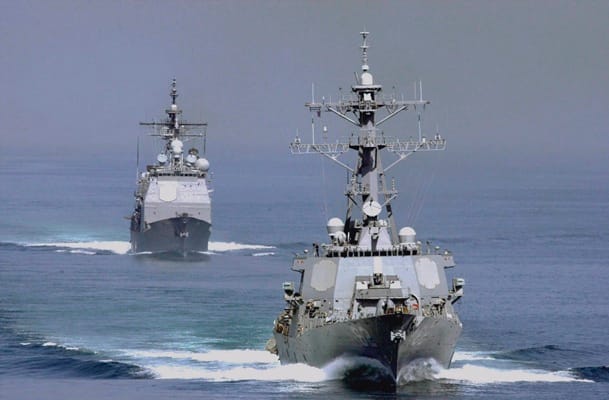
US Central Command said its forces struck three Iranian tankers on Saturday, including one off Kharg Island. Washington said the action followed the Islamic Revolutionary Guard Corps launching ballistic missiles at two American Navy ships.
Admiral Brad Cooper, head of US Central Command, delivered his own warning to Tehran.
“Let the message to the IRGC be clear: If you shoot at two of our ships, we will impose an even higher economic cost — taking out three of yours,” he said.
The IRGC responded by threatening intensified attacks against US military vessels and said it had targeted the three tankers as well as three US-linked vessels in other areas.
“Do not be deceived by the ‘terrorist’ U.S. military and refrain from any suspicious movement aimed at passing through unauthorized waterways,” the IRGC Navy said in a statement carried on Iranian state television.
“Otherwise, you will be targeted.”
The increasingly direct language from both sides points to a conflict in which retaliation itself has become the organising principle.
Washington is imposing economic costs on Iran in response to attacks on US forces, while Tehran is threatening further action against American interests and warning commercial vessels away from areas it considers under its control.
The danger is that the cycle becomes progressively harder to contain.
Qalibaf’s threat of a “faster, heavier and more painful response” represents a clear warning that Tehran intends to answer future US strikes with greater force.
With Kharg Island and the Strait of Hormuz both potential flashpoints, the next exchange could carry consequences far beyond the immediate US-Iran confrontation — putting energy markets, regional security and the fragile prospects for a ceasefire under renewed pressure.


Leave a Comment