
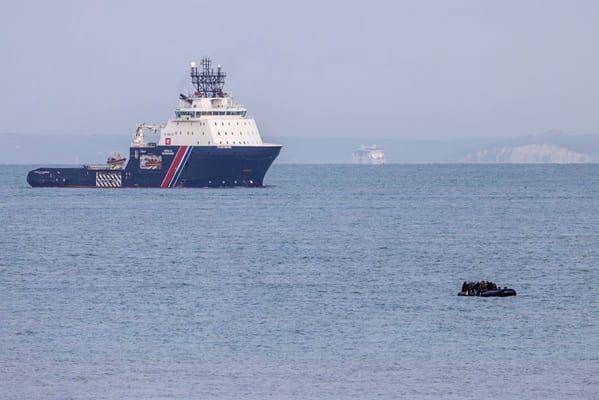
French authorities are intercepting a smaller share of migrant boats attempting to cross the Channel despite a £662m deal with Britain designed to strengthen beach patrols and disrupt people-smuggling gangs.
An analysis of Home Office figures shows that the proportion of attempted crossings prevented by French police has barely changed since the bilateral agreement came into force, undermining claims that the deal is delivering a step-change in enforcement.
French police prevented 185 small boats from launching in the three months since the agreement was signed, while 120 boats reached Britain. That gives an interception rate of 60.7 per cent.
In the three months before the deal, French authorities stopped 131 boats and 83 reached the UK, producing a marginally higher interception rate of 61.2 per cent.
The figures mean that, despite an increase in the number of boats intercepted, the French success rate has actually edged down.
The 185 prevented crossings represented around 4,312 migrants who were stopped from reaching Britain — equivalent to roughly two boats intercepted each day. The number of boats stopped was about 5 per cent higher than during the corresponding period last year.
The figures come as smugglers increasingly deploy larger vessels and adapt their tactics, with so-called mega-dinghies carrying more than 160 people on some crossings.
The British government has committed £662m to the three-year agreement, including a conditional £100m payment linked to French performance in preventing crossings.
Home Secretary Shabana Mahmood said the arrangement was already producing results.
“The deal is already having a real impact, stopping crossings before they happen and disrupting the criminal gangs behind them,” she said.
“People smugglers should be in no doubt, we’re taking down their operations, seizing their equipment and breaking their business model for good.”
But the scale of the challenge was underlined by footage released by the Home Office showing migrants attacking French police as officers attempted to prevent a boat from launching.
The migrants, wearing life jackets, are seen throwing projectiles at officers in an effort to keep them away from a large dinghy. Police subsequently deploy pepper spray to disperse the group.
When the agreement was announced, Mahmood said it would “really arm us to go after the people smugglers”.
At least 50 additional officers were expected to be deployed to French beaches, with specialist training in riot and crowd-control tactics. France also pledged to expand its enforcement capabilities with drones, two helicopters and a network of cameras.
Yet the conditional £100m payment leaves Britain with a financial lever if French efforts fail to produce a sufficiently effective reduction in crossings.
For ministers, the political test is increasingly whether more interceptions translate into fewer successful arrivals. So far, the data suggest that the increase in French interventions has not materially improved the proportion of crossings being stopped.
The agreement may therefore be generating more enforcement activity without yet delivering a decisive improvement in the outcome Britain is paying for: preventing migrants from reaching the Channel in the first place.


Leave a Comment